
Solar for factories in Madhya Pradesh

We pay for the solar plant.
You just buy the power.

r-solar funds, builds, owns and maintains a solar plant for your facility. You put in no capital. You buy the units it makes at a fixed price, well below your grid tariff, on a 25-year contract. Most factories cut their electricity bill by around 40% from the first bill.

We sign an NDA before we look at your bills.

Your grid tariff today₹7.50 to ₹9.50
Your r-solar price₹4.50 / unit
Fixed for25 years
You invest₹0

Indicative for MP HT industrial supply. Your actual model is built from your own bills.

What we actually do

Three things happen. That is the whole arrangement.

No capital request, no equipment to buy, no maintenance contract to manage.

1

We fund and build it

We pay for the plant, design it, obtain the approvals and commission it on your site or ours.

2

We own and run it

The asset stays on our books. We insure it, monitor it and maintain it for the full term.

3

You pay per unit

You are billed only for the power you actually use, at a price fixed on day one.

On the jargon: the industry calls this a PPA (power purchase agreement), an OPEX model or a RESCO model. They all describe the arrangement above. We use "PPA" from here on.

Why it costs you less

Your grid tariff keeps climbing. Your PPA price does not.

Every year you stay on grid supply alone, the gap between the two widens. That gap is your saving.
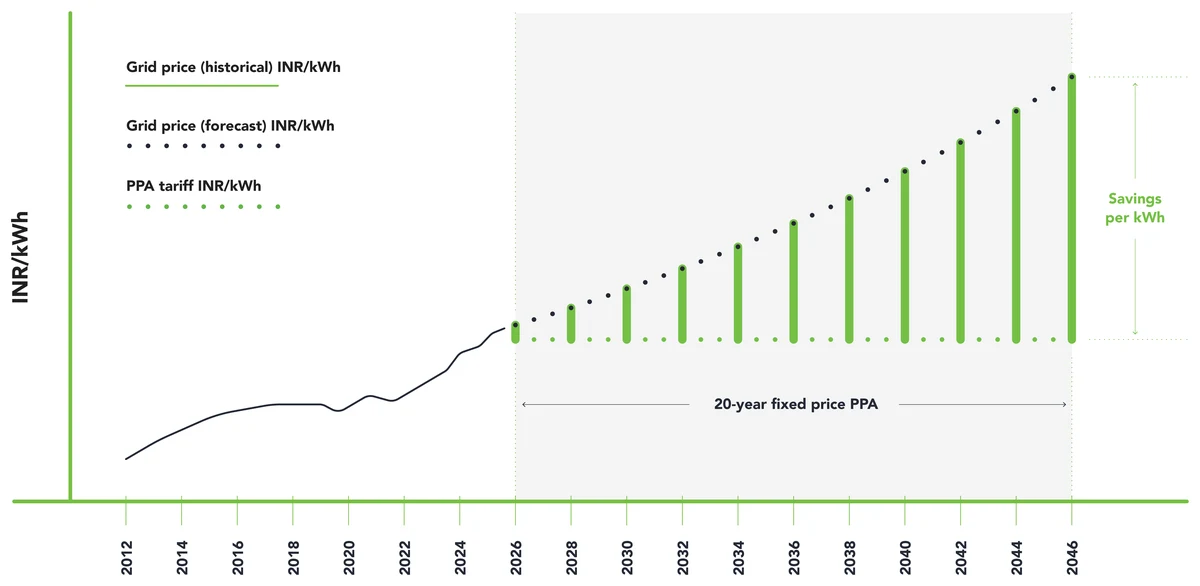
Chart comparing grid electricity price per kWh, rising historically and forecast to keep rising, against a flat r-solar PPA tariff held fixed for the contract term. The widening gap between the two lines is labelled savings per kWh.
The grid only goes one wayMP industrial tariffs have risen year on year and are forecast to keep rising.
Your price is lockedAgreed on day one and held for the life of the contract.
The saving compoundsYear one is the smallest saving you will ever make.

Three ways to buy solar from us

Pick the one that fits your site.

Same principle every time: we own the plant, you buy the power at a fixed price. What changes is where the plant sits and how the power reaches you.

Option 1

On-site PPA

You have the roof or the land. The plant goes on your own site.

  • We build on your roof, shed or spare land. Nothing to pay upfront.
  • You buy only the units generated, at a fixed rate for 25 years.
  • Your existing grid connection stays as it is, for nights and backup.
  • The renewable energy certificates are yours, for RPO and Scope 2 reporting.
  • We insure, monitor and maintain the plant for the full term.
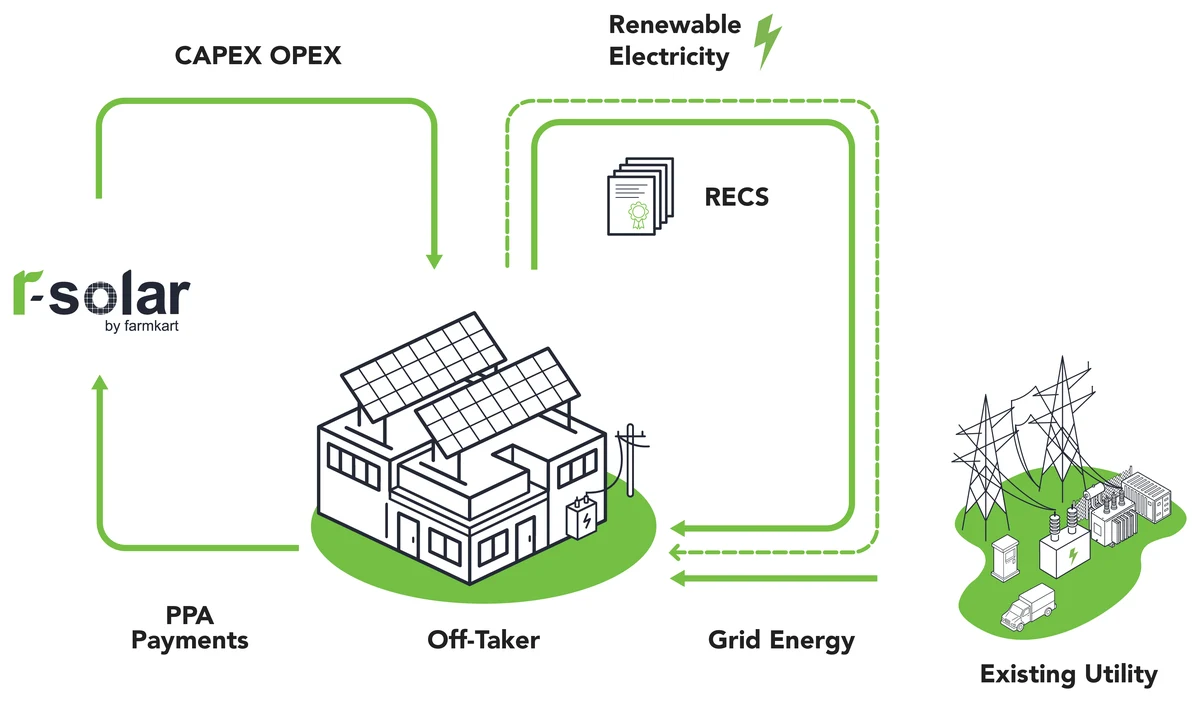
On-site PPA flow diagram: r-solar funds the capital and operating cost of a solar plant built on the customer's own building. The building receives renewable electricity and renewable energy certificates, sends PPA payments back to r-solar, and continues to draw grid energy from the existing utility.
Option 2

Off-site PPA

Not enough roof for the load you need. The plant goes somewhere else in MP.

  • We build a larger ground-mount plant on land we secure.
  • The power reaches you across the existing grid, under Open Access.
  • Same fixed per-unit price, same 25-year term.
  • Lets you cover far more of your load than a rooftop alone can.
  • The certificates are still yours.

Wheeling, transmission and distribution charges apply on Open Access. We show them in your model upfront so the number you compare is the true landed cost.
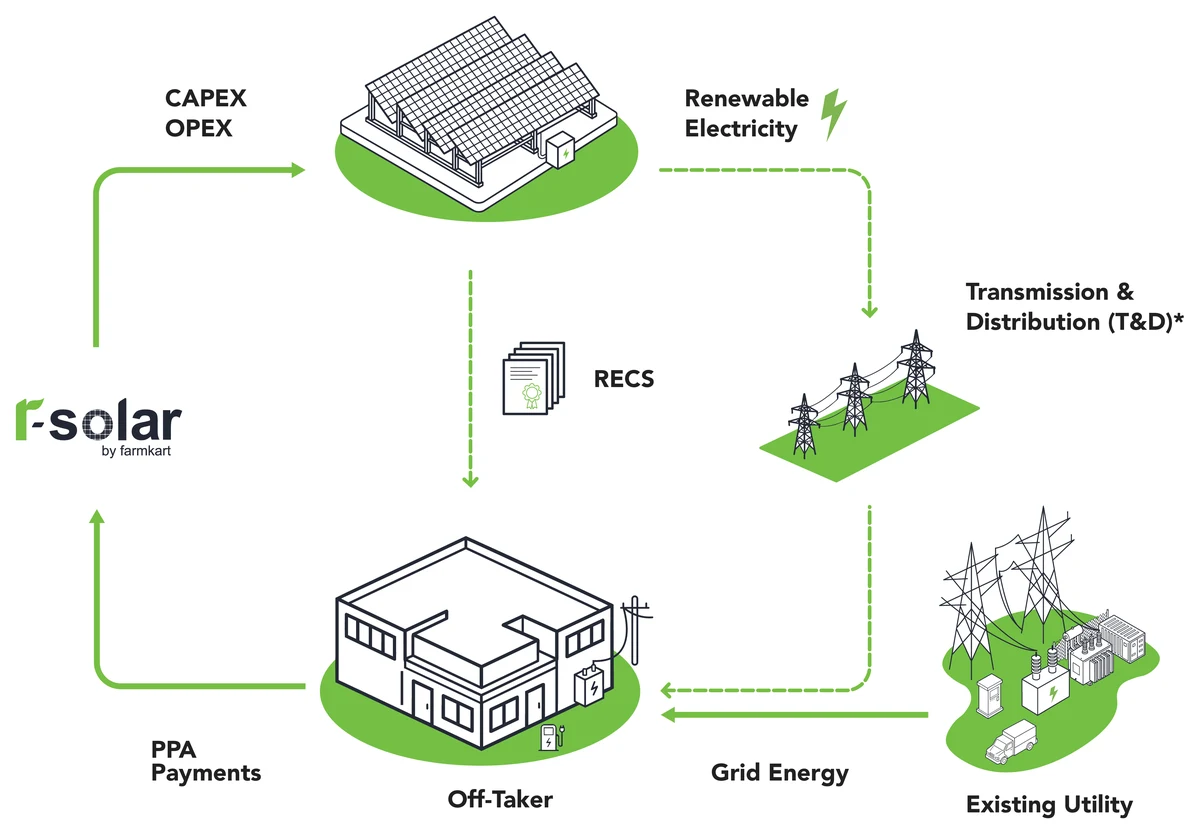
Off-site physical PPA flow diagram: r-solar funds a ground-mount solar plant at a separate site. Its renewable electricity is wheeled through transmission and distribution infrastructure to the customer's building, which also still draws grid energy and receives the renewable energy certificates.
Option 3

Virtual PPA

When physical delivery is not practical. A financial arrangement, not a wire.

  • The plant sells its output into the electricity market, not to you directly.
  • You carry on buying grid power exactly as you do today. Nothing changes on site.
  • You receive the renewable energy certificates against your consumption.
  • Useful when you have multiple plants, leased premises or no usable land.
  • Settles financially, so your reporting improves without touching your supply.
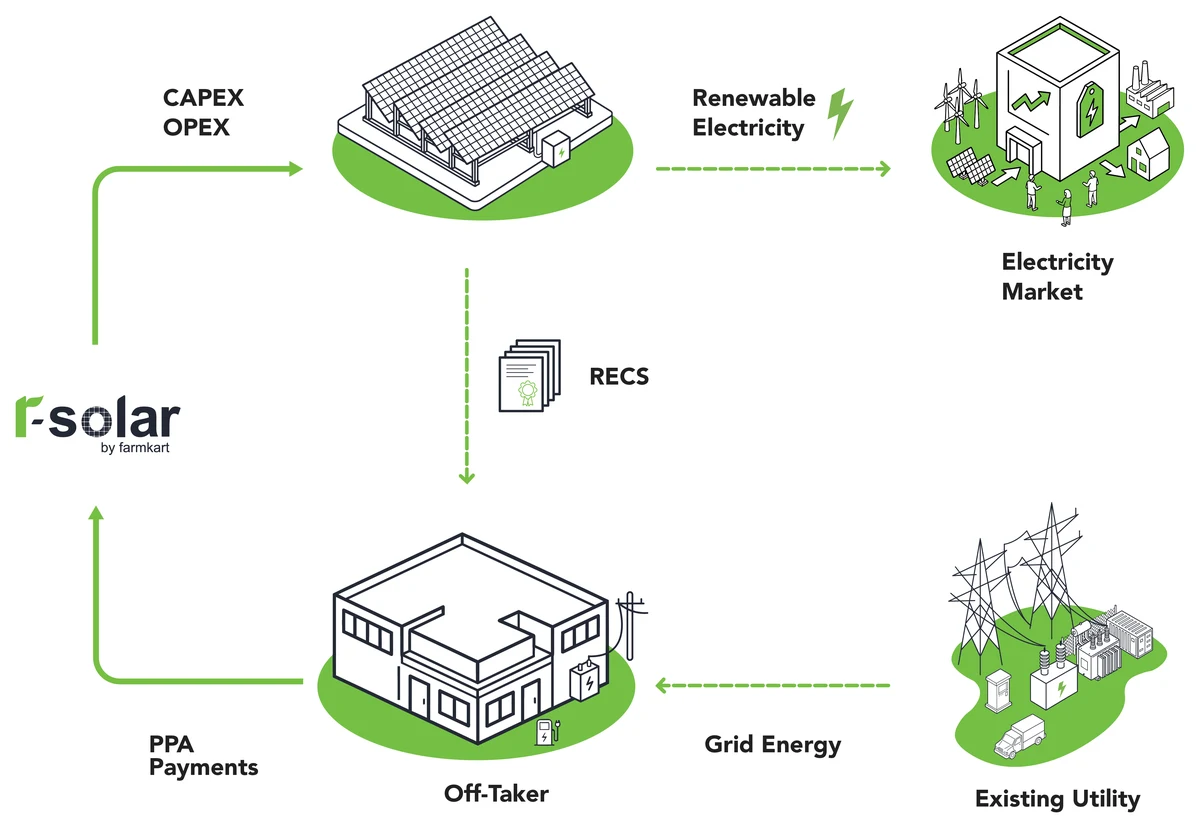
Virtual PPA flow diagram: r-solar funds a solar plant whose renewable electricity is sold into the electricity market. The customer continues to buy grid energy from the existing utility, receives renewable energy certificates, and makes PPA payments to r-solar.

Is this for you?

Worth a conversation if this sounds like your facility.

A good fit

  • 500 kW or more of contracted demand
  • In Madhya Pradesh: Indore, Pithampur, Barwani, Sendhwa, Mandideep, Dhar, Khandwa, Khargone
  • Running on HT industrial supply and feeling the tariff
  • Steel, cement, food processing, textiles, auto, pharma, warehousing or data centres
  • Under RPO obligation or customer ESG pressure

Probably not, yet

  • Under 500 kW contracted demand. Our residential and small-commercial team can help instead.
  • Outside Madhya Pradesh. Talk to us anyway and we will tell you honestly.
  • Planning to relocate the facility within a few years.

How we get there

From first conversation to lower bills.

You are not managing this project. We are.

Week 1

We model it

Send us 12 months of bills. We come back with a savings model and an indicative tariff.

Week 2 to 4

Site visit and offer

Our team surveys the site and issues a firm proposal and draft PPA.

Month 2 to 3

Sign and approvals

We handle the DISCOM paperwork, Open Access filings and permissions.

Month 4 to 6

Build and energise

We construct, commission and start supplying. Your savings begin at the first billing cycle.

The long view

It is a 25-year relationship. Here is how it works.

The questions a finance team asks before signing anything this long.

The green attributes are yours

Every renewable energy certificate the plant generates belongs to you, for RPO compliance and for Scope 2 reporting to your own customers.

We carry the operating risk

Repairs, insurance, monitoring and replacement are on us for the full term. You pay per unit delivered, so a plant that does not generate does not bill you.

At the end of the term

When the contract ends, the choice is yours. We hand the plant and its operation over to you, or we dismantle it and clear the site. Either way you are not left with an asset you did not ask for.

Is Your Facility Eligible?
Let's Model It.

Share a few details and our C&I team will prepare a custom savings projection based on your actual electricity bills, within 48 hours, under NDA.

check_circle

Custom financial model based on your actual bills

check_circle

Indicative PPA tariff and 25-year savings projection

check_circle

No commitment. We sign an NDA before sharing anything.

check_circle

Response within 48 hours from our Barwani/Indore team

picture_as_pdfDownload Commercial Solar Booklet
Get a Custom Savings Projection

For C&I facilities with ≥500 kW contracted demand in Madhya Pradesh.

Step 1 of 2

Frequently Asked Questions

In a traditional CAPEX model, your company buys and owns the solar system, paying ₹4–5.5 Cr/MW upfront and managing O&M. In the OPEX/PPA model, r-solar owns and operates the plant via a project SPV. You sign a Power Purchase Agreement (PPA) to buy the electricity generated at a fixed tariff (₹4.50/kWh) for 25 years. Zero upfront investment, off-balance-sheet treatment, and Day-1 savings.
Open Access allows large consumers to purchase electricity directly from a generator (like r-solar) instead of solely from the DISCOM grid. For ground-mount plants, Open Access charges in MP include wheeling (₹0.18/kWh), transmission (₹0.86/kWh), and cross-subsidy surcharge (~₹0.20/kWh). Even after these charges, the landed cost of our PPA is ₹4.04–4.44/kWh, versus ₹7.50/kWh from the grid. That's still a 40% saving. For rooftop plants (behind-the-meter), Open Access charges don't apply at all.
PPA agreements include minimum offtake commitments and provisions for changes in contracted demand. We structure the PPA to match your minimum baseline load, not your peak. For major events like facility closure, the PPA includes step-in and assignment rights. Our legal team will walk you through all scenarios during the PPA negotiation phase, which happens before you commit to anything financial.
Under the MP RE Policy 2025, large industrial consumers (obligated entities) must source a minimum 30% of their total energy consumption from renewable sources by FY2027. Electricity purchased through an Open Access solar PPA with a registered generator (like r-solar) directly counts towards RPO compliance. r-solar provides monthly generation certificates (RECs/RPO compliance data) that you submit to the SLDC and MPERC as part of your compliance reporting.
Our sweet spot is facilities with ≥3 MW contracted demand in MP, suitable for 5–10 MW ground-mount Open Access projects. However, we also consider rooftop OPEX projects for facilities from 500 kW upward, particularly in Pithampur, Mandideep, and the Barwani/Sendhwa industrial belt. If your demand is below 500 kW, a traditional CAPEX rooftop installation may be a better fit, and we offer those too.
For rooftop projects (behind-the-meter, up to 2 MW), our target is 90 days from LOI to commissioning. For ground-mount Open Access (5–10 MW), our 6-month roadmap takes you from LOI to first generation. r-solar's local presence in Barwani/Indore, existing EPC partnerships (Solluz, ISES Indore), and pre-qualified module supply chain means we move significantly faster than national developers operating from Delhi or Bangalore.
The choice is yours. At the end of the contract period r-solar hands the plant and its operation over to you, or dismantles it and clears the site, whichever you prefer. You are never left with an asset you did not ask for, and there is no automatic obligation to buy the plant or to renew.
You do. Every renewable energy certificate the plant generates belongs to you, the off-taker, for RPO compliance and for Scope 2 reporting to your own customers. This applies across all three structures we offer: on-site PPA, off-site (physical) PPA and virtual PPA.
In an on-site PPA the plant is built on your own roof or land and the power is consumed behind the meter, so no Open Access charges apply. In an off-site (physical) PPA the plant is built elsewhere in Madhya Pradesh and the power is wheeled to you over the existing grid under Open Access, which lets you cover far more of your load than a rooftop alone; wheeling and transmission charges apply and are shown upfront. In a virtual PPA the plant sells its output into the electricity market, you keep buying grid power exactly as you do today, and you receive the renewable energy certificates against your consumption. In all three cases r-solar funds, owns and maintains the plant and you buy power at a fixed price.
r-solar is the solar business of the Farmkart group, a rural-India platform founded in 2017 that today serves over 200,000 farmers across Central India. The same team and the same village-level field network now design, build and operate solar plants. Our head office is in Barwani, Madhya Pradesh, with offices in Indore, Khargone and Ahmedabad. For commercial and industrial customers that means a single accountable EPC and asset owner, not a broker passing your project to a subcontractor.
This page covers our OPEX and PPA offer, where the sweet spot is facilities with 3 MW or more of contracted demand, and rooftop OPEX projects from around 500 kW. If you are looking at a 1 kW to 10 kW rooftop system for a home or a small shop, that is our residential business and it is a completely different process, with the PM Surya Ghar subsidy rather than a PPA. Start with our home solar guide or the 3 kW system guide, or just call us on +91 9407059000 and we will point you to the right team.

Send us 12 months of bills.

We will come back with a savings model built on your actual consumption. No cost, no obligation, and we sign an NDA first.

r-solar · Barwani & Indore, Madhya Pradesh · myrsolar.com/commercial-industrial-solar

Chat with us