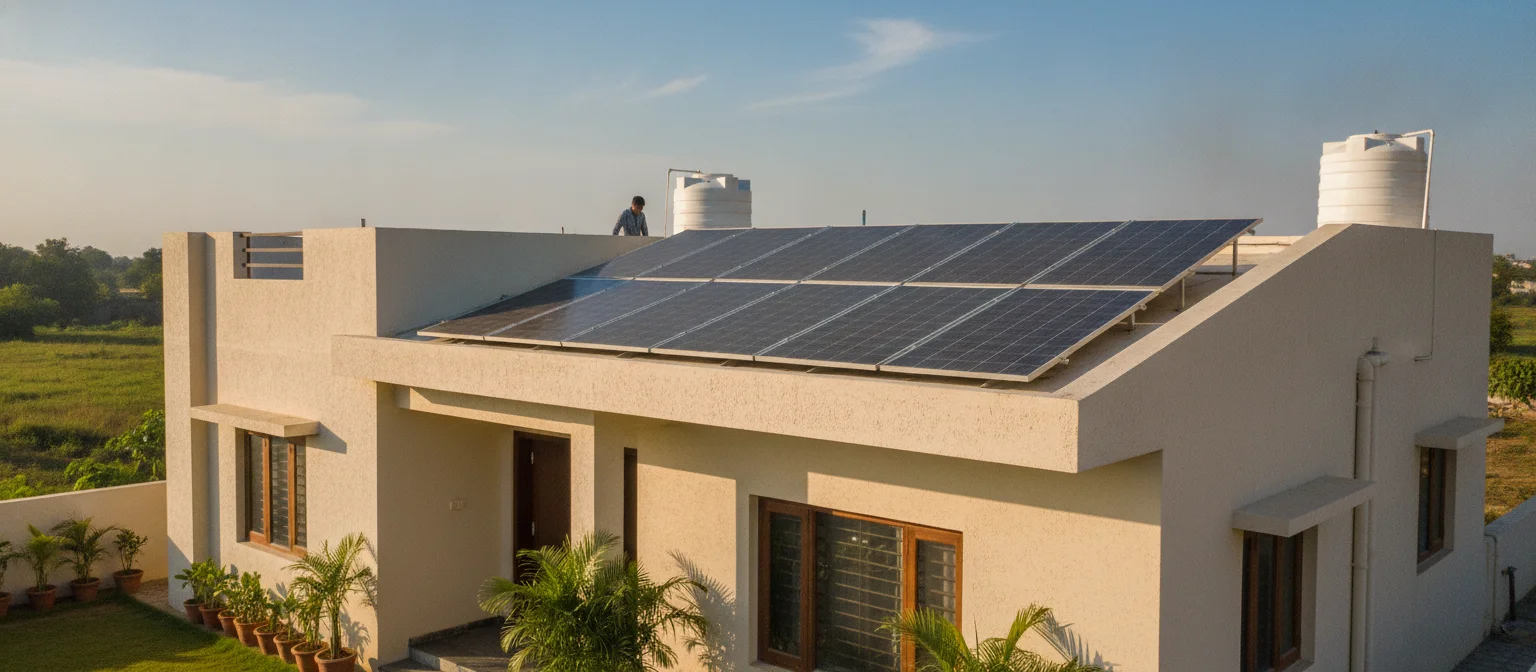
The 4 kW system sits in the gap between r-solar's two most common residential sizes: the subsidy-optimised 3 kW and the higher-consumption 5 kW. It isn't a package r-solar publishes a fixed price for today, but plenty of buyers land here anyway, homes whose bills are too high for 3 kW to fully offset but not quite at the level that justifies 5 kW. This guide walks through a transparent, math-based estimate for what a 4 kW-class system costs in India in 2026, how it's sized, what it generates, and how the subsidy and loan math work out.
Why Consider a 4 kW System?
A 4 kW-class system makes sense for households sitting in the gap between r-solar's two published sizes. If your monthly electricity bill runs ₹2,500-₹3,200, a 3 kW system (360-400 units/month) may leave a chunk of your consumption unoffset, but a 5 kW system might be more capacity, and more upfront cost, than you actually need. R-solar recommends this in-between size for homes with two ACs used moderately, a 3-4 BHK layout, and consistent (not spiky) evening loads, because it captures most of the subsidy percentage a 3 kW system enjoys while covering meaningfully more consumption.
A typical trader or shopkeeper household in a city like Indore or Dewas, running two 1.5-ton ACs and a small refrigeration unit for a home-based business, often finds their bill sitting exactly in this ₹2,800-₹3,200 band. That is the buyer this guide is written for.
Three quick signals that 4 kW, not 3 kW or 5 kW, is your size:
- Your bill is consistently above ₹2,500 but rarely crosses ₹3,500. A 3 kW system caps out around 360-400 units/month; a 4 kW-class system pushes that to roughly 490-550 units/month in Madhya Pradesh.
- You have moderate but real AC load. One or two 1.5-ton units running 5-8 hours daily, not round-the-clock.
- You want more headroom than 3 kW without paying for capacity you won't use. Compare this guide against the 3 kW system guide and the 5 kW system guide before deciding; sizing correctly the first time avoids an expensive redo.
4 kW Solar System Price in India 2026 (An Estimate, Not a Confirmed Quote)
Here is the honest position: r-solar has not published a fixed 4 kW turnkey price the way it has for 3 kW and 5 kW. What follows is a transparent estimate, not a confirmed number, built by interpolating between two real, published data points.
r-solar's 3 kW tier is actually a 3.27 kW system (six 545 W panels) at ₹1,91,000 turnkey.
r-solar's 5 kW tier is actually a 5.45 kW system (ten panels) at ₹2,76,706 turnkey.
Difference: 2.18 kW of capacity costs an additional ₹85,706, or ₹39,315 per additional kW in that range (this is lower than the 3 kW system's own ₹58,000/kW because fixed costs, site visit, inverter wiring, net-metering filing, are spread over more capacity: the same economies-of-scale effect both published pages already describe).
A realistic 4 kW-class system, following r-solar's own panel-count convention, uses eight 545 W panels for an actual capacity of 4.36 kW (seven panels would total only 3.815 kW, too close to the 3 kW tier to be worth marketing separately).
4.36 kW is 1.09 kW above the 3.27 kW baseline. Estimated cost = ₹1,91,000 + (1.09 × ₹39,315) = ₹1,91,000 + ₹42,853 = ₹2,33,853, or about ₹53,600 per kW.
Rounding for regional variance in labour and mounting costs (the same ±10% spread both published component tables already show): ₹2.2-2.4 lakh turnkey, estimated.
That ₹53,600/kW sits exactly where it should: below the 3 kW system's ₹58,000/kW and above the 5 kW system's ~₹50,762/kW, confirming the interpolation tracks the same economies-of-scale curve both existing pages describe. This 8-panel, 4.36 kW convention also matches how competitor installers price their "4 kW" tier: independent research into the top-ranking articles for this query found at least one major competitor explicitly titling their 4 kW guide around 4.32 kW and 4.86 kW actual capacities, the same convention.
| Component | Estimated cost | % of total |
|---|---|---|
| 8× ALMM-approved monocrystalline solar panels (540-550W each) | ₹1,24,000-₹1,32,000 | ~55% |
| 4 kW string inverter (Sungrow / Growatt / Sofar / Microtek) | ₹24,000-₹28,000 | ~11% |
| Galvanised steel mounting structure (HDG) | ₹19,000-₹23,000 | ~9% |
| AC + DC cabling, conduits, junction boxes | ₹11,000-₹14,000 | ~5% |
| Earthing kit, MCBs, SPDs, DCDB/ACDB | ₹7,000-₹9,000 | ~3% |
| Civil work (mounting base, cable trays, weatherproofing) | ₹5,500-₹8,000 | ~3% |
| Net metering application + DISCOM coordination | ₹3,000-₹5,000 | ~2% |
| Installation labour, commissioning, monitoring setup | ₹19,000-₹24,000 | ~9% |
| Estimated total turnkey installed cost | ₹2.2-2.4 lakh | 100% |
Why this is a range, not a fixed number, and why that's normal
Exact solar pricing depends on your roof geometry, the distance from panels to inverter, shading, local labour rates, and your DISCOM's specific net-metering process, none of which a generic guide can know in advance. This is standard practice across the industry: even installers who publish exact numbers for their most common sizes (3 kW, 5 kW) present ranges, not single figures, for less-common in-between tiers, for the same reason.
The estimate above is a genuine starting point for budgeting, not a substitute for a real quote. r-solar's price for a finished 4 kW-class job covers system design sized to your bill and roof, ALMM-approved hardware, professional installation, the DISCOM net-metering application, and the full PM Surya Ghar subsidy filing followed through until the ₹78,000 lands in your account. Get an exact, firm quote for your roof rather than budgeting off this estimate alone.
For a complete component-by-component guide across all system sizes, see our solar panel installation cost in India 2026 deep-dive. Comparing sizes? See the 3 kW and 5 kW system guides for r-solar's actual published pricing.
On-Grid, Off-Grid & Hybrid: What r-solar Actually Installs at 4 kW
Some competitor guides for this query present on-grid, off-grid, and hybrid 4 kW systems as three equal options. r-solar does not; it installs on-grid, grid-tied systems only, at 4 kW and every other residential size. Here's the honest breakdown of why:
- On-grid (grid-tied): the system feeds surplus power into the DISCOM grid via net metering and draws from the grid at night or during cloudy periods. No battery bank needed, which keeps costs down and qualifies the system for the ₹78,000 PM Surya Ghar subsidy. This is what every price in this guide refers to, and it's what r-solar installs.
- Off-grid: requires a battery bank sized for your full nightly load, roughly doubling or tripling the system cost per kW, and is not eligible for the central subsidy. Only sensible where there is no grid connection at all.
- Hybrid: combines grid-tied operation with a battery for backup during outages. Useful in areas with frequent load-shedding, but batteries add ₹1.5-3 lakh or more depending on backup hours needed, and hybrid systems are also outside standard PM Surya Ghar subsidy eligibility.
If backup power during outages matters to you, ask r-solar about a battery add-on to a standard on-grid 4 kW system rather than assuming a subsidised "hybrid 4 kW" package exists; for residential PM Surya Ghar buyers, it doesn't.
How Much Electricity Does a 4 kW System Generate?
A 4 kW-class (4.36 kW actual) system generates approximately 490-550 units (kWh) per month in Madhya Pradesh, or roughly 16-18 units per day, using the same formula r-solar uses for its published sizes: peak sun hours × capacity (kW) × 0.8 performance ratio × 30 days. For MP's 5 peak sun hours: 5 × 4.36 × 0.8 × 30 ≈ 523 units/month.
| State | Monthly (units) | Annual (kWh) |
|---|---|---|
| Rajasthan, Gujarat | 550-600 | 6,600-7,200 |
| Madhya Pradesh, Maharashtra, Karnataka, Andhra Pradesh, Telangana | 490-550 | 5,900-6,600 |
| Tamil Nadu, Punjab, Haryana, Uttar Pradesh | 440-490 | 5,300-5,900 |
| Bihar, Odisha, West Bengal | 390-440 | 4,700-5,300 |
| Northeast states, Coastal Kerala | 340-390 | 4,100-4,700 |
These figures assume regular panel cleaning; generation can drop 15-25% during the dry season if panels go uncleaned, see our 25-rooftop cleaning study for the field data. Net metering then reconciles the timing mismatch between when you generate (daytime) and when you consume (mornings and evenings): your meter runs backwards while exporting and forwards while importing, netted monthly by your DISCOM.
The ₹78,000 Subsidy Math for a 4 kW System
The PM Surya Ghar subsidy structure doesn't change based on your system size once you're past 3 kW. Here's exactly how it applies to a 4 kW-class system:
- First kW: ₹30,000 subsidy
- Second kW: ₹30,000 subsidy (₹60,000 cumulative)
- Third kW: ₹18,000 subsidy (₹78,000 cumulative, the cap)
- Fourth kW (and beyond): ₹0 additional subsidy
On an estimated ₹2,33,853 system, the ₹78,000 subsidy covers roughly 33% of the cost, sitting neatly between the ~41% a 3 kW system captures and the ~28% a 5 kW system captures. Estimated net cost after subsidy: ₹2,33,853 − ₹78,000 = ₹1,55,853, or roughly ₹1.5-1.65 lakh accounting for the underlying price range. The subsidy is credited directly to your bank account 30-45 days after DISCOM inspection and commissioning, same as at every other system size. For the complete subsidy process, see PM Surya Ghar subsidy guide 2026.
How to Apply for the PM Surya Ghar Subsidy on a 4 kW System
The application process is identical regardless of system size:
- Register on the portal: Go to pmsuryaghar.gov.in and register with your electricity consumer number, state, and DISCOM (in Madhya Pradesh, this is typically MPMKVVCL, MPPKVVCL, or MPEZ depending on your region).
- Submit a feasibility application: Enter your rooftop details and requested capacity; the DISCOM reviews and approves feasibility, usually within a few days to a couple of weeks.
- Choose an installer and get the system installed: r-solar designs, installs, and commissions the ALMM-approved system, only ALMM-listed panel models qualify for subsidy.
- Net metering application: Your installer files the net-metering request with the DISCOM. This is normally bundled into r-solar's turnkey price rather than left to you.
- DISCOM inspection and commissioning: An inspector verifies the installation matches the approved application before activating the net meter.
- Submit the final subsidy claim: Once commissioning is confirmed on the portal, submit your bank account details for the subsidy transfer.
- Subsidy credited: ₹78,000 lands in your account 30-45 days after commissioning.
A cheap quote often prices the hardware and leaves steps 4-6 to you: chasing DISCOM approvals and re-submitting a rejected portal application is not a one-afternoon job. r-solar's turnkey price includes this filing, followed through until the money is actually in your account, not just submitted.
4 kW Solar System EMI with Bank Loan
PM Surya Ghar loans are charged SBI's concessional 5.75% up to ₹2 lakh; banks lend up to ₹6 lakh, but above ₹2 lakh SBI charges 7.90%. Because the estimated 4 kW-class price (₹2.2-2.4 lakh) exceeds ₹2 lakh, this example borrows ₹2 lakh at the lower rate and self-funds the difference as a down payment, the same approach as r-solar's 5 kW example.
| Estimated turnkey installed cost (4 kW-class) | ~₹2,33,850 |
| Down payment (customer pays upfront) | ~₹33,850 |
| Loan amount (kept at ₹2 lakh for the 5.75% rate) | ₹2,00,000 |
| SBI rate (loans up to ₹2 lakh) | 5.75% p.a. |
| Tenure | 10 years |
| EMI before subsidy credit | ~₹2,195 / month |
| Subsidy credited (month 2), part-paid to principal | – ₹78,000 |
| Remaining principal | ₹1,22,000 |
| EMI after subsidy part-payment | ~₹1,339 / month |
Because the loan amount, rate, and tenure are identical to r-solar's 5 kW loan example, the resulting EMI is the same, only the upfront down payment differs (~₹33,850 here versus ~₹76,706 for a 5 kW system). Compare ~₹1,339/month EMI against the typical electricity bill this system size replaces (₹2,600-₹3,600/month), and the system runs net cash-positive by roughly ₹1,260-₹2,260/month from quarter one. Canara Bank, Bank of Baroda, PNB and Indian Bank also list 5.75% for loans up to ₹2 lakh (September 2026). See our complete PM Surya Ghar bank loan list for full comparison, or the detailed SBI PM Surya Ghar solar loan guide.
Payback Period & 25-Year Savings
For a 4 kW-class system, the estimated payback period is 4-5 years under CAPEX with subsidy, in line with r-solar's 3 kW and 5 kW systems. Here is the calculation:
- Estimated net cost after subsidy: ~₹1.5-1.65 lakh
- Estimated annual electricity bill savings: ~₹31,000-₹43,000 (at ₹6-9/unit tariff on 490-550 units/month generation)
- Payback on net cost: roughly 4-5 years
- Payback on gross cost (if subsidy is skipped): roughly 6-7 years
After payback, the system produces effectively free electricity for the remaining 20-21 years of the 25-year panel warranty period. Estimated total 25-year savings: roughly ₹8-11 lakh, sitting between r-solar's published ₹6-8 lakh figure for 3 kW and ₹10-18 lakh figure for 5 kW, exactly where a 4 kW-class system should land. As with the published sizes, these are estimates: with Indian grid tariffs historically rising 3-5% annually, actual savings tend to run higher than static models suggest.
Factors That Move Your Actual 4 kW Price Up or Down
The ₹2.2-2.4 lakh estimate above is a starting point. Your actual quote will move based on:
- Roof type and height: RCC slab roofs are cheapest to mount on; tile or sheet roofs and multi-storey buildings add civil work and labour time.
- Distance from panels to inverter and meter room: longer cable runs mean more AC/DC cabling and conduit, a real line item, not a rounding error, on the cost table above.
- Shading: trees, water tanks, or neighbouring structures that shade part of the array between 10am-3pm can require micro-inverters or power optimisers, which cost more than a standard string inverter but recover 8-12% of shading losses.
- Sanctioned load and DISCOM-specific paperwork requirements: some DISCOMs (MPMKVVCL districts especially) require sanctioned load upgrades before approving net metering, an extra step and sometimes an extra fee.
- Panel brand and wattage: higher-efficiency ALMM-listed panels from top-tier manufacturers cost more per watt than budget-tier ALMM options, though both qualify for subsidy.
None of these are unusual or something to be worried about, every solar quote in India varies for the same reasons. It's exactly why r-solar recommends a free site visit before you commit to a number: a proper site survey turns this ₹2.2-2.4 lakh estimate into a firm, roof-specific quote.
r-solar's ALMM Verification: Why Serial Numbers Matter for Your Subsidy
Here's a detail most competitor guides for this query skip entirely, because it's specific to how r-solar actually runs a job, not something you can find on a generic pricing page. Every panel installed under PM Surya Ghar must be on the MNRE's Approved List of Models and Manufacturers (ALMM) List-I, and the panel's exact model number, not just the manufacturer name, must match what was quoted. A different model number from the same brand is not interchangeable for subsidy purposes; DISCOM inspectors and the PM Surya Ghar portal can reject a claim over a mismatched serial number alone.
r-solar verifies serial numbers at delivery and again at commissioning, checking each panel's rear-side label against both the MNRE ALMM portal and the original quote before it goes on your roof, and again before the DISCOM inspection is scheduled. This two-point check exists because subsidy rejections over serial-number mismatches are a real, avoidable failure mode; catching it at delivery costs nothing, catching it after commissioning can mean re-installation. For the full ALMM list and how it's structured, see ALMM List 2026: which solar panel brands are subsidy-eligible.
4 kW System Components Explained
A typical 4 kW-class residential rooftop system in India 2026 consists of:
- 8 solar panels, 540-550W each, monocrystalline PERC, ALMM List-I approved (Waaree, Adani Solar, Tata Power Solar, Vikram Solar, Premier Energies, or similar). Panel warranty: 25-year linear power output, 10-12 year product warranty. For a full brand comparison, see best solar panels in India 2026.
- 1 string inverter, ~4 kW capacity, MPPT-based (typically Sungrow, Growatt, Sofar, or Microtek). Inverter warranty: 5-10 years, with extension options.
- Galvanised steel mounting structure, HDG-coated, designed for 25+ year roof life, anchoring varies with roof type (RCC slab, tile, or sheet).
- AC and DC cabling, conduits, MCBs, SPDs (surge protection), DCDB and ACDB junction boxes, per IS standards.
- Earthing kit: chemical earthing or copper-plate, depending on local soil conditions.
- Net meter: installed and configured by your DISCOM after the installation passes inspection.
- Software monitoring: most quality installers, r-solar included, provide a mobile app or web dashboard showing real-time and historical generation, essential for catching underperformance early.
Roof space required is approximately 270-300 sq ft, oriented south for maximum generation. For installer selection criteria that apply regardless of system size, see how to choose a solar installer in MP.
Want an exact, firm 4 kW-class quote for your roof?
Get a Free Site VisitOr run the numbers yourself first: use our solar savings calculator.
Get a free quote for your 4 kW-class system
Tell us your details. r-solar designs, installs and handles your subsidy. Free callback within 2 hours (10 AM–7 PM IST).
Frequently Asked Questions
What is the price of a 4 kW solar system in India in 2026?
r-solar does not sell a fixed 4 kW package today, so the honest answer is an estimate, not a confirmed price. Interpolating between r-solar's published 3 kW turnkey price (₹1.91 lakh for a 3.27 kW system) and its published 5 kW turnkey price (₹2,76,706 for a 5.45 kW system), a 4 kW-class system (built from eight 545 W panels, 4.36 kW actual capacity) works out to roughly ₹2.2-2.4 lakh turnkey installed, or about ₹53,600 per kW. This is an estimate derived from adjacent published tiers, not a confirmed quote. Get an exact number for your roof and consumption via r-solar's free site visit.
Is the "4kW solar panel price" the same as the 4 kW system price?
Mostly yes, and this is where buyers get confused. When people search for the "4kW solar panel price" or "4 kilowatt solar system cost", they almost always mean the price of the complete installed system, not one panel. A single 545 W panel costs roughly ₹10,000 to ₹13,000, and a 4 kW-class setup needs eight of them. Panels are only about half the total cost. The rest is the inverter, mounting structure, cabling, net-meter filing, and installation labour. The honest number to budget for is the estimated turnkey 4 kW price of ₹2.2-2.4 lakh installed, not just the panel cost.
How much electricity does a 4 kW solar system generate in India?
A 4 kW-class (4.36 kW actual) rooftop solar system in India generates approximately 490-550 units (kWh) of electricity per month in Madhya Pradesh, or roughly 16-18 units per day, using the standard formula of peak sun hours times capacity times a 0.8 performance ratio times 30 days. Generation is higher in Rajasthan and Gujarat (550-600 units/month) and lower in the Northeast and coastal Kerala (340-390 units/month). Annual generation in MP is approximately 5,900-6,600 kWh.
How many solar panels are needed for a 4 kW system?
A 4 kW-class system typically uses 8 panels of 540-550W each, giving an actual capacity of about 4.36 kW (seven panels would only reach 3.8 kW, too close to the 3 kW tier to be worth the extra spend). Rooftop space required is approximately 270-300 sq ft, oriented south for maximum generation. This 8-panel convention matches how most Indian solar installers, including competitors researched for this guide, market their 4 kW tier at 4.3-4.4 kW actual capacity.
What is the PM Surya Ghar subsidy for a 4 kW solar system?
The PM Surya Ghar Muft Bijli Yojana subsidy for a 4 kW residential rooftop solar system is ₹78,000, the same amount given to 3 kW and 5 kW systems, because the subsidy is capped at 3 kW (₹30,000 for the first kW, ₹30,000 for the second, ₹18,000 for the third). No additional subsidy is given for the 4th kW. On an estimated ₹2.2-2.4 lakh system, ₹78,000 covers roughly 33% of the cost, between the ~41% a 3 kW system captures and the ~28% a 5 kW system captures.
How do I apply for the PM Surya Ghar subsidy on a 4 kW system?
Register on the national PM Surya Ghar portal (pmsuryaghar.gov.in) with your electricity consumer number, select your DISCOM and state, and submit a feasibility application. Once approved, your installer installs the ALMM-approved system, files the net-metering application with your DISCOM, and applies for commissioning. After DISCOM inspection confirms the net meter is live, you submit the final subsidy claim on the portal with your bank details. The ₹78,000 is credited directly to your bank account 30-45 days after commissioning. r-solar handles the installer-side paperwork end to end so you are not filing this alone.
What is the EMI for a 4 kW solar system with a bank loan?
On an estimated ₹2.2-2.4 lakh system, SBI's concessional 5.75% rate applies to loans up to ₹2 lakh (larger loans, up to ₹6 lakh, are charged 7.90%), so this example keeps the loan at ₹2 lakh and puts down roughly ₹34,000-₹40,000 upfront. At 5.75% per annum over a 10-year tenure, the EMI before subsidy is approximately ₹2,195 per month. After the ₹78,000 subsidy is credited in month 2 and part-paid against the principal, the remaining EMI drops to approximately ₹1,339 per month, the same as a 5 kW buyer pays on a ₹2 lakh loan.
What is the payback period for a 4 kW solar system in India?
Based on the estimated net cost of ~₹1.5-1.65 lakh after subsidy and typical monthly bill savings of ₹2,600-₹3,600 for a household this system size serves, the payback period works out to roughly 4-5 years, in line with r-solar's 3 kW and 5 kW systems. After payback, the system produces free electricity for the remaining 20-21 years of the 25-year panel warranty, with total 25-year savings estimated at ₹8-11 lakh.
Does r-solar install off-grid or hybrid 4 kW systems?
No. r-solar installs on-grid, grid-tied rooftop solar exclusively, at 4 kW and every other size. An on-grid system uses net metering to export surplus power to the DISCOM grid and draw from it at night, which is what qualifies it for the PM Surya Ghar subsidy and keeps the system cost down because no battery bank is needed. Off-grid and hybrid (battery-backed) systems cost significantly more per kW and are not eligible for the central subsidy, so r-solar does not position them for standard residential 4 kW buyers.

About the Author
r-solar Editorial Team
r-solar installs and maintains rooftop solar across Madhya Pradesh: residential PM Surya Ghar systems, commercial OPEX/PPA, and RESCO at industrial scale, with software-monitored generation tracking from day one.
Ready to get a firm quote for your 4 kW-class system?
Get Your Free Quote