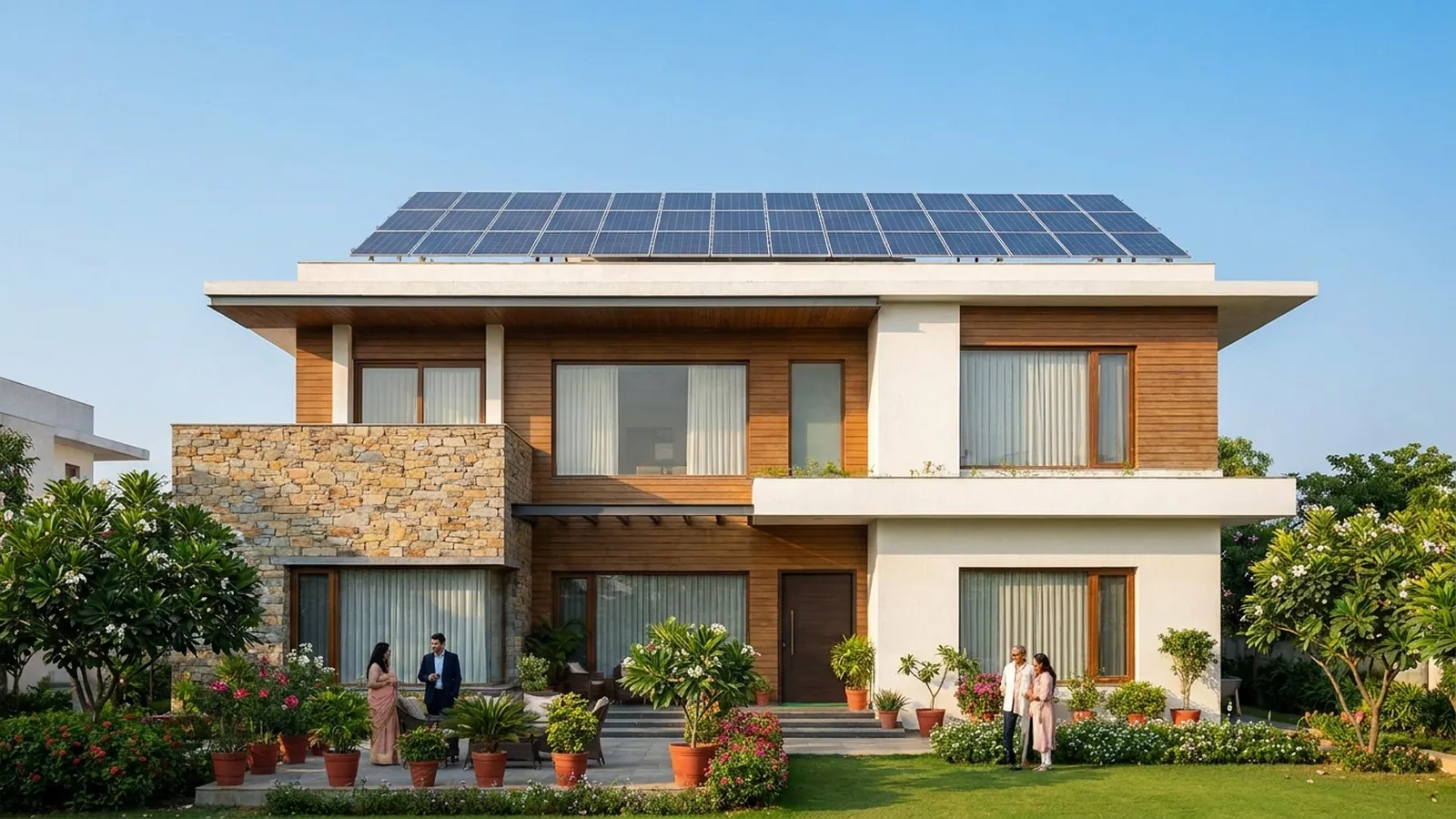
India's residential rooftop solar market has fundamentally changed over the last two years. The PM Surya Ghar Muft Bijli Yojana launched in 2024 brought subsidies, low-cost loans, and a unified online portal that has made going solar the most financially obvious home improvement decision most Indian homeowners can make. This guide covers every step of the journey: from understanding how rooftop solar works to commissioning your system and claiming your subsidy.
How residential rooftop solar works in India
A grid-tied residential rooftop solar system does one thing: it generates electricity from sunlight and feeds it directly into your home's electrical circuit, reducing how much power you draw from the grid. The four core components are:
- Solar panels: mounted on your rooftop, they convert sunlight into direct current (DC) electricity. A standard residential panel in 2026 is 540-550W monocrystalline.
- Inverter: converts DC from the panels to 230V AC, the standard for all home appliances in India. For a 3 kW system, a single string inverter handles this.
- Net meter: installed by your DISCOM (electricity distribution company) at your connection point. It measures both how much power you import from the grid and how much you export to it, a two-way meter replacing your existing one.
- Wiring, MCBs, earthing, and protection devices: the electrical infrastructure connecting panels to inverter to your home's load and to the grid, built to IS standards.
During the day, your panels generate electricity that runs your home directly. If generation exceeds current consumption (e.g., peak noon sun while everyone is at work), excess power flows out to the grid through the net meter, and you earn a credit at retail tariff. At night, you draw from the grid, debiting those credits. At month end, your DISCOM settles the net difference: if you exported more than you imported, your bill is zero (or near-zero). This is net metering, and it is the financial mechanism that makes rooftop solar viable for Indian homes.
What a residential solar system costs in India 2026
The total installed cost of a residential rooftop solar system in India in 2026 is approximately ₹55,000-₹65,000 per kW (all-in, turnkey). Here is what that looks like across common system sizes:
| System size | Gross installed cost | PM Surya Ghar subsidy | Net cost after subsidy |
|---|---|---|---|
| 1 kW | ~₹65,000 | ₹30,000 | ~₹35,000 |
| 2 kW | ~₹1.20 lakh | ₹60,000 | ~₹60,000 |
| 3 kW (most common) | ~₹1.91 lakh | ₹78,000 | ~₹1.13 lakh |
| 4 kW | ~₹2.36 lakh | ₹78,000 (capped) | ~₹1.58 lakh |
| 5 kW | ~₹2.77 lakh | ₹78,000 (capped) | ~₹1.99 lakh |
What your r-solar price actually buys
A cheap quote prices the panels and stops there. The hardware lands on your roof and the rest becomes your problem: finding an electrician, filing the DISCOM net metering application, registering on the PM Surya Ghar portal, and chasing the ₹78,000 subsidy yourself for months.
An r-solar price is for the finished job, not a box of parts. It covers:
- System design sized to your bill, roof and sanctioned load
- ALMM-approved panels, inverter and mounting structure
- Professional installation and electrical safety compliance
- DISCOM net metering application and integration
- The full PM Surya Ghar subsidy filing, followed through until the ₹78,000 reaches your bank account
- One team accountable from your first call to a commissioned, subsidy-credited system
Quotes that look cheaper skip this work and leave you to install, file and chase the subsidy on your own.
The 3 kW system is the most popular residential choice because it captures the maximum PM Surya Ghar subsidy (~41% of the system cost at that size) and generates 360-400 units/month, enough to zero out the average Indian household electricity bill. For a component-by-component breakdown of what makes up these costs, see our solar panel installation cost in India 2026 deep-dive.
The PM Surya Ghar subsidy and what it covers
The PM Surya Ghar Muft Bijli Yojana is the central government's flagship residential rooftop solar scheme, launched in February 2024. It provides direct cash subsidies to homeowners who install grid-tied rooftop solar through an MNRE-empanelled installer using ALMM-approved panels.
The subsidy structure (tiered by system size):
- First 1 kW: ₹30,000 subsidy
- Second 1 kW: ₹30,000 additional (₹60,000 cumulative)
- Third 1 kW: ₹18,000 additional (₹78,000 cumulative, this is the cap)
- Any kW above 3 kW: no additional subsidy
The subsidy is credited directly to your bank account 30-45 days after your DISCOM inspects and commissions the installation. You do not receive it upfront. You (or your lender) pay the installer the full amount first. Key eligibility conditions: you must be a domestic electricity consumer (residential, not commercial tariff), you must use an MNRE-empanelled installer, and your panels must be on the current ALMM List-I.
For the complete eligibility checklist, application process, and common rejection reasons, see our PM Surya Ghar subsidy guide.
How to size your system: matching kW to your monthly bill
The right system size depends on your actual monthly electricity consumption, not a vague sense of "we use a lot of electricity." Pull out your last three electricity bills and note the units consumed (kWh) each month.
The sizing formula for India: monthly consumption (units) ÷ 120 = recommended kW
| Monthly consumption | Approx. monthly bill | Recommended system size |
|---|---|---|
| 150-200 units | ₹700-₹1,200 | 1-2 kW |
| 200-300 units | ₹1,200-₹1,800 | 2 kW |
| 300-400 units | ₹1,800-₹2,800 | 3 kW (sweet spot) |
| 400-500 units | ₹2,800-₹3,500 | 3-4 kW |
| 500+ units | ₹3,500+ | 4-5 kW |
A few factors that push you toward a larger system: inverter AC loads (each 1.5-ton AC adds ~120 units/month), electric water heating (replaces gas/solar water heating), EV charging (adds 100-150 units/month). Avoid over-sizing significantly above 3 kW unless your consumption genuinely warrants it. The subsidy cap means the economics of the 4th and 5th kW are less attractive. For the detailed 3 kW numbers including generation by state, see our 3 kW solar system guide. For common mistakes in sizing, see solar system size mistakes.
Choosing the right solar panels for your home
For a residential installation in 2026, panel selection reduces to one non-negotiable and one strong default:
- Non-negotiable: ALMM List-I approved panel. No ALMM = no PM Surya Ghar subsidy. See our ALMM list decoded guide for how to verify a specific panel model.
- Strong default: monocrystalline PERC, 540-550W per panel. Mono PERC at 21-22% efficiency requires 25-30% less rooftop space than polycrystalline and costs under 5% more per watt. For almost every residential roof in India, this is the right choice in 2026.
The top ALMM-approved manufacturers in India's fast-growing solar manufacturing sector are Waaree, Adani Solar, Tata Power Solar, Vikram Solar, and Premier Energies. All publish 25-year linear power warranties. For a full brand comparison including their specific panel models and warranty terms, see our best solar panels in India 2026 buyer's guide.
Bank loans and EMI math for home solar
You do not need to pay for a solar installation upfront. The PM Surya Ghar scheme partnered with public-sector banks to offer collateral-free solar loans at concessional rates. The numbers for the most common 3 kW system:
| System cost (3 kW, turnkey) | ₹1,91,000 |
| SBI PM Surya Ghar loan (5.75% p.a. up to ₹2 lakh) | Up to ₹2 lakh, 10-year tenure |
| Loan amount (90% LTV) | ₹1,72,000 |
| EMI before subsidy credit | ~₹1,888 / month |
| Subsidy credited ~month 2 | – ₹78,000 (principal part-payment) |
| EMI after subsidy part-payment | ~₹1,032 / month |
| Typical electricity bill replaced | ₹2,000-₹2,500 / month |
| Net monthly cash benefit | +₹900-₹1,400 / month |
The system is cash-flow positive from the first full month of operation. You save more on your electricity bill than you pay in EMI. The loan is collateral-free up to ₹2 lakh (no property hypothecation required) and requires basic KYC documentation plus the DISCOM sanction letter. For other bank options and rates, see our PM Surya Ghar bank loan list. For SBI specifically, see SBI PM Surya Ghar solar loan guide.
Payback period on net cost (₹1,13,000): 4-5 years. Savings over 25-year panel lifetime: ₹6-8 lakh.
How long does the installation take?
The full journey from "I want solar" to "system is generating electricity" takes 4-8 weeks for most residential installations in India. Here is the typical sequence:
- Site visit and quote (1-2 days): installer visits your home, inspects the rooftop, assesses shading and structural load, and provides a written quote.
- Contract signing and advance payment (3-5 days): you sign the agreement and pay the advance (typically 30-50% of system cost).
- DISCOM technical sanction filing (2-4 weeks): your installer files the technical sanction application with your DISCOM through the PM Surya Ghar national portal. This is typically the longest step. DISCOM response time varies widely by state and city.
- Physical installation (1-2 days of actual work): panel mounting, inverter installation, wiring, earthing, and protection devices. A 3 kW system typically takes 1 full day on the roof for a crew of 3-4.
- DISCOM inspection (1-2 weeks after installation): your DISCOM inspects the installation and signs off on it.
- Net meter installation (3-7 days after inspection pass): DISCOM replaces your existing meter with a net meter.
- Commissioning and system activation (1 day): installer activates the system and confirms generation data on monitoring platform.
- Subsidy disbursement (30-45 days after commissioning): PM Surya Ghar subsidy is credited to your registered bank account.
Installers with strong DISCOM relationships (and clean paperwork) often compress total timelines to 3-4 weeks. Delays almost always happen at the DISCOM technical sanction stage, and there is nothing you or your installer can do except submit complete, accurate documentation the first time.
How to choose a solar installer for your home
The installer is the single most important decision in the entire solar journey, more important than panel brand, inverter brand, or even price. A competent installer with good DISCOM relationships will deliver a working system with correct documentation and a smooth subsidy process. A poor installer will cause delays, DISCOM filing errors, documentation gaps that delay your subsidy, and potentially quality issues that emerge years later.
Five things to verify before signing with an installer:
- MNRE empanelment: required for PM Surya Ghar subsidy eligibility. Ask for the empanelment certificate or verify on the MNRE portal.
- Local DISCOM experience: have they filed technical sanctions with your specific DISCOM before? How many approvals this year? A first-time DISCOM filer will have a longer sanction timeline.
- Written warranty documentation: the installer's workmanship warranty (minimum 5 years) and the panel manufacturer's warranty must be in the signed contract, not just mentioned verbally.
- References in your area: ask for 2-3 recent residential customers you can call. Ask specifically about DISCOM filing accuracy and post-installation support responsiveness.
- Transparent quotation: the quote should itemise panel make and model number, inverter make and model, mounting structure specification, and net metering filing charges separately. A quote that says only "3 kW solar system: ₹1.91 lakh" without itemisation is a yellow flag.
For the complete due-diligence checklist for installer selection, see how to choose a solar installer in MP.
Get started: free site visit and savings calculator
r-solar installs residential PM Surya Ghar systems across Madhya Pradesh using ALMM List-I approved panels, with in-house DISCOM filing for all major MP DISCOMs. Our typical residential installation timeline is 4-5 weeks from site visit to commissioning.
Two ways to start:
- Run the numbers first: use our solar savings calculator. Enter your monthly bill and address, get an estimated system size, cost, subsidy, EMI, and payback in under 2 minutes.
- Book a free site visit: our engineer visits your rooftop, assesses shade angles, roof load, and DISCOM metering point, and provides a written quote within 24 hours, no obligation.
Ready to go solar at home?
Book a free site visitOr estimate your savings first. Use our solar calculator.
Get a free home-solar quote
Tell us your details. We'll size the right system for your home and bill. Free callback within 2 hours (10 AM–7 PM IST).
Frequently asked questions
How much do solar panels cost for a home in India 2026?
A complete residential rooftop solar system in India costs roughly ₹55,000-₹65,000 per kW installed (turnkey). For the most common 3 kW system, total cost is ₹1.91 lakh. After the PM Surya Ghar central subsidy of ₹78,000, your net out-of-pocket cost for a 3 kW system drops to approximately ₹1,13,000. Smaller 1 kW systems cost about ₹65,000 (net ₹35,000 after subsidy), and larger 5 kW systems cost ~₹2.75 lakh (net ~₹1.97 lakh, since the subsidy is capped at ₹78,000 regardless of size).
How do solar panels for home actually work?
A residential rooftop solar system has four main components: (1) solar panels that convert sunlight into DC electricity, (2) an inverter that converts DC to AC at 230V suitable for home use, (3) a net meter installed by your DISCOM that measures both power you import from the grid and power you export to it, and (4) wiring/protection devices connecting it all. During the day, panels generate power that runs your home directly. Excess power flows backwards through the net meter into the grid, earning you credits at retail tariff. At night, you draw from the grid using those credits. Most homes see net-zero bills with a properly sized system.
What size solar system do I need for my home?
System size depends on your monthly electricity consumption. The rough sizing rule for India: monthly bill (units) ÷ 120 = recommended kW. So a home consuming 350 units/month needs roughly a 3 kW system; 250 units needs 2 kW; 500 units needs 4 kW. The PM Surya Ghar subsidy caps at 3 kW so most residential installations target exactly this size. If your bill is over ₹3,000/month with significant AC load, a 5 kW system makes sense despite the subsidy cap. See our 3 kW solar system deep dive for the specific numbers.
Are solar panels worth it for home use in India?
Yes, mathematically, for nearly any homeowner with a monthly electricity bill above ₹1,200 and a south-facing rooftop. A 3 kW system at ₹1.91 lakh costs ₹1,13,000 net after subsidy and pays back in 4-5 years through electricity bill savings of ₹2,000-₹2,500/month. After payback, you save approximately ₹6-8 lakh over the remaining 20 years of the 25-year panel warranty. Financed via SBI's 5.75% PM Surya Ghar loan, the EMI is ~₹1,032/month after subsidy, typically less than the bill it replaces, making the system cash-flow positive from quarter one.
How long does solar panel installation take for a home?
The full timeline from initial quote to commissioning is typically 4-8 weeks: site visit and quote (1-2 days), customer signs contract and pays advance (3-5 days), DISCOM technical sanction filed (2-4 weeks, this is the longest wait), installation (1-2 days actual work), DISCOM inspection scheduled (1-2 weeks), inspection passes and net meter installed (1 week), commissioning and first generation (1 day). The PM Surya Ghar subsidy is credited 30-45 days after commissioning. Faster timelines (3-4 weeks total) are possible if your installer has strong DISCOM relationships and your paperwork is clean.
Do I need permission to install solar panels on my house?
For residential rooftop solar in India, you do not need separate municipal permission for the panels themselves, but you do need DISCOM technical sanction (required for net metering) and you must use an MNRE-empanelled installer (required for the PM Surya Ghar subsidy). The technical sanction is filed by your installer on your behalf through the national PM Surya Ghar portal. For apartment complexes and society buildings, you also need RWA (Resident Welfare Association) approval since the rooftop is typically common property. For rental properties, the property owner must apply or provide a notarised no-objection certificate.

About the author
r-solar Editorial Team
r-solar installs and maintains rooftop solar across Madhya Pradesh: residential PM Surya Ghar systems, commercial OPEX/PPA, and RESCO at industrial scale, with software-monitored generation tracking from day one.
Ready to go solar at home?
Get your free quote