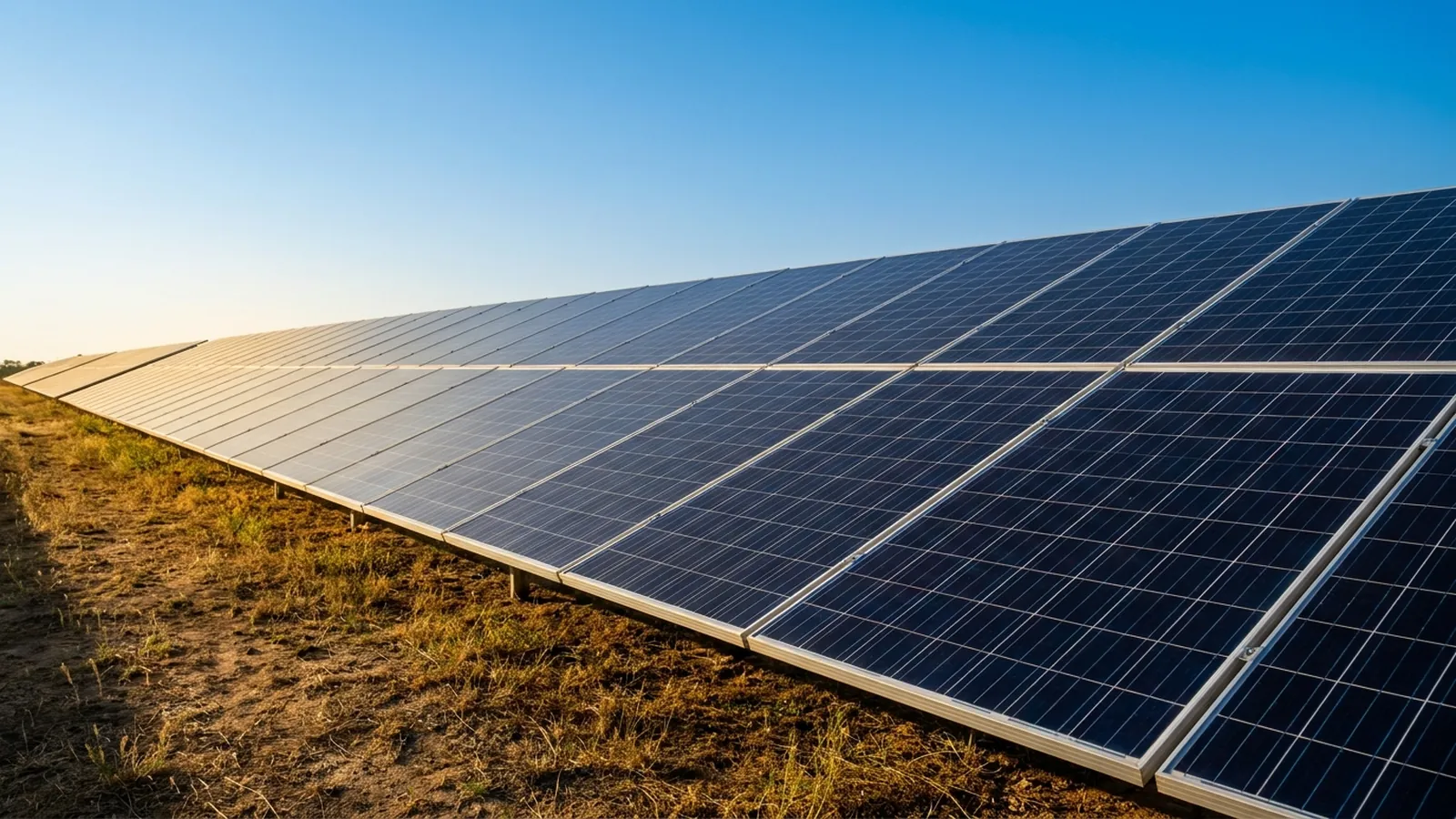
Choosing a solar panel in India in 2026 sounds complex, with dozens of brands, multiple technologies, and confusing wattage numbers, but the decision tree is actually quite short. Start with ALMM List-I compliance (non-negotiable for subsidy eligibility), then pick an N-type TOPCon panel for most new roofs (Mono PERC if budget is tight), then check that your installer's specific model has positive power tolerance and a credible 25-year warranty. Everything else is noise. This guide walks through each step, with the full brand breakdown and a practical checklist for reviewing quotes.
What are the best solar panels in India, and why panel choice matters
Short answer: for most Indian homes in 2026, the best solar panels are DCR, ALMM-listed N-type TOPCon modules from a manufacturer with a strong service network near you. The leading choices are Waaree (Elite BiN-08, up to 23.23% efficiency, 560-600 W), Adani Solar (ELAN Shine TOPCon, up to 22.5%, 550-580 W), Tata Power Solar (TP580HG10NB TOPCon, 560-580 W), Vikram Solar (Hypersol N-type, up to 23.42%, 580-605 W) and Premier Energies (PE-144 HC TOPCon, up to 22.83%, 560-590 W). All five carry a 12-year product warranty and a 30-year performance warranty on these flagships. To claim the PM Surya Ghar subsidy, the exact model must be DCR and on the current ALMM list.
Top 10 solar panel brands in India at a glance (2026)
| Brand | Flagship | Cell type | Max efficiency | Wattage | Warranty (years) | DCR option |
|---|---|---|---|---|---|---|
| Waaree | Elite BiN-08 | TOPCon | 23.23% | 560-600 W | 12 / 30 | Yes |
| Adani Solar | ELAN Shine Gen-II | TOPCon | 22.5% | 550-580 W | 12 / 30 | Yes |
| Tata Power Solar | TP580HG10NB | TOPCon | Not published | 560-580 W | 12 / 30 | Yes |
| Vikram Solar | Hypersol M10R | N-type | 23.42% | 580-605 W | 12 / 30 | Confirm |
| Premier Energies | PE-144 HC | TOPCon | 22.83% | 560-590 W | 12 / 30 | Confirm |
| RenewSys | DESERV Extreme 144X | TOPCon | 23.26% | 565-600 W | 12 / 30 | PERC only |
| Emmvee | Titanium Duo | TOPCon | 22.45% | 560-580 W | 12 / 30 | Confirm |
| Saatvik | TEJ N-TOPCon 144 | TOPCon | 23.23% | 560-600 W | 12 / 30 | Confirm |
| Goldi Solar | GS10-T144-GF | TOPCon | 23.03% | 565-595 W | 12 / 30 | Confirm |
| Websol | W5500-GTB-MP | Mono PERC | 21.29% | 525-550 W | 10 / 27 | Yes |
All ten flagships are bifacial. Max efficiency is the highest module efficiency in the series; warranty is product / performance. "Confirm" means the manufacturer does not name a DCR version of this model on its own site, so ask the seller. Specs from each manufacturer's current datasheet, checked 14 September 2026 and linked under each brand below. For panel and system prices, see prices.
When homeowners ask "which solar panel is best?" they are usually focused on the wrong variable. Panel brand accounts for a small fraction of the lifetime value difference between two installations. The quality of mounting, wiring, earthing, and who is accountable for service over 25 years matters far more. That said, panel choice does matter in three concrete ways:
- Subsidy eligibility: Only DCR panels (made with Indian cells) that are on MNRE's ALMM List-I qualify for the PM Surya Ghar subsidy of up to ₹78,000. A non-DCR panel can save roughly ₹24,000 to ₹33,000 on a 3 kW system but costs you the ₹78,000 subsidy, a net loss of ₹45,000 or more.
- Warranty credibility: A 25-year warranty is only worth as much as the manufacturer's ability to honour it. The top Indian manufacturers, including Waaree, Adani Solar, Tata Power Solar, Vikram Solar, and Premier Energies, have the manufacturing scale and balance sheet to be credibly present in 25 years. Lesser-known importers may not.
- Generation per square foot: Current TOPCon flagships reach 22.5-23.7% module efficiency and Mono PERC about 21%, far ahead of older polycrystalline panels at 14-17%, which matters when your available rooftop is limited.
See our solar panel installation cost guide for the full cost breakdown across 1-10 kW system sizes, our 3 kW system deep dive for the most common residential configuration, and our guide to solar panels for the home if you are starting from scratch.
The non-negotiables: ALMM List-I and List-II compliance
ALMM stands for Approved List of Models and Manufacturers: MNRE's official register of solar module models that meet Indian quality and manufacturing standards. As of 2026, there are two lists that matter for residential installations:
- ALMM List-I (Solar Modules): The module itself must appear on this list. This has been the requirement for PM Surya Ghar subsidy eligibility since the scheme launched. Any installer quoting you a non-List-I panel for a subsidised installation is either uninformed or cutting corners.
- ALMM List-II (Solar Cells): The ALMM order requires net-metered projects to use cells from ALMM List-II certified manufacturers, but MNRE's 4 August 2026 clarification exempts net-metering projects commissioned by 31 December 2026, and households that forgo the subsidy under "Give It Up" until 31 March 2027. Separately, the subsidy itself always requires DCR panels made with Indian cells, and no ALMM exemption relaxes that. This closes the loophole of assembling modules from imported cells while claiming domestic manufacturer status, part of the wider push behind India's solar manufacturing boom. See our ALMM List-II explainer for what this means for panel availability and pricing.
The ALMM list is updated periodically. Panels can be removed if a manufacturer fails a re-audit. Always verify the specific model number, not just the brand, is currently listed before installation begins.
Monocrystalline vs polycrystalline in 2026
This question had a genuine two-sided answer five years ago. In 2026, for residential rooftop solar in India, the answer is essentially settled: monocrystalline mono PERC is the correct default.
| Factor | Monocrystalline PERC (2026) | Polycrystalline (2026) |
|---|---|---|
| Cell efficiency | 21–22% | 14–17% |
| Standard panel wattage | 540–550W | 280–340W |
| Rooftop area for 3 kW | ~200 sq ft | ~280 sq ft |
| Per-watt cost premium | Reference | Under 5% cheaper |
| Performance in high heat | Better (lower temp coefficient) | Moderate |
| ALMM-listed models available | Wide selection | Narrowing |
| Verdict for residential India | Strong default choice | Niche use only |
The per-watt cost gap between mono and poly has narrowed to under 5% in 2026. Given that monocrystalline panels save 25-30% rooftop space for the same output and perform better in the high ambient temperatures typical of most Indian states, there is no longer a meaningful case for polycrystalline on a residential rooftop. Polycrystalline retains a niche in very-low-cost commercial ground-mount installations where space is unlimited and upfront capital is the primary constraint.
Top 10 ALMM-approved solar panel manufacturers in India
The following manufacturers are consistently on MNRE's ALMM List-I, manufacture in India, and have the service infrastructure to credibly honour long-term warranties. The order reflects residential market presence, not a quality ranking. Every spec below comes from the manufacturer's own current datasheet, linked under each brand; capacity figures are company-stated.
1. Waaree Energies
Founded in 1990, Waaree is India's largest solar panel manufacturer by installed capacity, with over 12 GW of annual module capacity across its Surat and Chikhli facilities. Waaree panels are widely available across Indian states through a large distributor and installer network, making after-sales support more accessible than most competitors.
- Flagship: Elite Series BiN-08 (also Elite R BiN-21 at 600-635 W)
- Technology: N-type TOPCon, bifacial, dual glass
- Module efficiency: up to 23.23%
- Wattage: 560-600 W
- Warranty: 12 years product, 30 years performance (87.4% output at year 30)
- DCR option: yes, Waaree sells DCR versions of this module
- Source: Elite BiN-08 datasheet (v10, June 2025)
2. Adani Solar (Adani Green Energy / Mundra Solar PV)
Part of the Adani Group, Adani Solar manufactures at Mundra, Gujarat, and is widely used in both residential PM Surya Ghar installations and large utility-scale projects, with particularly strong distribution in Gujarat, Rajasthan and Maharashtra. Its own product page quotes efficiency figures that differ from the datasheet, so we use the datasheet.
- Flagship: ELAN Shine TOPCon Gen-II
- Technology: N-type TOPCon, bifacial, dual glass
- Module efficiency: up to 22.5%
- Wattage: 550-580 W
- Warranty: 12 years product, 30 years performance (87.4% output at year 30)
- DCR option: yes, Adani lists DCR TOPCon modules
- Source: Shine TOPCon Gen-II datasheet
3. Tata Power Solar
Tata Power Solar, a subsidiary of Tata Power, is one of India's oldest solar manufacturers, in the business since 1989. The Tata brand carries significant trust and a strong service network, which matters for long warranty claims, and Tata Power Solar also sells complete residential installations through its own channels in several states. It still markets a Mono PERC module (TP540HG10B, 530-550 W, up to 21.29%) alongside its TOPCon line.
- Flagship: TP580HG10NB
- Technology: TOPCon, bifacial
- Module efficiency: not published in the brochure we checked; ask for the model datasheet
- Wattage: 560-580 W
- Warranty: 12 years product, 30 years performance
- DCR option: yes, Tata Power Solar makes DCR modules with Indian-made cells
- Source: TP Solar module brochure (February 2025), TP540HG10B datasheet
4. Vikram Solar
Kolkata-headquartered Vikram Solar is among the top-tier Indian manufacturers, with strong export credentials in the USA and Europe, a useful indicator of quality-control discipline since export markets enforce stricter audits. Its datasheets describe the Hypersol cells as N-type without naming the cell architecture.
- Flagship: Hypersol M10R, 144 cell (also Hypersol G12R at 615-640 W, up to 23.69%)
- Technology: N-type, bifacial
- Module efficiency: up to 23.42%
- Wattage: 580-605 W
- Warranty: 12 years product, 30 years performance (87.4% output at year 30)
- DCR option: Vikram says its panels are DCR-compliant; confirm the DCR model with the seller
- Source: Hypersol 580-605 W datasheet (V03, 2025)
5. Premier Energies
Hyderabad-based Premier Energies is a fast-growing manufacturer that listed on the NSE in 2024 and has been expanding domestic and export volumes aggressively. Its TOPCon module is built with its own M10 cells.
- Flagship: PE-144 HC TOPCon
- Technology: N-type TOPCon, bifacial, dual glass
- Module efficiency: up to 22.83%
- Wattage: 560-590 W
- Warranty: 12 years product, 30 years performance (1% degradation in year 1, then 0.4% a year)
- DCR option: not labelled on the datasheet; confirm with the seller
- Source: PE-144 HC TOPCon datasheet
6. RenewSys India
Mumbai-headquartered RenewSys India, part of the ENPEE Group, has been manufacturing since 2011 and runs module lines in Bengaluru, Hyderabad, Patalganga and Khopoli, Maharashtra. RenewSys is unusual among Indian manufacturers in also making its own backsheets and encapsulants in-house rather than sourcing them, a real quality-control advantage.
- Flagship: DESERV Extreme 144X (also Extreme R 132X at 600-625 W)
- Technology: N-type TOPCon, bifacial, dual glass
- Module efficiency: up to 23.26%
- Wattage: 565-600 W
- Warranty: 12 years product, 30 years performance (end-of-term output percentage not stated on the datasheet)
- DCR option: DCR is offered on its Mono PERC lines; confirm DCR availability for the TOPCon line before ordering
- Source: DESERV Extreme 144X datasheet
7. Emmvee Photovoltaic Power
Bengaluru-based Emmvee entered solar PV manufacturing in 2007 and had grown to roughly 10.3 GW of module capacity and 2.94 GW of cell capacity by March 2026. Emmvee listed on the NSE and BSE in November 2025 through a ₹2,900 crore IPO, giving it the public financial disclosure and scrutiny that private manufacturers don't carry.
- Flagship: Titanium Duo
- Technology: N-type TOPCon, bifacial, glass-to-glass
- Module efficiency: up to 22.45%
- Wattage: 560-580 W (144-cell)
- Warranty: 12 years product, 30 years performance (87.4% output at year 30)
- DCR option: Emmvee supplies DCR TOPCon modules to utility projects; confirm a DCR rooftop model with the seller
- Source: Titanium Duo datasheet
8. Saatvik Green Energy
Gurugram-headquartered Saatvik Green Energy, founded in 2015, manufactures at Ambala, Haryana, with capacity of roughly 4.8 GW and a further Odisha facility under development. Saatvik listed on the NSE and BSE in September 2025. It still sells a Mono PERC range (380-555 W, up to 21.48%) for small rooftops alongside its TOPCon modules.
- Flagship: TEJ Bifacial N-TOPCon 144 (also TEJ PLUS G12R at 600-640 W)
- Technology: N-type TOPCon, bifacial, dual glass
- Module efficiency: up to 23.23%
- Wattage: 560-600 W
- Warranty: 12 years product, 30 years performance (87.4% output at year 30)
- DCR option: not named on its website; confirm with the seller
- Source: N-TOPCon bifacial datasheet
9. Goldi Solar
Surat-based Goldi Solar, founded in 2011, runs four Gujarat plants and states a total module manufacturing capacity of 15.2 GW, among the largest of any Indian panel maker. It is certified a "Star Export House" by India's Ministry of Commerce and remains privately held, so treat capacity figures as company-stated rather than independently audited.
- Flagship: GS10-T144-GF (M10R)
- Technology: N-type TOPCon, bifacial, double glass
- Module efficiency: up to 23.03%
- Wattage: 565-595 W
- Warranty: 12 years product, 30 years performance (87.4% output at year 30)
- DCR option: not confirmed on its website; confirm with the seller
- Source: GS10-T144-GF datasheet (v1.1, March 2026)
10. Websol Energy System
Kolkata-headquartered Websol Energy System was incorporated in 1990, making it one of India's earliest solar cell manufacturers, and has been listed on the NSE (WEBELSOLAR) and BSE for years. Unlike most names above, Websol has not yet moved its modules to TOPCon, and says its Mono PERC cells are on ALMM List-II, which makes modules built with them DCR-compliant.
- Flagship: W5500-GTB-MP series
- Technology: Mono PERC, bifacial (glass and transparent backsheet)
- Module efficiency: up to 21.29%
- Wattage: 525-550 W
- Warranty: 10 years product, 27 years performance (83.7% output at year 27)
- DCR option: yes, via its ALMM List-II cells (no separately named DCR model)
- Source: Websol module datasheet (November 2025)
Best solar panels in India with price (2026)
Two prices get mixed up in most comparisons: what a panel costs when it leaves the factory, and what you actually pay for a working rooftop system. Both matter, for different reasons.
Solar panel price per watt
Wholesale module prices in India are tracked monthly by JMK Research. The latest month with published rupee figures is April 2026:
| Panel type | Wholesale price (April 2026) | Qualifies for PM Surya Ghar subsidy? |
|---|---|---|
| Mono PERC, non-DCR | ₹13.8 per watt | No |
| TOPCon, non-DCR | ₹14.2 per watt | No |
| TOPCon, DCR (made with Indian cells) | ₹22.3 per watt | Yes |
These are wholesale figures, before GST, distributor and installer margins, and DCR prices have risen a few percent in JMK's monthly updates since April. What you pay for a single panel at retail is higher: a 500 watt panel sells for roughly ₹24 to ₹36 per watt, as covered in our 500 watt solar panel price guide.
DCR vs non-DCR: is the premium worth it?
DCR (Domestic Content Requirement) panels use solar cells made in India, and only DCR panels qualify for the PM Surya Ghar subsidy. Across JMK's December 2025 to April 2026 data, DCR modules cost about ₹8 to ₹11 more per watt than non-DCR. On a 3 kW system that is roughly ₹24,000 to ₹33,000 extra, against a ₹78,000 subsidy you can only claim with DCR panels. For any home claiming the subsidy, DCR is clearly worth it. Non-DCR only makes financial sense if you are not claiming the subsidy at all.
What a complete rooftop system costs
The panels are only part of the price. The inverter, mounting structure, DC and AC wiring, earthing, net-meter paperwork and installation make up the rest. r-solar's standard turnkey prices:
| System | Price | PM Surya Ghar subsidy | You pay |
|---|---|---|---|
| 3.27 kW, DCR (6 × 545 W panels) | ₹1,91,000 | ₹78,000 | ₹1,13,000 |
| 5.45 kW, DCR (10 panels) | ₹2,76,706 | ₹78,000 | ₹1,98,706 |
| 9.81 kW, non-DCR (18 panels) | ₹3,69,268 | ₹0 | ₹3,69,268 |
For the full size-by-size breakdown, see our 3 kW and 5 kW solar system guides, or run your own numbers in the solar savings calculator.
Sources: JMK Research module price trends, April 2026 (via SolarBytes, 18 May 2026); MNRE PM Surya Ghar guidelines. r-solar prices from our current price sheet.
Latest solar panel technology in India (2026): TOPCon, bifacial and HJT
Short answer: N-type TOPCon is the latest mainstream solar panel technology in India in 2026. Nine of the ten manufacturers above now sell TOPCon or other N-type flagships at roughly 22.5% to 23.7% module efficiency and 550 to 640 W, usually bifacial with dual glass and a 30-year performance warranty. HJT is more efficient still, but little of it is made in India yet, so most HJT panels do not qualify for the subsidy.
Solar panel technologies in India at a glance (2026)
| Technology | Module efficiency | Wholesale price (non-DCR) | Status in India | PM Surya Ghar subsidy |
|---|---|---|---|---|
| N-type TOPCon | 22.5-23.7% | ₹14.2/W | Mainstream: the N-type flagship of 9 of the top 10 brands | Yes, with DCR cells (DCR TOPCon ₹22.3/W) |
| Mono PERC | Up to about 21.3% | ₹13.8/W | Mature, still widely installed | Yes, with DCR cells |
| Bifacial (a panel build, not a cell type) | Same as its cells, plus 5-15% rear-side gain | About 8-12% premium | Common on TOPCon panels, usually dual glass | Yes, if the model is DCR and on ALMM List-I |
| HJT (heterojunction) | About 23-24% | Not tracked | Mostly imported, little made in India yet | Rarely: imported HJT is not on ALMM List-I |
| Perovskite-silicon tandem | Not published for sale | Not sold | Research and pilot stage worldwide | No: not a product you can buy for a rooftop yet |
Efficiency comes from the manufacturer datasheets in the table above, and prices from JMK Research's April 2026 wholesale data (sources under the price table). Subsidy eligibility needs the exact model on ALMM List-I and domestic (DCR) cells.
Beyond standard mono PERC, three advanced panel technologies are increasingly available from Indian manufacturers in 2026. Here is when each genuinely makes sense for a residential installation. (Separately, you may also see the marketing term "hydrogen solar panels", a different, largely experimental concept we break down on its own page.)
Bifacial panels
Bifacial panels generate power from both the front and rear surfaces, with the rear surface capturing reflected light (albedo). Generation gain: 5-15% depending on ground reflectivity. On an RCC rooftop with light-coloured tiles or gravel, expect 7-10% more generation than a comparable monofacial panel. On a dark or bitumen roof, the gain drops to 3-5%. Bifacial panels require elevated mounting to allow light to reach the rear. Most residential installations already achieve this. The cost premium is approximately 8-12%. Verdict: worth considering if your roof has high albedo; marginal benefit otherwise. For the full rooftop-by-rooftop breakdown of albedo, mounting, and real-world generation gain, see our bifacial solar panels guide.
TOPCon (tunnel oxide passivated contact)
TOPCon is the most commercially mature of the next-generation technologies. Cell efficiency: ~23% vs ~21-22% for PERC. Key advantages: better performance at high temperatures (lower temperature coefficient), better low-light performance, and lower degradation rate. The price gap has largely closed: in JMK Research's April 2026 wholesale data, non-DCR TOPCon modules cost ₹14.2 per watt against ₹13.8 for Mono PERC, about 3% more. The generation advantage over PERC in India's hot climate is real, approximately 5-10% more annual output per kW installed. Verdict: with the premium this small, TOPCon is now a sensible default for most new rooftops, and most of the manufacturers above have moved their flagship lines to it. Mono PERC is still a sound, slightly cheaper choice where roof space is not a constraint. Our TOPCon solar panels guide covers the trade-offs in detail.
HJT (heterojunction technology)
HJT achieves ~23-24% efficiency and has the lowest temperature coefficient of any commercial technology, meaning it performs best in India's summer heat. However, domestic HJT manufacturing in India is still limited in 2026, meaning most HJT panels available are imported. Imported panels do not qualify for ALMM List-I status, and therefore do not qualify for PM Surya Ghar subsidy. Verdict: not appropriate for most residential installations in India in 2026 due to ALMM compliance limitations. Monitor for domestic manufacturing scale-up over 2026-2027. Our dedicated HJT solar panels guide covers the efficiency and subsidy-eligibility trade-offs in depth.
What to actually look for in a solar panel quote
When an installer hands you a quote with a panel specification, these are the five numbers that actually matter:
- 1. ALMM List-I model number: Cross-check the exact model number on the MNRE portal. Not the brand name, the full model/series code.
- 2. Power tolerance: Should be 0/+5W or better (e.g. "0/+5W" or "+3%/-0%"). Negative power tolerance means you are paying for 550W but could receive a 545W panel legally. Positive-only tolerance is the industry standard from reputable manufacturers.
- 3. Temperature coefficient (Pmax): The percentage of power lost per degree Celsius above 25°C. Better panels: -0.35%/°C or lower. Typical PERC: -0.35% to -0.40%/°C. TOPCon: -0.30%/°C or better. In MP summers at 45°C, a panel at -0.35%/°C loses 7% less power than one at -0.40%/°C, compounding over 25 years.
- 4. Warranty terms in writing: The performance warranty (25 to 30 years on current panels) must be stated in the contract, with the manufacturer name and model. Verbal assurances about "industry standard warranty" are not enforceable.
- 5. Product warranty duration: 10-12 years for defects (cracks, delamination, junction box failures). Less than 10 years from a major manufacturer is below standard and should prompt questions.
For a complete guide to evaluating installers (not just panels), see how to choose a solar installer in MP.
Red flags to avoid when buying solar panels
These are the warning signs that an installer is cutting corners on panel quality:
- Non-ALMM panels pitched as "equivalent quality": There is no equivalent-quality workaround for subsidy eligibility. If the model is not on ALMM List-I, you forfeit the ₹78,000 subsidy. Full stop.
- Vague spec sheets or spec sheets without model codes: A legitimate ALMM-approved panel comes with a full IEC-certified datasheet showing nameplate wattage, power tolerance, temperature coefficient, and exact model code. If an installer cannot produce this before contract signing, that is a concern.
- Re-coloured or re-labelled cells: Some grey-market suppliers assemble panels from off-spec or rejected cells and label them with a brand name. Signs: the model code does not appear on the ALMM list, the datasheet is low quality or photocopied, the price is significantly below market.
- Outdated stock: If an installer is quoting 330-400W panels in 2026, they are clearing old inventory. Current residential panels run about 540-600 W, so a 3 kW system needs 5 to 6 panels, not 8 to 10. Older panels are not necessarily bad, but using them for a subsidised installation requires verifying their continued presence on the ALMM list.
- No written warranty documentation: A warranty that is not in the written contract does not legally exist. Every subsidised installation should include a signed document from the installer (and, ideally, the manufacturer's warranty card) specifying the model, warranty type, and term.
How r-solar handles panel selection
r-solar uses ALMM List-I approved panels exclusively. No exceptions. For subsidised homes we currently install DCR mono bifacial 550 W modules (domestic cells, so they qualify for the ₹78,000 PM Surya Ghar subsidy), and we use N-type TOPCon modules on other projects. Either way, the specific model number is confirmed on the current MNRE list before procurement. We also check the cell maker's ALMM List-II status, which becomes mandatory for net-metered projects commissioned after 31 December 2026.
We document the panel model, serial numbers, and warranty terms in every customer contract. If you are comparing quotes and want a plain-language explanation of whether a specific panel model is ALMM-compliant, our team can verify it for you, no obligation. See our ALMM list decoded guide for how to check yourself, and our installer selection guide for the full due-diligence checklist. For system sizing and cost context, see the 3 kW solar system guide and our solar savings calculator.
Prefer to check your savings first? Use our solar savings calculator.
Not sure which panel is right for your home?
Tell us your details and we'll recommend the right ALMM-listed panel for your roof, budget and bill, free and no pressure. Callback within 2 hours (10 AM–7 PM IST).
Frequently asked questions
What is the best solar panel brand in India 2026?
For most homes in 2026, the best choice is a DCR, ALMM-listed N-type TOPCon panel from a manufacturer with a strong service network. The leading brands are Waaree (Elite BiN-08, up to 23.23% efficiency), Adani Solar (ELAN Shine TOPCon, up to 22.5%), Tata Power Solar (TP580HG10NB), Vikram Solar (Hypersol, up to 23.42%) and Premier Energies (up to 22.83%), all with a 12-year product and 30-year performance warranty on their current flagships. The brand matters less than confirming the exact model is DCR and on the current ALMM list, and that your installer will stand behind the installation.
Are monocrystalline solar panels better than polycrystalline in 2026?
Yes, for almost all residential applications in India. Modern monocrystalline mono PERC panels offer 21-22% efficiency vs 14-17% for polycrystalline. The per-watt cost gap has narrowed to under 5% in 2026, while mono panels save 25-30% rooftop space for the same output. For a 3 kW system, mono panels need ~200 sq ft of rooftop vs ~280 sq ft for polycrystalline. Polycrystalline still has a niche in very-low-cost commercial ground-mount installations where space is unlimited, but for residential rooftops in India, mono is the correct default in 2026.
What is ALMM and why does it matter for solar panels?
ALMM is MNRE's Approved List of Models and Manufacturers: the official register of solar panel models eligible for use in subsidised installations in India. Only ALMM-approved panels qualify for the PM Surya Ghar subsidy of up to ₹78,000. The list is updated periodically; panels can be added or removed based on manufacturer audits. The subsidy also requires DCR panels made with Indian cells, and ALMM List-II (approved cell makers) becomes mandatory for net-metered projects commissioned after 31 December 2026. A panel that is not DCR-compliant saves about ₹8 to ₹11 per watt wholesale but voids your subsidy claim entirely, a net loss of ₹45,000 or more on a 3 kW system.
How long do solar panels last in India?
Current TOPCon flagships from the leading Indian manufacturers carry a 12-year product warranty and a 30-year performance warranty, typically guaranteeing 87.4% of nameplate output at year 30. Mono PERC lines often carry shorter terms (Websol, for example, offers 10 years product and 27 years performance at 83.7%). Realistic lifespan is 25-30 years or more. The components that actually need replacement during the panel lifetime are the inverter (every 8-12 years) and occasionally MCBs or wiring, not the panels themselves.
What is the difference between TOPCon, HJT, and PERC solar panels?
PERC (Passivated Emitter Rear Cell) is the standard mass-market technology in India 2026: 21-22% cell efficiency, robust, widely available from all ALMM manufacturers. TOPCon (Tunnel Oxide Passivated Contact) offers ~23% efficiency with better temperature performance and 5-10% higher generation in hot climates, and by April 2026 cost only about 3% more than PERC at wholesale. HJT (Heterojunction) is the highest-tier technology at ~23-24% efficiency but is still niche in India due to limited domestic manufacturing. For most new residential installations in 2026, TOPCon is now a sensible default; PERC remains a sound, slightly cheaper option where roof space is not a constraint.
Tata Power Solar vs Adani Solar: which is better?
Both are safe, ALMM-listed choices with DCR options, 12-year product and 30-year performance warranties. On current datasheets, Adani's ELAN Shine TOPCon runs 550-580 W at up to 22.5% efficiency, and Tata Power Solar's TP580HG10NB TOPCon runs 560-580 W (Tata does not publish its efficiency in the brochure we checked). The practical difference is service: Tata Power Solar also sells complete installations through its own channels, while Adani is strongest through installers in Gujarat, Rajasthan and Maharashtra. Pick the one your installer can supply as a verified DCR model and support locally.
Waaree vs Adani: which solar panel is better?
On paper, Waaree's Elite BiN-08 is slightly ahead: up to 23.23% efficiency and 560-600 W, against up to 22.5% and 550-580 W for Adani's ELAN Shine TOPCon. Both are N-type TOPCon, bifacial and dual glass, both offer DCR versions, and both carry a 12-year product and 30-year performance warranty with 87.4% output at year 30. Waaree's larger distributor network makes it easier to find and service in most states; a one-point efficiency gap matters mainly if your roof space is limited.
Which solar panel is best for home in India?
For a home claiming the PM Surya Ghar subsidy, choose a DCR, ALMM-listed N-type TOPCon panel of about 550-600 W from a manufacturer with local service, such as Waaree, Adani Solar, Tata Power Solar, Vikram Solar or Premier Energies. A 3 kW system needs 5 to 6 such panels. Mono PERC is a slightly cheaper alternative if roof space is not a constraint. Whatever the brand, confirm the exact model number on the ALMM list and get the warranty terms in writing.

About the author
r-solar Editorial Team
r-solar installs and maintains rooftop solar across Madhya Pradesh: residential PM Surya Ghar systems, commercial OPEX/PPA, and RESCO at industrial scale, with software-monitored generation tracking from day one.
Ready to install with verified ALMM-approved panels?
Get your free quote