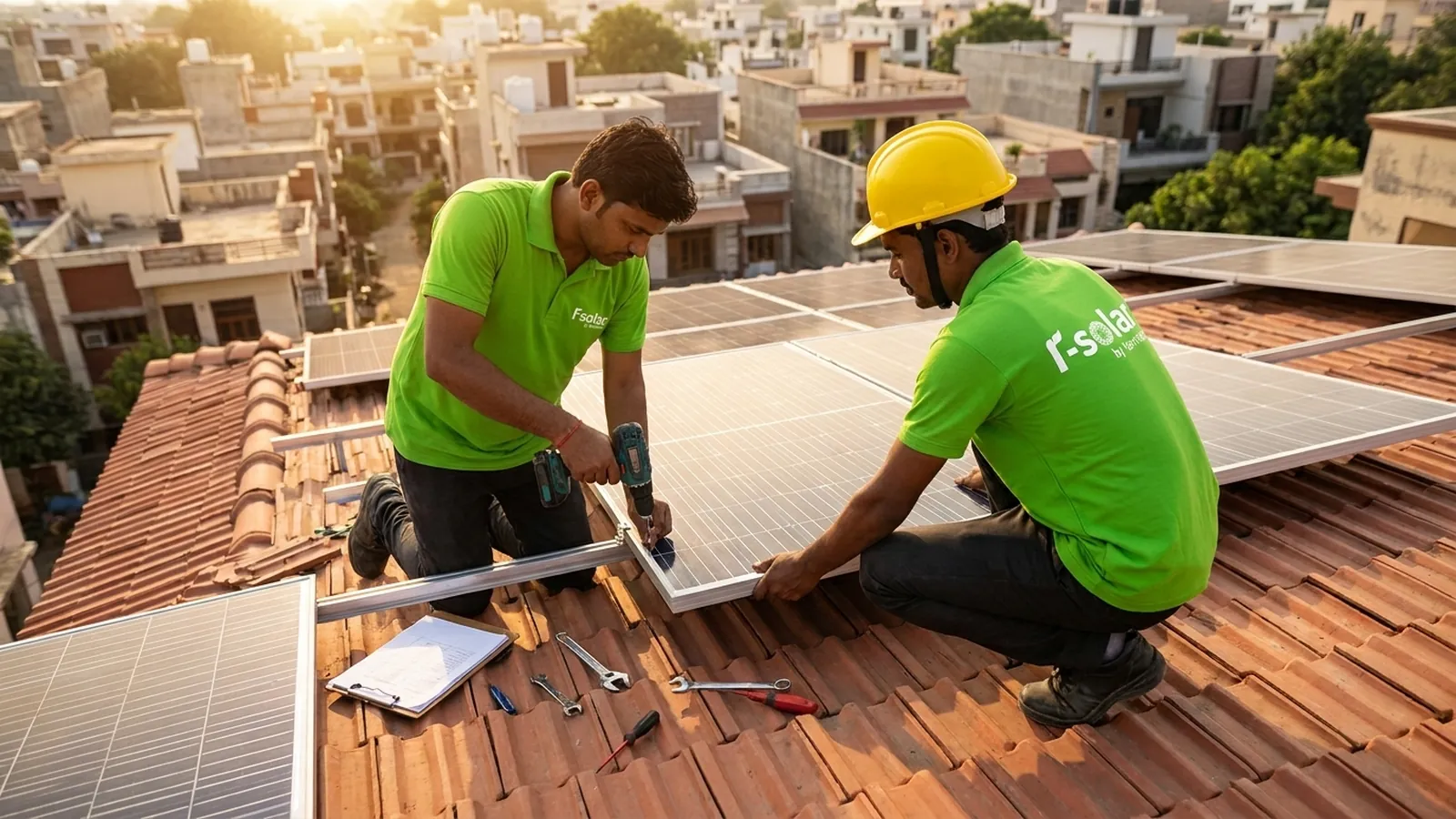
Solar installation pricing in India looks simple on a website ("₹1 lakh for 3 kW!") and gets complicated the moment you ask for a quote. The reason is that "installation cost" is not one number. It is a stack of hardware costs, BOS (balance of system) costs, civil work, electrical work, DISCOM filing, and installer overhead, with most installers rolling some line items in and breaking others out. Two quotes can both say "₹1.91 lakh for 3 kW" and mean very different things.
This guide gives you the real numbers for residential rooftop solar in India 2026, organised by system size (1 kW, 2 kW, 3 kW, 5 kW, 10 kW), with the subsidy and loan EMI math worked through. Every figure here is sourced from r-solar's actual MP installations and from MNRE's published benchmarks, with no inflated "starting from" claims.
Solar panel installation cost by system size
Short answer: solar panel installation cost in India runs roughly ₹55,000 to ₹65,000 per kW installed in 2026, so a 3 kW rooftop system lands at about ₹1.91 lakh turnkey and drops to about ₹1,13,000 once the ₹78,000 PM Surya Ghar subsidy is credited. The table below breaks that down for every size from 1 kW to 10 kW.
Here is the turnkey installed cost for residential rooftop solar systems across the most common sizes. All prices assume ALMM-approved monocrystalline panels, a quality string inverter (typically Microtek, Sungrow, or Growatt), galvanised mounting structure, AC and DC wiring, earthing, MCBs, and net metering application filing.
| System Size | Turnkey Cost (incl. GST) | Per kW | Typical Use Case |
|---|---|---|---|
| 1 kW | ₹60,000 – ₹70,000 | ~₹65,000 | Small home, monthly bill ₹400–₹700 |
| 2 kW | ₹1.10 – ₹1.30 lakh | ~₹60,000 | 2-3 BHK home, monthly bill ₹800–₹1,200 |
| 3 kW (most common) | ₹1.91 lakh | ~₹58,000 | 3-4 BHK home, monthly bill ₹1,500–₹2,500 |
| 5 kW | ₹2.77 lakh | ~₹51,000 | Large home with AC load, monthly bill ₹3,000–₹4,500 |
| 10 kW | ₹3.69 lakh | ~₹38,000 | Bungalow, small shop, or two-family home; bill ₹6,000+ |
Per-kW costs come down with system size because fixed costs are amortised across more capacity: the same site visit, the same DISCOM filing, the same single inverter (up to 5 kW) is roughly the same effort whether the system is 3 kW or 5 kW. A 10 kW system at ₹38,000/kW is not "premium" pricing; it reflects the same workmanship across more panels.
For commercial and industrial systems above 25 kW, see C&I solar solutions: different equipment class (central inverters, monitoring systems), different financing models (CAPEX vs OPEX/PPA), and per-kW costs typically ₹40,000–₹50,000.
What's actually included in the installation cost
A turnkey rooftop solar quote should include every component and every service required to commission the system. Here is the breakdown for a typical 3 kW residential installation in India:
| Line item | ~ Share of cost | Notes |
|---|---|---|
| ALMM-approved solar panels (e.g., Waaree, Adani, Tata Power Solar, Premier Energies) | 50–55% | Mono PERC, 540–550 W class |
| String inverter (Microtek / Sungrow / Growatt) | 10–12% | 5–10 year manufacturer warranty |
| Galvanised mounting structure (HDG steel) | 8–10% | 15–25 year structural life |
| AC and DC cabling, conduits, junction boxes | 5–7% | Length depends on inverter location |
| Earthing kit, MCBs, SPDs, DCDB/ACDB | 3–5% | Code-compliant per IS standards |
| Civil work (mounting base, cable trays) | 3–4% | Higher for older homes |
| Net metering application filing + DISCOM coordination | 2–3% | MPEZ / MPMKVVCL / MPWZ in MP |
| Installation labour, commissioning, monitoring setup | 10–15% | In-house team vs sub-contracted |
The two line items that most often get separated out and surprise homeowners are civil work (any concrete base, roof penetration sealing, or rooftop access modifications) and extended cable runs (if the inverter location is far from the panels or from the meter). Ask the installer to confirm in writing that the quote includes both.
After subsidy: your real out-of-pocket cost
The PM Surya Ghar: Muft Bijli Yojana is the central government's residential rooftop solar subsidy scheme. It provides a direct bank-account credit (no GST refund hassle) after your system passes DISCOM inspection. The structure is tiered:
- 1 kW system: ₹30,000 subsidy
- 2 kW system: ₹60,000 subsidy (₹30,000 per kW for first 2 kW)
- 3 kW or larger residential: ₹78,000 subsidy (additional ₹18,000 for the 3rd kW, capped here)
The subsidy is capped at ₹78,000 regardless of system size. A 5 kW or 10 kW residential system receives the same ₹78,000. The additional capacity is paid for from your pocket or through a loan. Here is what that looks like in net terms:
| System Size | Turnkey Cost | Subsidy | Net Out-of-Pocket |
|---|---|---|---|
| 1 kW | ~₹65,000 | – ₹30,000 | ₹35,000 |
| 2 kW | ~₹1,20,000 | – ₹60,000 | ₹60,000 |
| 3 kW | ~₹1,91,000 | – ₹78,000 | ₹1,13,000 |
| 5 kW | ~₹2,76,706 | – ₹78,000 | ₹1,98,706 |
| 10 kW | ~₹3,69,268 | ₹0 (non-DCR, not subsidy-eligible) | ₹3,69,268 |
What your r-solar price actually buys
A cheap quote prices the panels and stops there. The hardware lands on your roof and the rest becomes your problem: finding an electrician, filing the DISCOM net metering application, registering on the PM Surya Ghar portal, and chasing the ₹78,000 subsidy yourself for months.
An r-solar price is for the finished job, not a box of parts. It covers:
- System design sized to your bill, roof and sanctioned load
- ALMM-approved panels, inverter and mounting structure
- Professional installation and electrical safety compliance
- DISCOM net metering application and integration
- The full PM Surya Ghar subsidy filing, followed through until the ₹78,000 reaches your bank account
- One team accountable from your first call to a commissioned, subsidy-credited system
Quotes that look cheaper skip this work and leave you to install, file and chase the subsidy on your own.
The subsidy is credited to your bank account 30 to 45 days after DISCOM commissioning, not at the time of quotation or installation. You pay the installer the full turnkey cost first (or finance the gross cost via a loan), and the subsidy lands later. Your installer should walk you through the application. See how to choose a solar installer in MP for what to look for.
With a bank loan: monthly EMI reality check
Most homeowners in MP finance their solar installation via a PM Surya Ghar bank loan. The scheme offers collateral-free loans up to ₹2 lakh from participating public-sector banks at concessional rates linked to RLLR (Repo-Linked Lending Rate).
Current PM Surya Ghar rooftop solar loan rates (2026):
- SBI: 5.75% p.a. up to ₹2 lakh, 7.90% from ₹2 lakh to ₹6 lakh. Collateral-free up to ₹2 lakh, up to 120 months, nil processing fee.
- Canara Bank: 5.75% p.a. up to ₹2 lakh, 8.75% above. Processing fee waived.
- Bank of Baroda, PNB and Indian Bank: 5.75% p.a. up to ₹2 lakh; rates above ₹2 lakh vary by bank and CIBIL score.
- Union Bank of India and Bank of India: 5.75% p.a. up to ₹2 lakh; above ₹2 lakh, 9.00% to 9.50% at Union Bank (by CIBIL score) and 8.10% at Bank of India.
Below is the EMI math for a 3 kW system in MP, financed via SBI at 5.75% over 10 years, with the PM Surya Ghar subsidy credited month 2 and used to part-pay principal at zero penalty:
| Turnkey installed cost (3 kW) | ₹1,91,000 |
| Loan amount (90% of cost) | ₹1,72,000 |
| EMI before subsidy credit (10 yr at 5.75%) | ~₹1,888 / month |
| PM Surya Ghar subsidy (credited month 2) | – ₹78,000 toward principal |
| Remaining principal after part-payment | ₹94,000 |
| EMI after subsidy credit (10 yr at 5.75%) | ~₹1,032 / month |
Compare that ~₹1,032 monthly EMI to the household electricity bill the same system replaces. A 3 kW system in MP generates roughly 12–14 units per day, which at MPPKVVCL's typical residential slab rate of ₹6.50–₹7.50/kWh saves around ₹2,500–₹3,000 per month in electricity costs. The bill saving exceeds the EMI by ₹1,450–₹1,950 per month. The system is cash-flow positive from the first quarter.
For a precise quote tailored to your roof, consumption pattern, and district DISCOM rates, use the r-solar savings calculator.
5 hidden costs most solar quotes don't show
The published quote is usually accurate for the equipment and the labour. The "surprises" happen at five specific friction points. Ask about every one of these before signing.
- Net metering application fee. MP's DISCOMs charge a one-time ₹1,000 net metering processing fee under MPERC's RG-39(II) regulation, waived for PM Surya Ghar applicants since June 2026. Some installers include this in the turnkey quote; others list it as a "DISCOM fees pass-through" billed separately. Always ask: is this in your quote or extra?
- Extended DC cable runs. A standard quote assumes the inverter is mounted close to the panels (typically a single short DC run). If your inverter has to go in the basement or far utility room, the additional DC cabling can add ₹3,000–₹8,000 to the cost. This becomes apparent only after the site visit.
- Older home electrical upgrades. If your home's existing electrical panel doesn't have spare capacity or proper earthing, the installer will need to upgrade it before the system is commissioned. This is a real safety requirement, not a sales add-on, but the cost (typically ₹4,000–₹12,000) is rarely in the headline quote.
- Roof penetration sealing and weatherproofing. Mounting brackets that penetrate the roof tile or slab require professional sealing to prevent monsoon leaks. Quality installers include this. Cheap quotes sometimes use silicone alone, adequate for two monsoons, then a leak. Cost of doing it properly: ₹1,500–₹3,000 for a 3 kW system.
- Annual Maintenance Contract (AMC) from year 2. Most installers bundle one year of free monitoring and one site visit into the original quote. Year 2 onwards, AMC costs ₹2,500–₹5,000 per year for a residential system. This isn't "hidden" exactly, but homeowners frequently miss that the original price did not include long-term maintenance.
MNRE benchmark cost vs real market pricing
MNRE (Ministry of New and Renewable Energy) publishes annual benchmark costs for grid-connected rooftop solar. These are the reference numbers DISCOMs and banks use to validate installer quotes and to compute the subsidy ceiling.
The 2026 residential benchmark is approximately ₹50,000–₹55,000 per kW for systems up to 10 kW. This is the "official" cost basis.
Real-world turnkey market prices in MP run slightly above the benchmark, typically ₹55,000–₹65,000 per kW, because:
- The benchmark doesn't include all civil and electrical contingencies
- Local logistics and labour rates in MP exceed pan-India averages for tier-2/3 districts
- Quality installers use higher-tier ALMM panels and HDG (not powder-coated) mounting
- Quote includes documentation work (subsidy filing, net metering application, bank coordination)
A quote significantly below MNRE benchmark deserves scrutiny. The two ways an installer hits a price below benchmark are: (a) non-ALMM panels, which void your subsidy claim, or (b) "stripped" quotes that exclude civil and DISCOM costs which then get billed separately later. Neither is a real discount.
Red flag: quote 30% below MNRE benchmark
If a quote comes in at ₹40,000/kW for a 3 kW system (₹1.20 lakh), that is 25%+ below benchmark. Politely ask: "Are all panels on the current ALMM list? Is civil work, earthing, net metering filing, and DISCOM follow-up included? Can I see the model numbers of every panel in writing?" The answers will tell you whether the discount is real or a stripped quote that will balloon at commissioning.
How r-solar prices differ from national brands
r-solar's published turnkey prices match the ranges in this guide. Two things are different from typical national-brand quotes:
- All-in pricing, no surprise line items. Net metering filing fees, DISCOM follow-up, basic civil work, earthing, and first-year AMC are bundled into the headline number. Extended cabling and major civil upgrades (rare) are itemised in writing before installation, not after.
- ALMM-only panels. Every quote uses panels currently on the MNRE ALMM list (Waaree, Adani Solar, Tata Power Solar, Vikram Solar, Premier Energies, or similar). We don't trade quality for a 5% discount. Your PM Surya Ghar subsidy is worth more than that.
- Local accountability. r-solar is headquartered in Barwani with offices in Indore, Khargone, and Ahmedabad. The 25-year warranty is enforced by the same team that installed the system, not a national helpline that routes year-5 service calls to a stranger.
- Bank coordination handled. SBI, Canara Bank, and Union Bank of India have active relationships with r-solar across MP districts. We file the loan application alongside your subsidy claim and the net metering application: three workstreams, one team.
For MP-specific pricing context and worked subsidy math, see our companion guide on solar panel cost in Madhya Pradesh 2026. For a side-by-side cost and service comparison vs national brands, see r-solar vs national solar companies in MP.
Want an exact price for your roof?
Get a free site visit and quoteSite visit and system design are free across MP. No commitment, no pressure.
Get your exact installation cost, free
Tell us your details and we'll send a real, itemised quote for your roof. Free callback within 2 hours (10 AM–7 PM IST).
Frequently asked questions
How much does it cost to install solar panels in India?
A residential rooftop solar system in India costs roughly ₹55,000–₹65,000 per kW installed, all-inclusive. A 1 kW system runs ₹60,000–₹70,000; a 3 kW system around ₹1.91 lakh; a 5 kW system ₹2.5–₹3.0 lakh; and a 10 kW system ₹4.8–₹5.5 lakh. After the PM Surya Ghar subsidy of up to ₹78,000 (for 3 kW or larger residential), the net out-of-pocket cost drops substantially. A 3 kW system can come down to around ₹1,13,000.
What is the cost of a 3 kW solar system in Madhya Pradesh?
A turnkey 3 kW residential rooftop solar system in MP typically costs around ₹1,91,000 fully installed with ALMM-approved panels, a string inverter, mounting structure, AC/DC wiring, earthing, and net metering filing. After the PM Surya Ghar central subsidy of ₹78,000, your effective out-of-pocket cost is approximately ₹1,13,000. With an SBI solar loan at 5.75% p.a. over 10 years on the loan amount, monthly EMI is roughly ₹1,032 after subsidy credit. r-solar offers free site visits across MP before any commitment.
Does PM Surya Ghar subsidy cover the full installation cost?
No. The PM Surya Ghar subsidy covers roughly 41% of a 3 kW residential system cost, not 100%. The scheme provides ₹30,000 for the first kW, ₹60,000 for 2 kW, and a maximum of ₹78,000 for 3 kW or larger residential systems. For larger systems (5–10 kW), the subsidy remains capped at ₹78,000, so the percentage covered drops to roughly 20–30%. The remaining cost is paid upfront in cash, or financed via a PM Surya Ghar bank loan (SBI, Canara Bank, Bank of Baroda, PNB and Indian Bank all at 5.75% for loans up to ₹2 lakh, collateral-free).
How much does a 5 kW solar system cost after subsidy in India?
A 5 kW residential rooftop solar system typically costs ₹2.5–₹3.0 lakh fully installed. The PM Surya Ghar subsidy is capped at ₹78,000 for systems of 3 kW or larger, so the net cost after subsidy is approximately ₹1.72–₹2.22 lakh. If you finance the net cost via SBI's PM Surya Ghar solar loan over 10 years, monthly EMI is roughly ₹1,890–₹2,680 (5.75% up to ₹2 lakh, 7.90% above), typically less than your monthly electricity bill savings, so the system is net cash-positive from month one.
Is the cost of solar panel installation negotiable?
Marginally, yes, but be cautious. Component costs (ALMM-approved panels, string inverter, mounting structure) are largely standardised, with manufacturer prices changing only when raw material costs shift. The negotiable component is installation labour and overhead, typically 15–25% of the turnkey price. A quote that is 30% cheaper than market is usually achieved by substituting non-ALMM panels (which void your PM Surya Ghar subsidy), undersizing the inverter, or excluding civil and earthing work that gets billed separately later. Compare quotes line-by-line, not just bottom-line.
What is the MNRE benchmark cost for rooftop solar in 2026?
MNRE publishes annual benchmark costs for grid-connected rooftop solar. These are the reference numbers DISCOMs and banks use to validate installer quotes. For 2026, the residential benchmark is approximately ₹50,000–₹55,000 per kW for systems up to 10 kW. Real-world turnkey market prices in MP run slightly above the benchmark (typically ₹55,000–₹65,000 per kW) because MNRE benchmarks don't always include net metering filing fees, civil work for shadow-free mounting, or contingency wiring runs in older homes. A quote significantly below MNRE benchmark should be questioned.

About the author
r-solar Editorial Team
r-solar installs and maintains rooftop solar across Madhya Pradesh: residential PM Surya Ghar systems, commercial OPEX/PPA, and RESCO at industrial scale, with software-monitored generation tracking from day one.
Ready to lock in your installation price?
Get your free quote