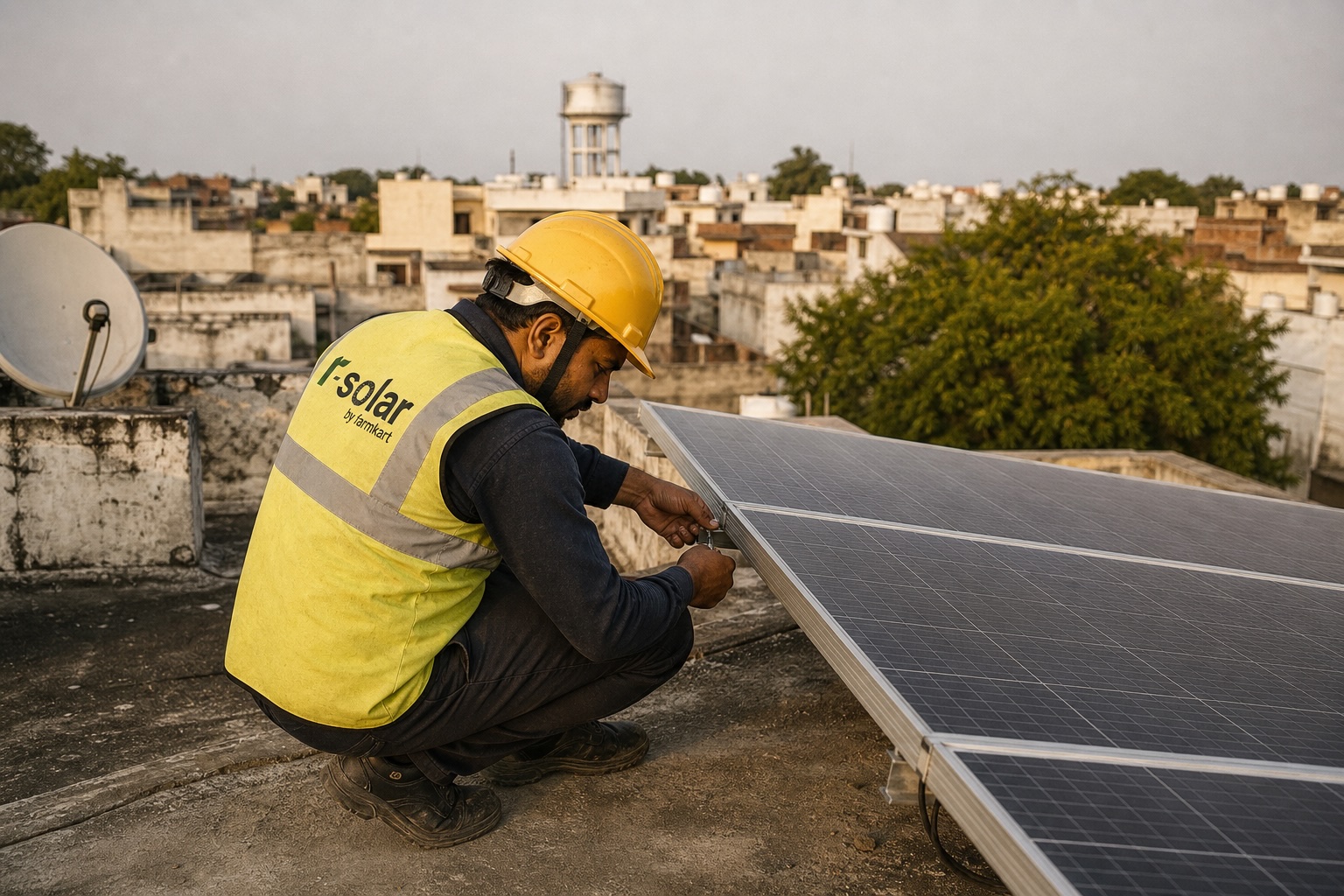
Solar installation is not a commodity purchase. The panels may last 25 years, but the installer relationship (the paperwork, the subsidy claim, the annual maintenance, the warranty call in year 8) lasts just as long. In Madhya Pradesh, the stakes are higher than in most states: DISCOM empanelment requirements, MPERC-specific net metering rules, and PM Surya Ghar subsidy documentation all create friction points that a credible local installer navigates every day. A national aggregator or an unregistered local contractor simply cannot.
This guide is written by r-solar, a MNRE-empanelled solar EPC company headquartered in Madhya Pradesh with 1,500+ installations across the state. We've seen exactly what goes wrong with bad installer choices, and we've documented the five checks that filter them out.
Use these five checks before signing any solar contract in MP.
Why choosing the right installer matters in MP
Madhya Pradesh has three DISCOMs: MPEZ (eastern zone), MPMKVVCL (central zone), and MPWZ (western zone), each with its own empanelment process for solar installers. An installer empanelled with one DISCOM may not be authorised to file net metering applications with another. If you're in Indore (MPWZ) but your installer is only empanelled with MPEZ, your net metering and subsidy paperwork stalls indefinitely.
Beyond paperwork, the PM Surya Ghar Muft Bijli Yojana (which provides up to ₹78,000 in central subsidy for a 3 kW residential system) has a sequential process: DISCOM technical sanction → installation → DISCOM inspection → subsidy disbursement. Every step requires the installer to be registered and to know the local DISCOM process. One wrong form or an unregistered installer collapses the entire chain.
Under MPERC's net metering regulation (RG-39(II) of 2024), the application goes to your DISCOM, and for PM Surya Ghar homes it runs through the national portal, where you pick from registered vendors. Without DISCOM empanelment, your system generates power but none of it feeds back to the grid. You lose the benefit of net metering entirely.
Check 1: MNRE registration & DISCOM empanelment
What it means: MNRE (Ministry of New and Renewable Energy) registers solar installers as "Channel Partners" for the PM Surya Ghar scheme. DISCOM empanelment is a separate, state-level registration that gives the installer the right to file net metering applications and subsidy paperwork with your local distribution company.
How to verify: Ask the installer for:
- Their MNRE Channel Partner ID: verify at pmsuryaghar.gov.in
- Their DISCOM empanelment certificate: issued by MPEZ, MPMKVVCL, or MPWZ depending on your district
Why it matters for subsidies: Only MNRE-registered installers can initiate your PM Surya Ghar application on the national portal. An unregistered installer cannot file on your behalf, and if you try to self-register without technical expertise, the application typically fails at the inspection stage. The subsidy delay alone (3–6 months in disputed cases) is often worth more than any price discount the unregistered installer offered.
Check 2: ALMM-approved panels only
The Approved List of Models and Manufacturers (ALMM) is MNRE's register of solar panel models approved for use in subsidised projects. This is the single most important technical check for homeowners claiming PM Surya Ghar subsidy.
Why non-ALMM panels disqualify your subsidy: During the DISCOM inspection after installation, the inspector cross-checks your panel serial numbers against the ALMM database. If even one panel is not listed, the entire subsidy claim is rejected. There is no appeal process. You'd need to replace the panels before reapplying, at your cost.
The ALMM list is updated periodically by MNRE. Panels that were compliant six months ago may have been delisted due to manufacturer audits. A credible installer tracks these changes and only procures from currently listed models.
Our detailed guide on the ALMM list 2026 covers the top approved manufacturers, Waaree, Adani Solar, Tata Power Solar, Vikram Solar, Premier Energies, and others, along with how to verify any model number on the MNRE portal.
What to ask: "Which ALMM-approved manufacturer and model number are you quoting?" Then verify the model on mnre.gov.in yourself before signing.
Check 3: Local presence & post-installation service
A 3 kW rooftop system has an expected life of 25 years. Your installer's service team will need to respond to panel cleaning queries, inverter replacements, monitoring issues, and occasional physical inspections across that entire period. The question is: will they still be reachable in year 10?
The sub-contracting problem: Many national solar brands that market heavily in MP don't have their own installation crews here. They sign you up centrally and then sub-contract installation to a local labour contractor. The sub-contractor has no ongoing relationship with you; they're paid per installation and move on. When your inverter throws an error code in year 4, you're calling a national helpline that dispatches a different contractor each time.
What to look for in a local MP installer:
- Physical office in your district or adjacent district, not just a sales agent
- Their own installation team (not sub-contracted labour)
- Named person responsible for your AMC (Annual Maintenance Contract)
- References from customers in your district who are 2+ years post-installation
For tier-2 and tier-3 towns in MP (Barwani, Khargone, Sendhwa, Khandwa), a national brand with centralised support simply cannot provide same-day or next-day service. Local presence is not a nice-to-have; it's the difference between a working system and months of follow-up.
Check 4: Bank loan tie-ups
The PM Surya Ghar bank loan list includes SBI, Canara Bank, Bank of Baroda, PNB, Indian Bank and others, most charging 5.75% p.a. for collateral-free loans up to ₹2 lakh under the scheme. These are genuinely affordable loans, often better than gold loan rates.
Why installer tie-ups matter: Getting the bank loan approved requires co-ordination between the installer, the bank, and the DISCOM. The bank won't disburse until the technical sanction is received from the DISCOM, and the DISCOM won't issue sanction until the installer files the net metering application. An installer without an active bank relationship cannot shepherd this process. You end up dealing with a bank branch officer who's never seen a solar loan application, and the process stalls.
What a working bank tie-up looks like:
- The installer has a named point of contact at the bank branch
- They can provide a reference from a previous customer who successfully got the loan
- They prepare and submit the loan documentation on your behalf
Ask specifically: "Which banks have you arranged solar loans with in this district, and can you refer me to a previous customer who used that loan?" Vague answers ("we can connect you to any bank") suggest no real relationship.
Check 5: Transparent pricing: CAPEX vs OPEX/PPA
Solar contracts in India come in two fundamentally different structures. Understanding which one you're being quoted is essential before comparing prices.
CAPEX (Capital Expenditure): You buy the system outright. You own the panels, the inverter, and the wiring. You claim the PM Surya Ghar subsidy directly. After loan repayment (typically 5–7 years), all electricity generated is effectively free. Best for: homeowners who want to maximise long-term savings and claim the government subsidy. Use our solar savings calculator to estimate your 25-year return.
OPEX / PPA (Power Purchase Agreement): The installer owns the system and installs it on your roof at zero cost. You pay a fixed per-unit rate (typically ₹4.50–₹5/kWh for commercial customers in MP) for a contracted period of 15–25 years. No upfront investment, no maintenance headache, and you still save 30–50% on your electricity bill compared to MSEDCL grid rates. Best for: factories, commercial buildings, and businesses that prefer predictable operating costs over capital investment. More detail on C&I solar solutions for MP industries.
Red flags in pricing: A quote that doesn't specify the model (CAPEX or PPA) is incomplete. A price comparison that mixes the two models is meaningless. Always ask the installer to clarify in writing: "Is this a CAPEX quote where I own the system, or a PPA where you own it?"
Beware of unusually cheap CAPEX quotes: they may use non-ALMM panels, undersize the inverter, or exclude civil work and earthing costs that will be billed separately after signing.
Red flags to avoid
Watch out for these warning signs
- Unrealistic ROI claims: "Your system will pay back in 2 years" for a residential system is almost certainly false. A well-sized residential system in MP typically pays back in 4–6 years under CAPEX with subsidy, depending on your consumption pattern.
- No written warranty documentation: Panel manufacturers provide a 25-year linear performance warranty and a 10-year product warranty. Inverter warranties are typically 5–10 years. If the installer won't give you the warranty certificates in writing before installation, walk away.
- Panels not on the ALMM list: Non-ALMM panels are the single most common cause of rejected PM Surya Ghar subsidy claims in MP. Verify the model number yourself on mnre.gov.in.
- No DISCOM documentation support: The installer should handle net metering application, technical sanction follow-up, and subsidy filing, not hand you a list of documents and tell you to manage it yourself.
- Pressure to sign quickly: "This price is only valid today" on a 25-year asset is a manipulation tactic. A credible installer holds their quote for at least 7–10 days.
- No physical office in MP: A company that operates entirely through agents with no registered address in Madhya Pradesh has no local accountability.
How r-solar ticks all 5 boxes
r-solar is Madhya Pradesh's largest regional rooftop solar installer, with 1,500+ installations across the state: residential, commercial, and industrial. Here's how we measure against the five checks above:
| Check | r-solar |
|---|---|
| MNRE Registration & DISCOM Empanelment | MNRE Channel Partner registered. Empanelled with all three MP DISCOMs: MPEZ, MPMKVVCL, and MPWZ. |
| ALMM-Approved Panels | We exclusively procure from ALMM List I manufacturers. Panel serial numbers are verified at delivery and at commissioning before filing subsidy paperwork. |
| Local Presence & Service | Headquartered in Barwani with offices in Indore, Khargone, and Ahmedabad. In-house installation and AMC team, no sub-contracting. Same-day response for most MP districts. |
| Bank Loan Tie-Ups | Active relationships with SBI, Canara Bank, and Union Bank of India across MP districts. We handle documentation and DISCOM-to-bank co-ordination end-to-end. |
| Transparent Pricing | All quotes clearly state CAPEX or OPEX/PPA model. CAPEX quotes include all costs (civil, earthing, net metering fees). PPA rates are fixed and documented in contract. |
We also offer a free site visit and system design before any commitment. Our engineers assess your roof orientation, shading, consumption pattern, and DISCOM requirements to size the system correctly, not to sell you the largest system possible.
If you're comparing us with national brands, our honest breakdown is available at r-solar vs national solar companies in MP.
Ready to get a verified, no-pressure quote?
Get a free site visitFrequently asked questions
How do I verify if a solar installer in MP is MNRE registered?
Ask the installer for their MNRE Channel Partner ID and cross-check it on the MNRE portal at solarrooftop.gov.in. You can also ask for their DISCOM empanelment certificate issued by MPEZ, MPMKVVCL, or MPWZ, whichever covers your district. An unregistered installer cannot file your PM Surya Ghar subsidy application, so this is a non-negotiable check.
Why does it matter if my solar panels are on the ALMM list?
The PM Surya Ghar Muft Bijli Yojana requires every panel installed to be on MNRE's Approved List of Models and Manufacturers (ALMM). If even one panel is non-ALMM, your entire subsidy claim, up to ₹78,000, is rejected at the DISCOM inspection stage. Non-ALMM panels also tend to come with weaker warranties and no domestic accountability for claims.
What bank loans are available for rooftop solar in Madhya Pradesh?
Under the PM Surya Ghar scheme, SBI, Canara Bank and most other public-sector banks charge 5.75% p.a. for PM Surya Ghar loans up to ₹2 lakh (September 2026). The installer you choose must have active tie-ups with these banks. They handle documentation and liaise with the branch on your behalf. r-solar has direct relationships with SBI, Canara Bank, and Union Bank across MP districts.
What is the difference between CAPEX and OPEX/PPA for solar in MP?
Under CAPEX, you purchase the solar system outright and own the asset. You benefit from the full subsidy and maximum long-term savings. Under OPEX or PPA (Power Purchase Agreement), the installer owns the system and charges you a fixed per-unit rate (typically ₹4.50–₹5/kWh for commercial) for 15–25 years, zero upfront investment. CAPEX suits homeowners claiming PM Surya Ghar subsidy; OPEX/PPA suits factories and businesses that prefer zero capex. r-solar offers both models.
How many solar installations has r-solar done in Madhya Pradesh?
r-solar has completed 1,500+ installations across Madhya Pradesh, covering residential rooftop systems, commercial buildings, and industrial facilities. The company is headquartered in Barwani with offices in Indore, Khargone, and Ahmedabad, ensuring local presence and same-day response across central and western MP.

About the Author
r-solar Editorial Team
r-solar installs and maintains rooftop solar across Madhya Pradesh: residential PM Surya Ghar systems, commercial OPEX/PPA, and RESCO at industrial scale, with software-monitored generation tracking from day one.
Ready to go solar the right way in MP?
Get your free quote