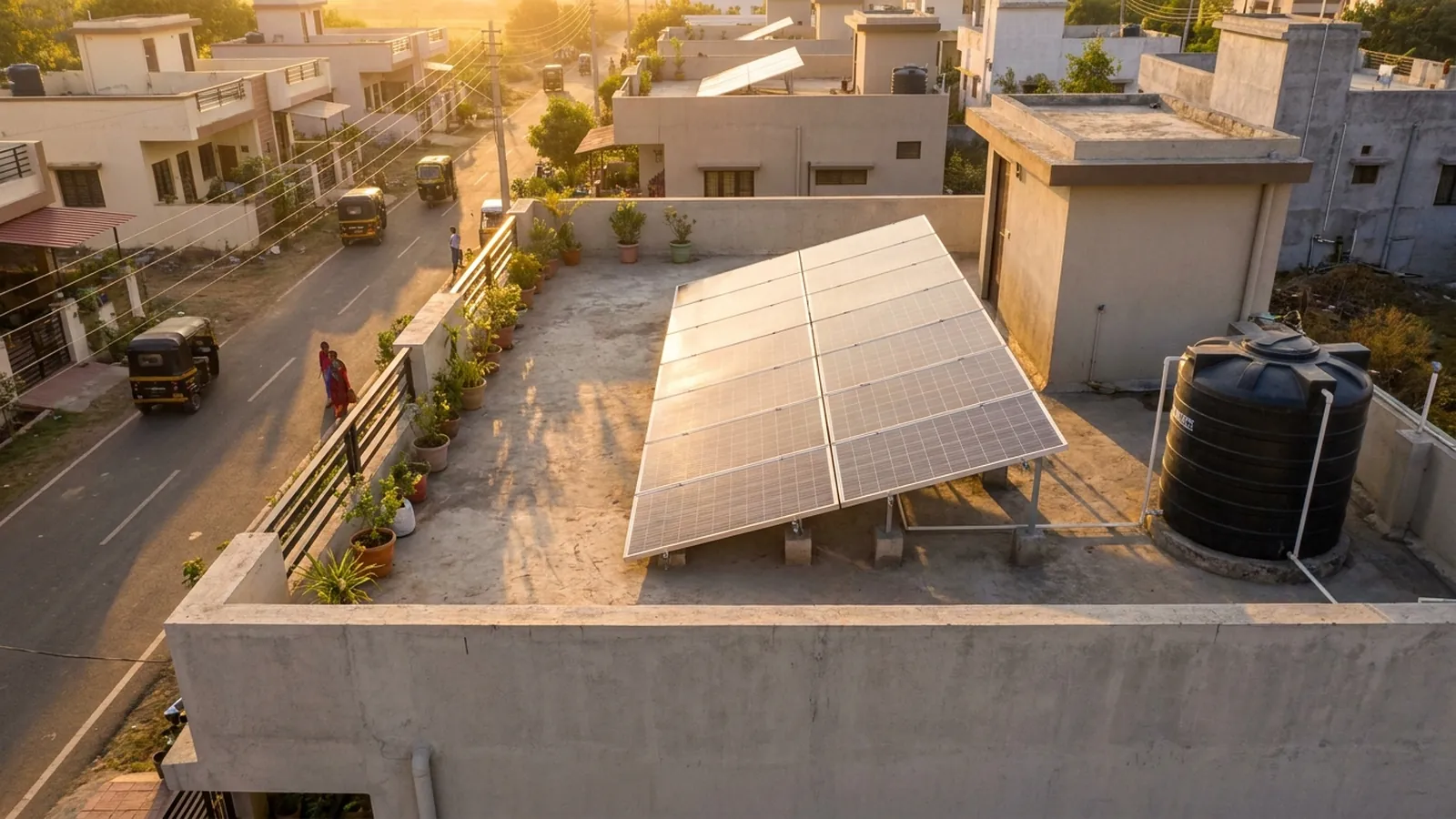
The 3 kW system size is the single most common residential solar choice in India in 2026, not by accident, but because it sits at the financial sweet spot of the PM Surya Ghar scheme. Slightly smaller systems lose subsidy proportionally; slightly larger systems don't gain any more subsidy. This guide walks through the exact numbers for a 3 kW installation in India: cost components, generation expectations by state, the subsidy math, the loan EMI math, and the realistic payback period.
3 kW solar system price in India 2026 at a glance
Short answer: a 3 kW rooftop solar system in India costs about ₹1.4 lakh for a manufacturer kit of panels, inverter and wiring (Waaree's official 3 kW DCR kit is ₹1,40,999) to about ₹1.9 lakh fully installed (r-solar's turnkey 3.27 kW price is ₹1,91,000), before the ₹78,000 PM Surya Ghar subsidy. After the subsidy, a complete installed system comes to about ₹1.13 lakh.
| Kit price (panels, inverter, DCDB, earthing, cables) | ₹1,40,999 (Waaree, incl. GST) |
| Fully installed turnkey price | ₹1,91,000 (r-solar, 3.27 kW) |
| PM Surya Ghar subsidy | ₹78,000 |
| Installed price after subsidy | ₹1,13,000 |
| Electricity generated | 12-14 units/day, 360-400 units/month |
| Panels needed | 6 × 545 W, or 5-6 × 560-600 W TOPCon |
| Size of one panel | about 7.5 × 3.7 ft (2278 × 1134 mm) |
| Shadow-free roof area | about 200-220 sq ft |
| Payback after subsidy | 4-5 years |
Kit price from Waaree's official online shop, checked September 14, 2026; panel size from the Waaree Elite BiN-08 datasheet. Check your own panel's datasheet, as sizes vary by model.
Why 3 kW is the sweet spot for Indian homes
The PM Surya Ghar Muft Bijli Yojana subsidises residential rooftop solar in three tiers: ₹30,000 for the first kW, ₹30,000 for the second kW, and ₹18,000 for the third kW, totalling ₹78,000 at 3 kW, capped at that level for any larger system. This creates a clear economic incentive to size at exactly 3 kW.
Three factors make 3 kW the optimal residential choice for most Indian homes:
- Maximum subsidy percentage: at 3 kW the subsidy covers ~41% of the system cost; at 5 kW it drops to ~28%; at 10 kW it covers a much smaller share
- Generation matches consumption: 3 kW produces 360-400 units/month, which is in the typical residential consumption range of 250-400 units for a 3-4 BHK home with moderate AC use
- Net metering benefits: any excess generation gets credited back at retail tariff via net metering, effectively storing summer surplus for winter use
If your monthly electricity bill is under ₹1,000, a smaller 2 kW system may be more economical. If you have a large AC load with bills consistently above ₹3,000, a 5 kW system makes sense despite the subsidy cap. For most homes in between, 3 kW is the answer.
3 kW solar system cost breakdown (2026)
A turnkey 3 kW residential solar installation in India costs ₹1.91 lakh in 2026 (a 3.27 kW system with six 545 W ALMM-approved panels, or roughly ₹58,000 per kW). This is the all-in price including hardware, installation, electrical work, and net metering filing. Here is what makes up that cost:
| Component | Cost | % of total |
|---|---|---|
| 6× DCR, ALMM-listed mono PERC solar panels (545 W each) | ₹98,000-₹1,04,000 | ~53% |
| 3 kW string inverter (Microtek / Sungrow / Growatt / Sofar) | ₹21,000-₹24,000 | ~12% |
| Galvanised steel mounting structure (HDG) | ₹17,000-₹20,000 | ~10% |
| AC + DC cabling, conduits, junction boxes | ₹10,000-₹13,000 | ~6% |
| Earthing kit, MCBs, SPDs, DCDB/ACDB | ₹6,000-₹8,000 | ~4% |
| Civil work (mounting base, cable trays, weatherproofing) | ₹5,000-₹7,000 | ~3% |
| Net metering application + DISCOM coordination | ₹3,000-₹5,000 | ~2% |
| Installation labour, commissioning, monitoring setup | ₹17,000-₹21,000 | ~10% |
| Total turnkey installed cost | ₹1.91 lakh | 100% |
What your r-solar price actually buys
A cheap quote prices the panels and stops there. The hardware lands on your roof and the rest becomes your problem: finding an electrician, filing the DISCOM net metering application, registering on the PM Surya Ghar portal, and chasing the ₹78,000 subsidy yourself for months.
An r-solar price is for the finished job, not a box of parts. It covers:
- System design sized to your bill, roof and sanctioned load
- ALMM-approved panels, inverter and mounting structure
- Professional installation and electrical safety compliance
- DISCOM net metering application and integration
- The full PM Surya Ghar subsidy filing, followed through until the ₹78,000 reaches your bank account
- One team accountable from your first call to a commissioned, subsidy-credited system
Quotes that look cheaper skip this work and leave you to install, file and chase the subsidy on your own.
3 kW solar kit price vs installed price
Online you will see 3 kW "solar kits" for around ₹1.4 lakh, well below installed prices. They are not the same thing. Waaree's official 3 kW on-grid kit, for example, costs ₹1,40,999 including GST and contains six 560-580 W DCR TOPCon panels, a 3 kVA inverter, a DCDB, an earthing kit and cables. Waaree's own listing states that the mounting structure and installation are not included.
| To turn a kit into a working system, you still need | Typical cost |
|---|---|
| Galvanised steel mounting structure | ₹17,000-₹20,000 |
| Civil work (mounting base, cable trays, weatherproofing) | ₹5,000-₹7,000 |
| Net metering application and DISCOM coordination | ₹3,000-₹5,000 |
| Labour for installation, commissioning and monitoring setup | ₹17,000-₹21,000 |
| Kit plus these items | about ₹1.83-₹1.94 lakh |
Costs for these items come from the breakdown above. That total lands in the same range as a turnkey price, before counting the subsidy paperwork, which a kit leaves entirely to you. The kit in this example is also a slightly larger 3.4 kW TOPCon system, so compare panel wattage and technology, not just the headline price.
For a complete component-by-component guide across all system sizes (1-10 kW), see our solar panel installation cost in India 2026 deep-dive. For MP-specific pricing context, see solar panel cost in Madhya Pradesh. Comparing sizes? See the 1 kW, 2 kW, 4 kW and 5 kW system guides.
How much electricity does a 3 kW system generate?
A 3 kW solar system in India generates approximately 360-400 units (kWh) per month, or roughly 12-14 units per day, averaged across a full year. Daily generation varies with cloud cover and panel angle, but the annual total is highly predictable.
State-by-state generation (annual, for a south-facing optimally-tilted 3 kW system):
| State | Daily avg (units) | Annual generation (kWh) |
|---|---|---|
| Rajasthan, Gujarat | 13-14 | 4,700-5,100 |
| Madhya Pradesh, Maharashtra, Karnataka, Andhra Pradesh, Telangana | 12-13 | 4,400-4,700 |
| Tamil Nadu, Punjab, Haryana, Uttar Pradesh | 11-12 | 4,000-4,400 |
| Bihar, Odisha, West Bengal | 10-11 | 3,700-4,000 |
| Northeast states, Coastal Kerala | 9-10 | 3,300-3,700 |
These are real-world numbers from grid-connected systems with regular cleaning. Generation drops 15-25% if panels are not cleaned regularly during the dry season; see our 25-rooftop cleaning study for the field data. Net metering then takes care of mismatches between when you generate (daytime) and when you consume (evenings + nights): your meter spins backwards during the day and forward at night, with the difference settled monthly.
On-grid, hybrid or off-grid: which 3 kW system gets the subsidy?
| System type | How it works | PM Surya Ghar subsidy |
|---|---|---|
| On-grid (net-metered) | Connected to the grid; surplus power is exported and credited through net metering. No battery. | Eligible |
| Hybrid (grid plus battery) | Grid-connected with battery storage for backup. | Eligible if approved by your state electricity regulator; the subsidy is calculated on panel capacity only, so the battery is not subsidised |
| Off-grid | Not connected to the grid; runs on panels and batteries alone. | Not eligible |
For most homes with a reliable grid connection, an on-grid system gives the lowest cost and the fastest payback, which is why the prices on this page are for on-grid systems and why on-grid is what r-solar installs. A battery makes sense mainly where power cuts are frequent, and it adds to the price without adding subsidy.
Source: PM Surya Ghar CFA guidelines, clauses 5(l) and 5(o).
3 kW solar panel price in India with subsidy: the ₹78,000 math
Put plainly: the 3 kW solar panel price in India is ₹1.91 lakh installed, and with the PM Surya Ghar subsidy applied it comes down to about ₹1.13 lakh. The rest of this section shows exactly how the ₹78,000 is built up and when it reaches your bank account.
Here is exactly how the PM Surya Ghar subsidy is calculated for a 3 kW system:
- First kW: ₹30,000 subsidy
- Second kW: ₹30,000 subsidy (₹60,000 cumulative)
- Third kW: ₹18,000 subsidy (₹78,000 cumulative, this is the cap)
- Any kW above 3: ₹0 additional subsidy
For a typical 3 kW system at ₹1.91 lakh turnkey, the ₹78,000 subsidy covers ~41%, the highest percentage at any size class. The subsidy is credited directly to your bank account 30-45 days after DISCOM inspection. You pay the installer the full turnkey amount first (or finance it via a loan), and the subsidy lands later.
For the complete subsidy process (eligibility, documents, application steps, rejection reasons), see PM Surya Ghar subsidy guide 2026.
3 kW solar system EMI with bank loan
The PM Surya Ghar scheme partners with public-sector banks to offer collateral-free solar loans up to ₹2 lakh at concessional rates. For a 3 kW system, here is the financing math:
| Turnkey installed cost (3 kW) | ₹1,91,000 |
| Loan amount (90% of cost) | ₹1,72,000 |
| SBI rate (loans up to ₹2 lakh) | 5.75% p.a. |
| Tenure | 10 years |
| EMI before subsidy credit | ~₹1,888 / month |
| Subsidy credited (month 2), part-paid to principal | – ₹78,000 |
| Remaining principal | ₹94,000 |
| EMI after subsidy part-payment | ~₹1,032 / month |
Compare ~₹1,032/month EMI to the residential electricity bill that a 3 kW system replaces (typically ₹2,000-₹2,500 per month for a 3-4 BHK home). The system is net cash-positive by ₹970-₹1,470 per month from quarter one. Canara Bank, Bank of Baroda, PNB and Indian Bank also list 5.75% for loans up to ₹2 lakh (September 2026). See our complete PM Surya Ghar bank loan list for full comparison.
Payback period and 25-year savings
For a 3 kW system in India, the realistic payback period is 4-5 years under CAPEX with subsidy. Here is the calculation:
- Net cost after subsidy: ~₹1.13 lakh
- Annual electricity bill savings: ~₹24,000-₹30,000 (depending on your DISCOM tariff and consumption pattern)
- Payback on net cost: 4-5 years
- Payback on gross cost (if you skipped subsidy): 6-8 years
After payback, your 3 kW system produces effectively free electricity for the remaining 19-21 years of the 25-year panel warranty period. Total 25-year savings: roughly ₹6-8 lakh, depending on grid tariff inflation over that period. With grid tariffs in India rising 3-5% annually, the actual savings tend to be higher than static models suggest.
3 kW system components explained
A typical 3 kW residential rooftop system in India 2026 consists of:
- 6 solar panels of about 545 W each in mono PERC, or 5-6 panels of 560-600 W in N-type TOPCon, which now costs only about 3% more per watt at wholesale. Choose ALMM List-I models from established manufacturers (Waaree, Adani Solar, Tata Power Solar, Vikram Solar, Premier Energies, or similar). For the subsidy the panels must also be DCR (made with Indian cells); ALMM List-II for cells becomes mandatory for net-metered systems commissioned after December 31, 2026. Panel warranty: typically 10-12 years product and 25-27 years performance for mono PERC, and 12 and 30 years on current TOPCon flagships; see our best solar panels guide for each brand's datasheet figures.
- 1 string inverter, 3 kW capacity, MPPT-based (typically Microtek, Sungrow, Growatt, or Sofar). Inverter warranty: 5-10 years, with extension options.
- Galvanised steel mounting structure, HDG-coated, designed for 25+ year roof life. Anchoring depends on roof type (RCC slab, tile, or sheet), and civil work varies accordingly.
- AC and DC cabling, conduits, MCBs, SPDs (surge protection), DCDB and ACDB junction boxes, all per IS standards.
- Earthing kit: typically chemical earthing or copper-plate, depending on local soil conditions.
- Net meter: installed and configured by your DISCOM after the installation passes inspection. This is the physical meter that measures both import and export.
- Software monitoring: most quality installers include a mobile app or web dashboard showing real-time and historical generation data. Essential for catching faults early.
For the panel-specific buyer's guide and brand comparison, see best solar panels in India 2026. For installer selection criteria, see how to choose a solar installer in MP. For what actually happens once you say yes, from site survey to grid connection, see our 7-step solar journey.
Prefer to run the numbers yourself first? Use our solar savings calculator.
Get a free quote for your 3 kW system
Tell us your details. r-solar designs, installs and handles your subsidy. Free callback within 2 hours (10 AM–7 PM IST).
Frequently asked questions
What is the price of a 3 kW solar system in India 2026?
A 3 kW residential rooftop solar system in India costs ₹1.91 lakh fully installed as a turnkey 3.27 kW system with six 545 W panels, or roughly ₹58,000 per kW. After the PM Surya Ghar central subsidy of ₹78,000, your net out-of-pocket cost drops to ₹1.13 lakh. This is the most common residential system size in India because it captures the maximum subsidy (~41% of the cost) and generates enough electricity to zero out a typical household bill.
Is the "3 kW solar panel price" the same as the 3 kW system price?
Mostly yes, and this is where buyers get confused. When people search for the "3 kilowatt solar panel price" or "3 kW solar panel price in India", they almost always mean the price of the complete system, not one panel. In our cost breakdown a single 545 W DCR panel works out to roughly ₹16,000 to ₹17,500, and a 3 kW setup needs six of them. Even so, panels are only about half of the total. The rest is the inverter, mounting structure, cabling, net-meter, and installation. So the honest number to budget for is the turnkey 3 kW solar panel price of ₹1.91 lakh installed (₹1.13 lakh net after the ₹78,000 PM Surya Ghar subsidy), not just the cost of the panels on their own.
How much electricity does a 3 kW solar system generate in India?
A 3 kW rooftop solar system in India generates approximately 360-400 units (kWh) of electricity per month, or roughly 12-14 units per day in clear sunlight. Generation varies by state: Rajasthan and Gujarat see 13-14 units/day average; Madhya Pradesh, Maharashtra, and Karnataka see 12-13; Northeast and coastal states see 10-11. Annual generation across India averages 4,300-4,800 kWh per kW installed, so a 3 kW system produces roughly 13,000-14,500 kWh per year.
How many solar panels are needed for a 3 kW system?
A 3 kW system uses 6 panels of about 545 W each in mono PERC, or 5-6 panels of 560-600 W in N-type TOPCon. Rooftop space required is approximately 200-220 sq ft of shadow-free roof, ideally facing south. Older 330-400 W panels would need 8-10 panels and more roof space. For the subsidy, the panels must be DCR models (made with Indian cells) on MNRE's ALMM List-I.
What is the PM Surya Ghar subsidy for a 3 kW solar system?
The PM Surya Ghar Muft Bijli Yojana subsidy for a 3 kW residential rooftop solar system is ₹78,000. The subsidy is calculated as ₹30,000 per kW for the first 2 kW (₹60,000) plus ₹18,000 for the third kW, totalling ₹78,000. This is the maximum subsidy cap. Systems larger than 3 kW receive the same ₹78,000. The subsidy is credited directly to your bank account 30-45 days after DISCOM inspection and commissioning.
What is the EMI for a 3 kW solar system with a bank loan?
With SBI's PM Surya Ghar solar loan at 5.75% per annum over a 10-year tenure, the EMI for a 3 kW system financed at 90% loan-to-value (₹1.72 lakh loan on a ₹1.91 lakh system) is approximately ₹1,888 per month before subsidy. After the ₹78,000 subsidy is credited month 2 and used to part-pay the principal, the remaining EMI drops to approximately ₹1,032 per month. That's typically ₹970-₹1,470 less than the monthly electricity bill the system replaces, making it cash-flow positive from quarter one.
What is the payback period for a 3 kW solar system in India?
A 3 kW solar system in India typically pays back in 4-5 years under the PM Surya Ghar scheme. The math: net cost after subsidy is ~₹1.13 lakh; monthly savings on electricity bills are ~₹2,000-₹2,500 (₹24,000-₹30,000 annually). That works out to break-even in about 4-5 years on the net cost, or 6-8 years on the gross cost if you didn't claim subsidy. After payback, you save ₹6-8 lakh over the remaining 20 years of the 25-year panel warranty period.
What size is a 3 kW solar panel system in feet?
A typical 560-600 W TOPCon panel measures 2278 × 1134 mm, about 7.5 × 3.7 feet (Waaree Elite BiN-08 datasheet), and a 3 kW system needs 5-6 of them. Allowing for spacing and access, plan for about 200-220 sq ft of shadow-free roof. Exact panel sizes vary by model, so check the datasheet of the panel you are quoted.
Why is a 3 kW solar kit cheaper than an installed system?
A kit covers the hardware only. Waaree's official 3 kW on-grid kit costs ₹1,40,999 including GST and includes panels, a 3 kVA inverter, a DCDB, earthing and cables, but its listing states that the mounting structure and installation are not included. Adding a structure, civil work, installation and net metering typically brings the total to about ₹1.83-₹1.94 lakh, similar to a turnkey price, before handling the subsidy paperwork yourself.
Does a 3 kW hybrid or off-grid solar system get the PM Surya Ghar subsidy?
On-grid systems are eligible. Hybrid systems with a battery are eligible if your state electricity regulator approves, but the subsidy is calculated on the capacity of the solar panels only, so the battery is not subsidised. Off-grid systems are not eligible (PM Surya Ghar CFA guidelines, clauses 5(l) and 5(o)).

About the author
r-solar Editorial Team
r-solar installs and maintains rooftop solar across Madhya Pradesh: residential PM Surya Ghar systems, commercial OPEX/PPA, and RESCO at industrial scale, with software-monitored generation tracking from day one.
Related reading
- → 4 kW Solar Panel Price in India 2026: Cost, Subsidy and EMI (for mid-size homes)
- → 5 kW Solar System India 2026: Price and Payback (for large homes)
- → 10 kW Solar System India 2026: Price and Payback (for large homes and small businesses)
- → Solar Panel Installation Cost India 2026 (1-10 kW comparison)
- → PM Surya Ghar Subsidy Guide: How to Apply and Get ₹78,000
- → Net Metering in Madhya Pradesh: How Your Surplus Is Credited
Ready to install your 3 kW system?
Get your free quote