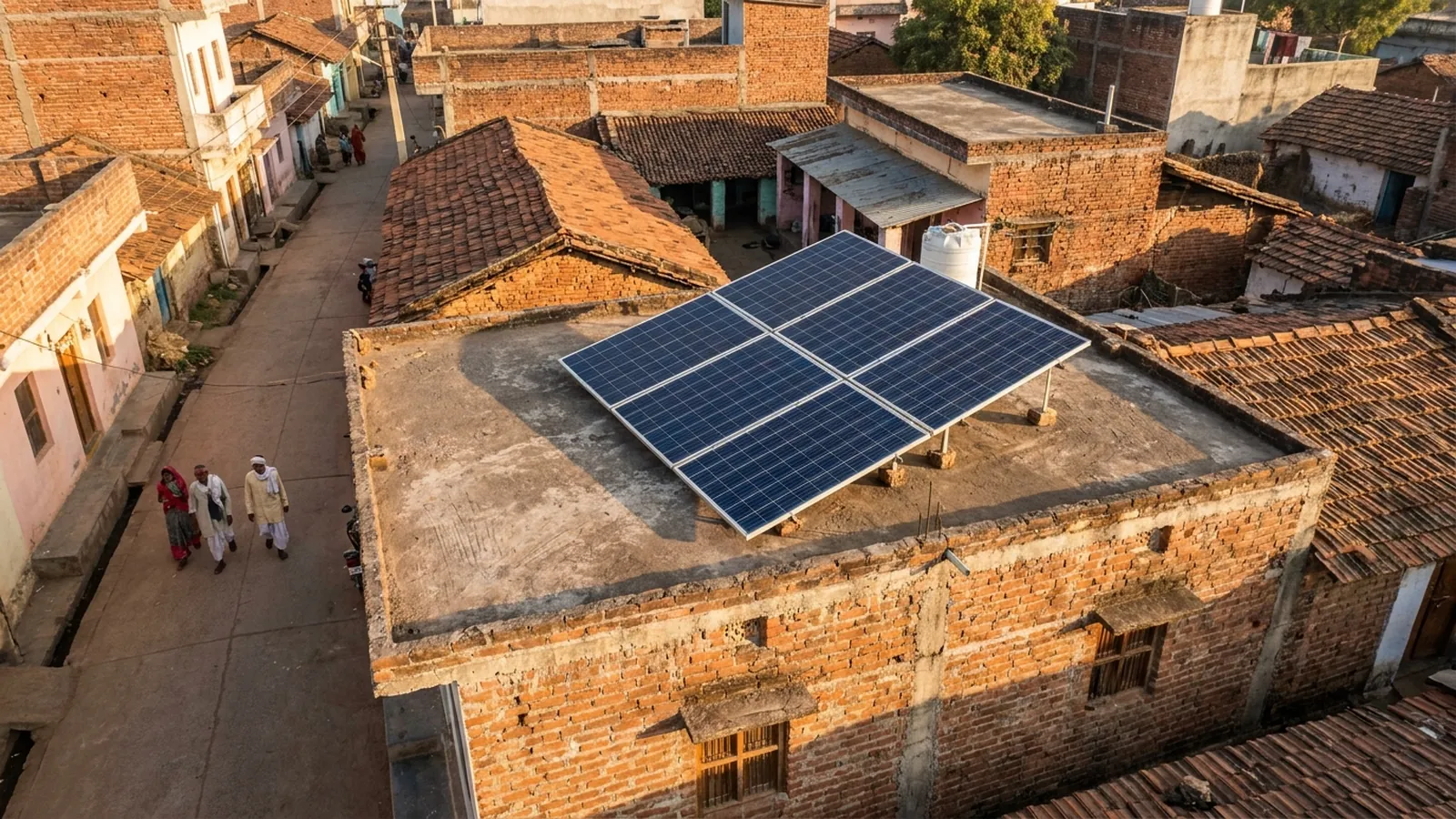
The 2 kW solar system is India's entry point for meaningful grid-connected solar, the smallest size that makes financial and technical sense for a home on the national net metering framework. If your monthly electricity bill sits between ₹1,000 and ₹2,500, a 2 kW system will cover most of it. If your bill is consistently above ₹2,500, size up to 3 kW. The additional ₹18,000 subsidy and 50% more generation makes it the financially superior choice. This guide lays out the exact 2 kW numbers: cost components, generation by state, the subsidy math, the loan EMI, and realistic payback.
Who actually needs a 2 kW solar system?
The 2 kW size suits a specific home profile. In r-solar's experience across 1,500+ MP installations, customers who benefit most from 2 kW are:
- 1-2 BHK apartments and small homes: a 2 kW system generates 240-280 units/month, which typically covers 80-100% of consumption for homes with two ceiling fans, lighting, a refrigerator, a TV, and occasional use of one inverter AC
- Homes with bills of ₹1,000-₹2,500/month: below ₹1,000, the economics are marginal; above ₹2,500, a 3 kW system delivers better rupee-per-rupee subsidy value
- Apartment and flat residents with limited rooftop quota: DISCOMs in MP allocate rooftop solar quota per flat, and some housing societies restrict individual units to 1-2 kW regardless of consumption
- Homes where only 130-150 sq ft of unshaded south-facing roof is available: four 540W panels fit in this footprint; a 3 kW system needs 200-220 sq ft
The decision is less about the system and more about your bill. If your bill is below ₹2,000, 2 kW is right. If it's above ₹2,500, 3 kW is almost certainly the better investment. See the comparison section at the bottom of this guide.
2 kW solar system cost breakdown (2026)
A turnkey 2 kW residential solar installation in India costs ₹1.10-₹1.30 lakh in 2026, with the median around ₹1.20 lakh. This is the all-in price: hardware, installation, electrical work, net metering filing. Here is what makes up that cost:
| Component | Cost | % of total |
|---|---|---|
| 4× ALMM-approved monocrystalline solar panels (540-550W each) | ₹58,000-₹66,000 | ~52% |
| 2 kW string inverter (Microtek / Sungrow / Growatt / Sofar) | ₹14,000-₹18,000 | ~13% |
| Galvanised steel mounting structure (HDG) | ₹10,000-₹13,000 | ~10% |
| AC + DC cabling, conduits, junction boxes | ₹6,000-₹9,000 | ~6% |
| Earthing kit, MCBs, SPDs, DCDB/ACDB | ₹4,000-₹6,000 | ~4% |
| Civil work (mounting base, cable trays, weatherproofing) | ₹4,000-₹6,000 | ~4% |
| Net metering application + DISCOM coordination | ₹3,000-₹5,000 | ~3% |
| Installation labour, commissioning, monitoring setup | ₹11,000-₹17,000 | ~12% |
| Total turnkey installed cost | ₹1.10-₹1.30 lakh | 100% |
What your r-solar price actually buys
A cheap quote prices the panels and stops there. The hardware lands on your roof and the rest becomes your problem: finding an electrician, filing the DISCOM net metering application, registering on the PM Surya Ghar portal, and chasing the ₹78,000 subsidy yourself for months.
An r-solar price is for the finished job, not a box of parts. It covers:
- System design sized to your bill, roof and sanctioned load
- ALMM-approved panels, inverter and mounting structure
- Professional installation and electrical safety compliance
- DISCOM net metering application and integration
- The full PM Surya Ghar subsidy filing, followed through until the ₹78,000 reaches your bank account
- One team accountable from your first call to a commissioned, subsidy-credited system
Quotes that look cheaper skip this work and leave you to install, file and chase the subsidy on your own.
For a complete component-by-component guide across all system sizes (1-10 kW), see our solar panel installation cost in India 2026 deep-dive. For MP-specific pricing context, see solar panel cost in Madhya Pradesh.
How much electricity does a 2 kW system generate?
A 2 kW solar system in India generates approximately 240-280 units (kWh) per month, or roughly 8-10 units per day, averaged across the full year. Daily generation varies with cloud cover and panel orientation, but the annual total is predictable.
State-by-state generation (annual, south-facing, optimally tilted, regularly cleaned):
| State | Daily avg (units) | Monthly (units) | Annual (kWh) |
|---|---|---|---|
| Rajasthan, Gujarat | 9-10 | 270-300 | 3,200-3,650 |
| Madhya Pradesh, Maharashtra, Karnataka, Andhra Pradesh, Telangana | 8.5-9.5 | 255-285 | 3,100-3,450 |
| Tamil Nadu, Punjab, Haryana, Uttar Pradesh | 7.5-8.5 | 225-255 | 2,730-3,100 |
| Bihar, Odisha, West Bengal | 6.5-7.5 | 195-225 | 2,370-2,730 |
| Northeast states, Coastal Kerala | 5.5-6.5 | 165-195 | 2,000-2,370 |
These are real-world numbers from grid-connected systems, accounting for typical dust losses and inverter efficiency. Generation drops 15-25% if panels are not cleaned regularly during the dry season; see our 25-rooftop cleaning study for field data on actual loss rates. Net metering handles the mismatch between daytime generation and evening consumption: your meter spins backwards during the day, forward at night, settled monthly.
The ₹60,000 subsidy math for 2 kW specifically
Here is exactly how the PM Surya Ghar subsidy is calculated for a 2 kW system:
- First kW: ₹30,000 subsidy
- Second kW: ₹30,000 subsidy (₹60,000 total)
- Above 2 kW: rate drops to ₹18,000/kW until the 3 kW cap
For a typical 2 kW system at ₹1.20 lakh turnkey, the ₹60,000 subsidy covers exactly 50%, which is actually a higher subsidy percentage than the 3 kW system (~41%). The subsidy is credited directly to your bank account 30-45 days after DISCOM inspection and commissioning.
For the complete subsidy process (eligibility, documents, application steps, rejection reasons), see PM Surya Ghar subsidy guide 2026.
2 kW solar system EMI with bank loan
The PM Surya Ghar scheme partners with public-sector banks to offer collateral-free solar loans up to ₹2 lakh at concessional rates. For a 2 kW system, here is the financing math:
| Turnkey installed cost (2 kW) | ₹1,20,000 |
| Loan amount (90% of cost) | ₹1,08,000 |
| SBI rate (loans up to ₹2 lakh) | 5.75% p.a. |
| Tenure | 10 years |
| EMI before subsidy credit | ~₹1,186 / month |
| Subsidy credited (month 2), part-paid to principal | – ₹60,000 |
| Remaining principal | ₹48,000 |
| EMI after subsidy part-payment | ~₹527 / month |
Compare ~₹527/month EMI to the residential electricity bill that a 2 kW system replaces (typically ₹1,200-₹1,800 per month). The system is net cash-positive by ₹670-₹1,270 per month from quarter one. Canara Bank, Bank of Baroda, PNB and Indian Bank also list 5.75% for loans up to ₹2 lakh (September 2026). See our complete PM Surya Ghar bank loan list for full comparison.
Payback period and 25-year savings for 2 kW
For a 2 kW system in India, the realistic payback period is 4-6 years under CAPEX with subsidy. Here is the calculation:
- Net cost after subsidy: ~₹60,000
- Annual electricity bill savings: ~₹14,400-₹21,600 (at ₹5-₹7/unit × 240-280 units/month × 12 months)
- Payback on net cost: 3-4 years at ₹7/unit; 4-5 years at ₹5/unit
- Payback on gross cost (if you skip subsidy and pay cash): 6-9 years
After payback, your 2 kW system produces effectively free electricity for the remaining 20-21 years of the 25-year panel warranty period. Total 25-year savings: roughly ₹3-4 lakh, depending on grid tariff inflation. With MP's residential tariff rising approximately 4% annually over the last decade, the static model understates actual savings.
2 kW system components explained
A typical 2 kW residential rooftop system in India 2026 consists of:
- 4 solar panels, 540-550W each, monocrystalline PERC, ALMM List-I approved (Waaree, Adani Solar, Tata Power Solar, Vikram Solar, Premier Energies, or similar). For the subsidy the panels must also be DCR (made with Indian cells); ALMM List-II for cells becomes mandatory for net-metered systems commissioned after December 31, 2026. Panel warranty: 25-year linear power output, 10-12 year product warranty.
- 1 string inverter, 2 kW capacity, MPPT-based (typically Microtek, Sungrow, Growatt, or Sofar). A 2 kW inverter is the smallest size that runs comfortably on 4 high-wattage panels in a single string. Inverter warranty: 5-10 years.
- Galvanised steel mounting structure, HDG-coated, designed for 25+ year roof life. A 2 kW structure fits in a single row of 4 panels, simpler civil work than larger systems with multiple rows.
- AC and DC cabling, conduits, MCBs, SPDs (surge protection), DCDB and ACDB junction boxes, all per IS standards.
- Earthing kit: chemical earthing or copper-plate, depending on local soil.
- Net meter: installed and configured by your DISCOM after the installation passes inspection. Measures both import and export, settled monthly.
- Software monitoring: most quality installers include a mobile app or web dashboard showing real-time and historical generation data. At 2 kW the generation is modest; monitoring helps spot fault conditions quickly.
For the panel-specific buyer's guide and brand comparison, see best solar panels in India 2026. For installer selection criteria, see how to choose a solar installer in MP.
2 kW vs 3 kW: side-by-side comparison
This is the question we get most often: is 2 kW enough, or should I go to 3 kW? The extra ₹71,000 in upfront cost (and ₹18,000 more subsidy) changes the economics significantly.
| Factor | 2 kW | 3 kW |
|---|---|---|
| Installed cost | ₹1.20 lakh | ₹1.91 lakh |
| PM Surya Ghar subsidy | ₹60,000 | ₹78,000 |
| Net cost after subsidy | ₹60,000 | ₹1,13,000 |
| Subsidy as % of cost | 50% | ~41% |
| Monthly generation (India avg) | 240-280 units | 360-400 units |
| Panels required | 4 × 540W | 6 × 540W |
| Roof area required | 130-150 sq ft | 200-220 sq ft |
| EMI after subsidy (SBI 5.75%, 10yr) | ~₹527/month | ~₹1,032/month |
| Suitable monthly bill range | ₹1,000-₹2,500 | ₹2,000-₹4,000 |
| r-solar's recommendation | If bill < ₹2,000 → 2 kW. If bill > ₹2,500 → 3 kW. If between → 3 kW (subsidy gap is small, generation gap is large). | |
The incremental cost of going from 2 kW to 3 kW is roughly ₹71,000 before subsidy, or ₹53,000 net after the extra ₹18,000 subsidy. For ₹53,000 extra, you get 50% more generation (120-150 more units/month, worth ₹720-₹1,050/month at ₹6/unit). That extra ₹53,000 investment pays back in 4-6 years. For most households, the maths point to 3 kW unless there is a genuine roof space constraint. See our 1 kW solar system guide, 3 kW guide, and 5 kW guide for other size classes.
Ready to go solar? r-solar installs from 3 kW upward.
See our 3 kW systemOr run the numbers yourself first: use our solar savings calculator.
Frequently asked questions
What is the price of a 2 kW solar system in India 2026?
A 2 kW residential rooftop solar system in India costs approximately ₹1.10-₹1.30 lakh fully installed (turnkey), or roughly ₹55,000-₹60,000 per kW. After the PM Surya Ghar central subsidy of ₹60,000, your net out-of-pocket cost drops to approximately ₹50,000-₹70,000. The 2 kW size suits homes with monthly electricity bills between ₹1,000 and ₹2,500, typically 1-2 BHK apartments or small homes with limited AC usage.
How much electricity does a 2 kW solar system generate in India?
A 2 kW rooftop solar system in India generates approximately 240-280 units (kWh) of electricity per month, or roughly 8-10 units per day averaged across the year. Generation varies by state: Rajasthan and Gujarat see 9-10 units/day; Madhya Pradesh, Maharashtra, and Karnataka see 8.5-9.5 units/day; Northeast and coastal states see 5.5-6.5 units/day. Annual generation averages 2,730-3,450 kWh for a 2 kW system in most of India.
How many solar panels are needed for a 2 kW system?
A 2 kW system uses 4 panels of 540-550W each, the standard ALMM-approved residential panel size in 2026. Rooftop space required is approximately 130-150 sq ft, oriented south for maximum generation. Four panels fit in a single row, making the mounting structure compact and civil work relatively simple compared to larger multi-row systems.
What is the PM Surya Ghar subsidy for a 2 kW solar system?
The PM Surya Ghar Muft Bijli Yojana subsidy for a 2 kW residential rooftop solar system is ₹60,000 (₹30,000 per kW for both kilowatts). On a ₹1.20 lakh system, this covers 50% of the installed cost, actually a higher percentage than the 3 kW subsidy (~41%). The subsidy is credited directly to your bank account 30-45 days after DISCOM inspection and commissioning.
What is the EMI for a 2 kW solar system with a bank loan?
With SBI's PM Surya Ghar solar loan at 5.75% per annum over a 10-year tenure, the EMI for a 2 kW system financed at 90% (₹1.08 lakh loan) is approximately ₹1,186 per month before subsidy. After the ₹60,000 subsidy is credited and part-paid to the principal, the remaining balance drops to ₹48,000 and the EMI falls to approximately ₹527 per month, less than most electricity bills the system replaces.
Is 2 kW enough for a 3 BHK home in India?
For a 3 BHK home, 2 kW usually covers 60-80% of electricity consumption, enough to significantly cut the bill but unlikely to eliminate it entirely. A 3 kW system is better suited for a 3 BHK home with one or two ACs. r-solar's recommendation: if your monthly average bill exceeds ₹2,000, size up to 3 kW. The extra ₹53,000 in net cost (after additional ₹18,000 subsidy) pays back in 4-6 years from the additional generation.

About the author
r-solar Editorial Team
r-solar installs and maintains rooftop solar across Madhya Pradesh: residential PM Surya Ghar systems, commercial OPEX/PPA, and RESCO at industrial scale, with software-monitored generation tracking from day one.
Ready to go solar? r-solar installs from 3 kW upward. See our 3 kW system.
Explore the 3 kW system