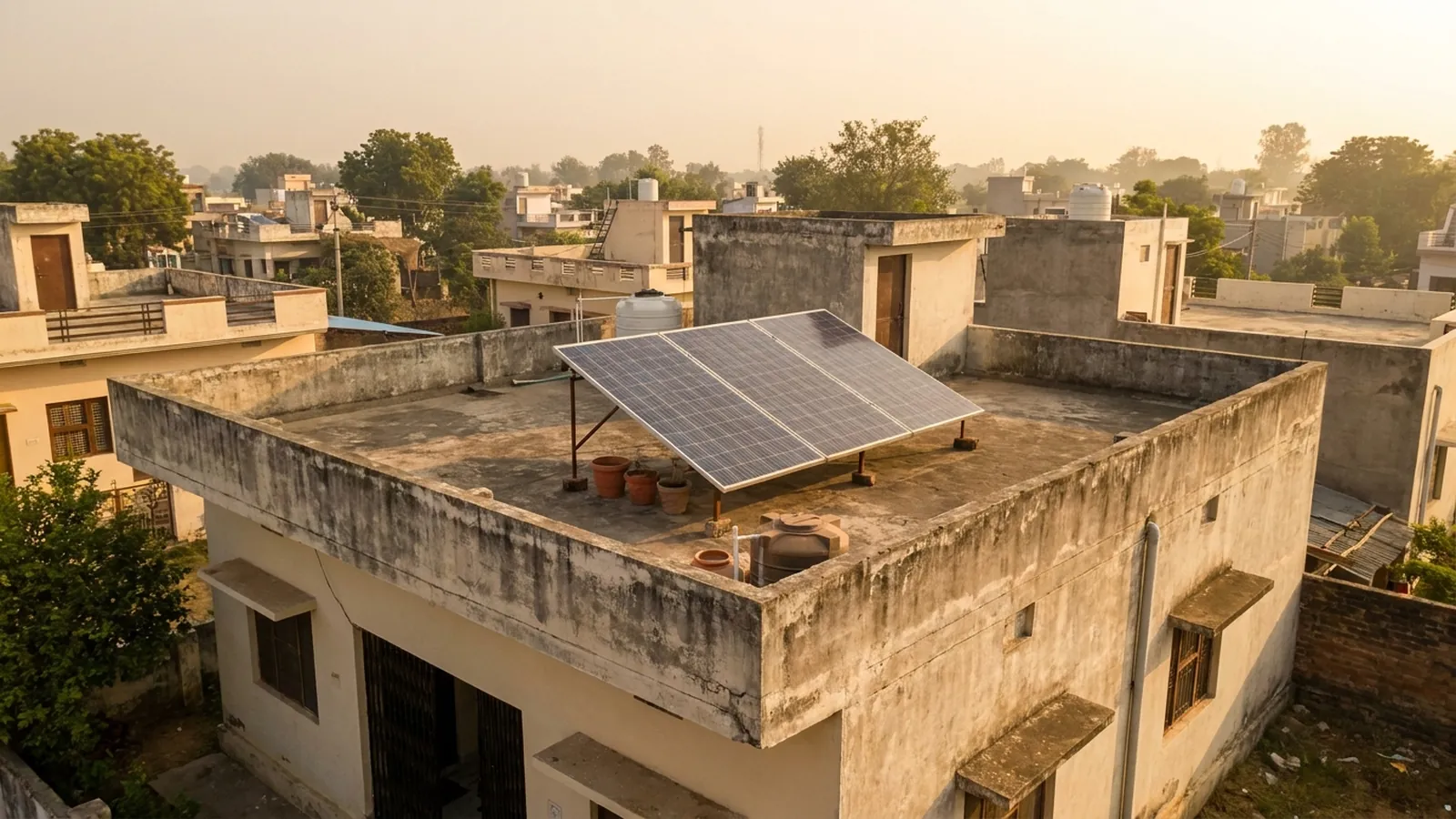
The 1 kW solar system is the entry point to grid-connected net-metered solar in India. It is the smallest practical size for a standard string inverter setup. Below 1 kW, you are in micro-inverter or off-grid territory with different economics. A 1 kW system makes financial sense in specific situations: very small homes with bills below ₹800/month, or homes where roof space is genuinely limited to under 80 sq ft. For most Indian households with bills above ₹1,000/month and even modest roof space, the 2 kW system is almost always the smarter choice, and we will show you the exact numbers why.
Who actually needs a 1 kW solar system?
In r-solar's experience across 1,500+ MP installations, customers who genuinely benefit from 1 kW are a specific group:
- Very small homes with bills consistently below ₹800/month: a 1 kW system generates 120-145 units/month, which covers fans, lighting, a small refrigerator and TV, but not an AC. If your consumption is this modest, 1 kW is well-matched.
- Apartment flats with less than 80 sq ft of unshaded south-facing roof: some DISCOMs and housing societies cap individual flat allocations at 1 kW. Two panels fit in roughly 65-75 sq ft, a genuinely constrained footprint.
- Small shops and commercial establishments with day-only loads: a petty shop or medical clinic that runs on fans, lighting, and a single computer during daytime hours is a good 1 kW candidate.
- Second homes and seasonal properties: a holiday home or farm building that sees intermittent use and occasional lighting loads does not need a 2-3 kW system.
1 kW solar system cost breakdown (2026)
A turnkey 1 kW residential solar installation in India costs ₹55,000-₹70,000 in 2026, with the median around ₹62,000. This is the all-in price: panels, inverter, mounting structure, cabling, and net metering filing. One important note: the per-kW cost for a 1 kW system is 10-20% higher than for 2-3 kW systems. Fixed costs like the inverter and installation labour are roughly the same regardless of size.
| Component | Cost | % of total |
|---|---|---|
| 2× ALMM-approved monocrystalline solar panels (500-550W each) | ₹28,000-₹34,000 | ~50% |
| 1 kW string inverter (Microtek / Sungrow / Growatt / Sofar) | ₹10,000-₹14,000 | ~19% |
| Galvanised steel mounting structure (HDG) | ₹5,000-₹7,000 | ~9% |
| AC + DC cabling, conduits, junction boxes | ₹4,000-₹6,000 | ~8% |
| Earthing kit, MCBs, SPDs, DCDB/ACDB | ₹3,000-₹5,000 | ~6% |
| Net metering application + DISCOM coordination | ₹3,000-₹5,000 | ~6% |
| Installation labour, commissioning, monitoring setup | ₹2,000-₹4,000 | ~4% |
| Total turnkey installed cost | ₹55,000-₹70,000 | 100% |
What your r-solar price actually buys
A cheap quote prices the panels and stops there. The hardware lands on your roof and the rest becomes your problem: finding an electrician, filing the DISCOM net metering application, registering on the PM Surya Ghar portal, and chasing the ₹78,000 subsidy yourself for months.
An r-solar price is for the finished job, not a box of parts. It covers:
- System design sized to your bill, roof and sanctioned load
- ALMM-approved panels, inverter and mounting structure
- Professional installation and electrical safety compliance
- DISCOM net metering application and integration
- The full PM Surya Ghar subsidy filing, followed through until the ₹78,000 reaches your bank account
- One team accountable from your first call to a commissioned, subsidy-credited system
Quotes that look cheaper skip this work and leave you to install, file and chase the subsidy on your own.
Notice that the net metering application fee (₹3,000-₹5,000) is identical whether you install 1 kW or 5 kW. It is a fixed cost that becomes proportionally heavier at smaller system sizes. The same applies to inverter setup and commissioning. This is why the per-kW economics of a 1 kW system are weaker than larger systems.
For a full component-by-component guide across all sizes, see our solar panel installation cost in India 2026 deep-dive.
How much electricity does a 1 kW system generate?
A 1 kW solar system in India generates approximately 120-145 units (kWh) per month, or roughly 4-5 units per day, averaged across the full year. This is enough to run two ceiling fans, LED lighting in 3-4 rooms, a small refrigerator, and a TV, but not an air conditioner running more than 1-2 hours per day.
| State / Region | Daily avg (units) | Monthly (units) | Annual (kWh) |
|---|---|---|---|
| Rajasthan, Gujarat | 4.8-5.5 | 144-165 | 1,750-2,000 |
| Madhya Pradesh, Maharashtra, Karnataka, Andhra Pradesh | 4.2-5.0 | 126-150 | 1,530-1,825 |
| Tamil Nadu, Punjab, Haryana, Uttar Pradesh | 3.8-4.5 | 114-135 | 1,390-1,640 |
| Bihar, Odisha, West Bengal | 3.2-3.8 | 96-114 | 1,170-1,390 |
| Northeast states, Coastal Kerala | 2.7-3.2 | 81-96 | 990-1,170 |
In Madhya Pradesh specifically, a 1 kW system generates approximately 130-135 units per month at 5.2-5.5 peak sun hours. At MPPKVVCL's domestic tariff of ₹5.90-₹6.15/unit, that is a monthly saving of roughly ₹770-₹830, which sets the payback clock for this system size. For net metering details in MP, see our MP net metering guide 2026.
The ₹30,000 subsidy math for 1 kW specifically
Here is exactly how the PM Surya Ghar subsidy calculates for a 1 kW system:
- First kW: ₹30,000 subsidy, the same ₹30,000/kW rate that applies to the second kW
- Total subsidy for 1 kW: ₹30,000
On a typical ₹62,000 system, the ₹30,000 subsidy covers 48% of the installed cost, nearly identical to the 2 kW subsidy percentage (50%). The absolute rupee amount is lower, but the proportional benefit is comparable. The subsidy is credited directly to your bank account 30-45 days after DISCOM inspection and commissioning.
For the complete subsidy process, including eligibility criteria, documents, application steps, and what to do if your application is rejected, see our PM Surya Ghar subsidy guide 2026.
1 kW solar system EMI with bank loan
The PM Surya Ghar scheme partners with public-sector banks for collateral-free solar loans up to ₹2 lakh. For a 1 kW system at SBI's 5.75% rate (loans up to ₹2 lakh) over 10 years:
| Turnkey installed cost (1 kW) | ₹62,000 |
| Loan amount (90% of cost) | ₹55,800 |
| SBI rate (loans up to ₹2 lakh) | 5.75% p.a. |
| Tenure | 10 years |
| EMI before subsidy credit | ~₹612 / month |
| Subsidy credited, part-paid to principal | – ₹30,000 |
| Remaining principal | ~₹25,800 |
| EMI after subsidy part-payment | ~₹283 / month |
A ₹283/month EMI against monthly electricity savings of ₹770-₹830 (at MP domestic tariffs) leaves roughly ₹490-₹550 of monthly benefit, meaning the system is cash-positive from year one. For a full bank rate comparison, see our PM Surya Ghar bank loan list 2026. Canara Bank, Bank of Baroda, PNB and Indian Bank also list 5.75% for loans up to ₹2 lakh (September 2026).
The honest take: is 1 kW the right size for you?
When a customer in Barwani or Indore calls us about a 1 kW system, our first question is: "What is your average monthly electricity bill?" If the answer is above ₹1,200, we will typically recommend 2 kW instead. Here is the reasoning from our field experience.
Whichever size you land on, the installer matters more than the panel brand. Our guide to choosing a solar installer in MP is the due-diligence checklist we would want a customer to hold us to.
A 1 kW system in MP generates ~130 units/month. At ₹6/unit, that is ₹780/month in savings. The net cost after subsidy is around ₹32,000. Payback: about 41 months, just over 3 years. Sound fine? Compare to 2 kW: net cost after subsidy is ~₹60,000, savings ~₹1,560/month, payback ~38 months. The 2 kW system pays back faster and generates twice the electricity for roughly double the net cost.
The scenario where 1 kW wins: if your bill is ₹600-₹800/month and your consumption matches a 1 kW system almost exactly, you avoid over-investment. One of our Barwani customers, a retired government teacher with a 1 BHK, one fan, and minimal AC usage, installed 1 kW in 2024 and covers 90% of his bill with it. For him, 2 kW would have been over-sized and the surplus generation wasted.
1 kW system components explained
- 2 solar panels, 500-550W each, monocrystalline PERC, ALMM List-I approved. For the subsidy the panels must also be DCR (made with Indian cells); ALMM List-II for cells becomes mandatory for net-metered systems commissioned after December 31, 2026. Panel warranty: 25-year linear power output, 10-12 year product warranty. Two panels is the minimum for a practical south-facing residential array.
- 1 string inverter, 1 kW capacity, MPPT-based. The inverter for 1 kW is essentially the same size class as a 2 kW inverter in many product lines. This is one reason the per-kW cost is higher at 1 kW than 2 kW.
- Galvanised steel mounting structure, HDG-coated, single row of 2 panels. Fits on a very small roof section, as little as 65 sq ft of clear south-facing surface.
- AC and DC cabling, conduits, MCBs, SPDs, DCDB/ACDB junction boxes, identical bill of materials to a 2 kW system in cabling type, just shorter cable runs.
- Earthing kit: standard chemical earthing or copper-plate, depending on local soil.
- Net meter: installed and configured by your DISCOM after inspection. The net metering application process, paperwork, and DISCOM approval timeline is identical for 1 kW and 5 kW, another reason the per-kW administrative overhead is proportionally heavier at 1 kW.
For guidance on which panel brands to choose and how to verify ALMM certification, see best solar panels in India 2026.
1 kW vs 2 kW: the direct comparison
This comparison answers the question we hear every week: should I do 1 kW or spend a bit more for 2 kW?
| Factor | 1 kW | 2 kW |
|---|---|---|
| Installed cost (median) | ₹62,000 | ₹1.20 lakh |
| PM Surya Ghar subsidy | ₹30,000 | ₹60,000 |
| Net cost after subsidy | ₹32,000 | ₹60,000 |
| Subsidy as % of installed cost | 48% | 50% |
| Per-kW installed cost | ₹62,000/kW | ₹60,000/kW |
| Monthly generation (MP, 5.3 sun hrs) | ~130 units | ~260 units |
| Monthly bill savings (at ₹6/unit) | ~₹780 | ~₹1,560 |
| Panels required | 2 × 540W | 4 × 540W |
| Roof area required | 65-75 sq ft | 130-150 sq ft |
| EMI after subsidy (SBI 5.75%, 10yr) | ~₹283/month | ~₹527/month |
| Payback (net cost ÷ monthly savings) | ~41 months | ~38 months |
| r-solar recommendation | Choose 1 kW only if roof space < 80 sq ft or bill < ₹800/month. For all other households, 2 kW is better economics. | |
The extra ₹28,000 in net cost (₹60,000 vs ₹32,000) buys 100% more generation. In MP, that extra generation saves an additional ₹780/month, paying back the incremental ₹28,000 in about 36 months. The 2 kW upgrade case writes itself. For larger system sizes, see our 3 kW and 5 kW solar system guides.
Ready to go solar? r-solar installs from 3 kW upward.
See our 3 kW systemOr calculate the numbers yourself: use our solar savings calculator.
Get a free quote for your home solar
Tell us your details. r-solar designs, installs and handles your subsidy. Free callback within 2 hours (10 AM–7 PM IST).
Frequently asked questions
What is the price of a 1 kW solar system in India 2026?
A 1 kW residential rooftop solar system in India costs approximately ₹55,000-₹70,000 fully installed (turnkey) in 2026. The median is around ₹62,000. After the PM Surya Ghar central subsidy of ₹30,000, your net cost drops to approximately ₹25,000-₹40,000. Note that the per-kW installed cost is 10-20% higher than for 2-3 kW systems, because inverter, installation, and net metering costs are fixed regardless of system size.
How many units does a 1 kW solar panel produce per day in India?
A 1 kW solar system produces approximately 4-5 units (kWh) of electricity per day on average across the year, or 120-145 units per month. Daily generation ranges from 2.7-3.2 units/day in cloud-prone regions to 4.8-5.5 units/day in Rajasthan and Gujarat. In Madhya Pradesh, a 1 kW system generates approximately 130-135 units per month at 5.2-5.5 peak sun hours per day.
How many solar panels are needed for a 1 kW system?
A 1 kW system uses 2 panels of 500-550W each, the standard ALMM-approved residential panel size in 2026. Rooftop space required is approximately 65-75 sq ft, oriented south for maximum generation. This is the minimum practical grid-connected net-metered setup in India. Below 1 kW, micro-inverters or off-grid configurations are needed.
What is the PM Surya Ghar subsidy for a 1 kW solar system?
The PM Surya Ghar Muft Bijli Yojana subsidy for a 1 kW system is ₹30,000 (₹30,000/kW for the first kilowatt). On a ₹62,000 system, this covers approximately 48% of installed cost. The subsidy is credited directly to your bank account 30-45 days after DISCOM inspection and commissioning. Tip: the second kW attracts the same ₹30,000 subsidy rate, making a 2 kW system nearly twice as subsidy-efficient in absolute terms.
Is a 1 kW solar system worth it in India?
A 1 kW system is financially viable but not optimal for most Indian homes. r-solar's recommendation: choose 1 kW only when roof space is genuinely under 80 sq ft, or when your monthly bill is consistently below ₹800. For homes with bills above ₹1,000/month, a 2 kW system delivers better economics. The extra ₹28,000 in net cost (after the additional ₹30,000 subsidy) buys 100% more generation and pays back in under 3 years from the extra savings.
What is the EMI for a 1 kW solar system with a bank loan?
With SBI's PM Surya Ghar solar loan at 5.75% per annum over 10 years, the EMI for a 1 kW system financed at 90% (₹55,800 loan on a ₹62,000 system) is approximately ₹612 per month before subsidy. After the ₹30,000 subsidy is credited and part-paid to the principal, the remaining balance drops to ~₹25,800 and the EMI falls to approximately ₹283 per month, typically less than the electricity bill it partially offsets.

About the author
r-solar Editorial Team
r-solar installs and maintains rooftop solar across Madhya Pradesh: residential PM Surya Ghar systems, commercial OPEX/PPA, and RESCO at industrial scale, with software-monitored generation tracking from day one.
Ready to go solar? r-solar installs from 3 kW upward. See our 3 kW system.
Explore the 3 kW system