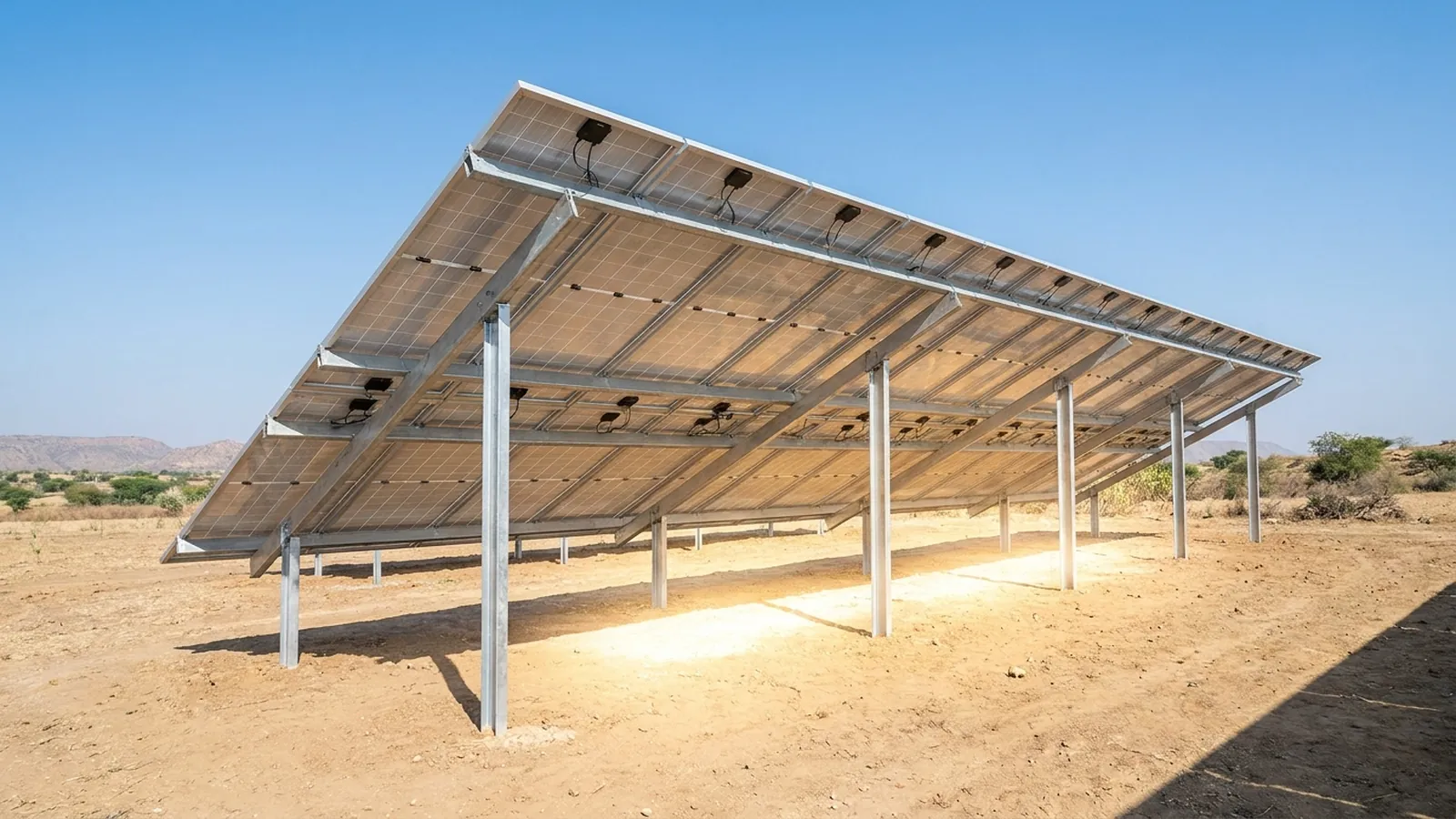
"Bifacial" is one of the most over-sold terms in solar. A panel that makes power from both sides sounds like an obvious upgrade, and on the right installation it genuinely is. But the extra generation comes entirely from sunlight reflected onto the rear of the panel, which means a bifacial panel is only as good as the surface and structure behind it. Get those right and you can add 15–25% more output for very little extra cost. Get them wrong, for example by laying a bifacial panel flat on a dark rooftop, and you've paid for a feature you can barely use. This guide gives you the honest decision framework for Indian conditions.
What are bifacial solar panels? (plain English)
Short answer: bifacial solar panels are modules that generate power from both faces, front and rear, so they capture light reflected off the surface beneath them as well as direct sunlight. In Indian conditions that rear-side contribution is worth anywhere from 5% to 30%, and which end of that range you land on is decided almost entirely by how the panel is mounted, not by the panel itself.
A conventional monofacial panel has a glass front and an opaque plastic backsheet. It only makes power from the front. A bifacial panel replaces that backsheet with a second sheet of glass (or a transparent backsheet), so light can reach the solar cells from behind too. The front works exactly like a normal panel; the rear harvests whatever sunlight bounces up off the ground or surface beneath it.
The key spec is the bifaciality factor, usually 70–90%, which tells you how efficient the rear is compared to the front. A 80% bifaciality factor means the back side is 80% as good as the front at converting the light it receives. The catch is in those last five words: the rear only produces if reflected light actually reaches it. That reflected fraction is called albedo, and it is the single biggest variable in whether bifacial is worth it. For the wider panel landscape, mono PERC, TOPCon, and how bifacial fits in, see our best solar panels in India buyer's guide.
The real bifacial gain: 5% to 30%, and why it varies so much
Manufacturers love to quote "up to 30% more energy." That number is real, but it's a best case that needs a specific setup. The actual bifacial gain you'll see depends on three things, none of which is the panel itself:
| Factor | Low gain (~5%) | High gain (~25–30%) |
|---|---|---|
| Surface below (albedo) | Dark soil, normal rooftop | White gravel, concrete, sand, snow |
| Mounting height and tilt | Flush / low to surface | Elevated, tilted ground-mount |
| Row spacing and shading | Tightly packed, rear shaded | Wide spacing, open rear |
| Typical setting | Flush home rooftop | Ground-mount / carport |
In other words: bifacial gain is an installation property, not a panel property. The same panel that adds 25% on an elevated ground-mount over white gravel might add only 3% lying flush on a dark terrace. This is the fact that decides everything below.
Bifacial on a typical home rooftop: the honest numbers
Most Indian residential rooftop systems are mounted close to the roof surface, sometimes only 10–15 cm of standoff, on a flat terrace finished in dark grey concrete or weatherproofing. That is close to the worst case for bifacial: the rear of the panel faces a low-albedo surface only a few inches away, and much of the rear is in its own shadow.
On that kind of setup, the realistic bifacial gain is around 2–7%. If a bifacial panel costs the same as a monofacial one (which is increasingly true, see below), that small gain is free upside and worth taking. But if you are being asked to pay a meaningful premium specifically for bifaciality on a flush home roof, the math rarely works. You'd usually get more output per rupee from a slightly larger array or a better inverter. Run the numbers for your own bill with our solar savings calculator, and see our 3 kW system guide for the most common residential configuration.
What bifacial panels cost in India in 2026
Here's the good news that reframes the whole decision: in 2026, bifacial dual-glass panels carry only a small premium, often 3–8%, sometimes nothing, because dual-glass TOPCon has become a mainstream, high-volume product from Indian manufacturers, one visible result of India's solar manufacturing boom. The panel itself is rarely the expensive part of going bifacial.
The real cost of capturing bifacial gain is the structure. To get the 15–25% upside you need an elevated, tilted mount with an open, reflective surface behind it: a ground-mount, a solar carport, or a flat commercial roof finished with a reflective membrane. Those structures cost far more than a simple flush rooftop frame. So the honest cost question isn't "how much is a bifacial panel". It's "does my installation let me capture enough rear-side generation to justify the structure?" For the full size-by-size system pricing, see our solar panel installation cost guide.
The underrated advantage: durability
Even where the energy gain is modest, bifacial dual-glass panels bring a real, often-overlooked benefit: they're more durable than glass-backsheet monofacial panels. Glass doesn't degrade, yellow, or delaminate the way plastic backsheets can in India's UV, heat, and humidity. Dual-glass modules also resist potential-induced degradation (PID) better, handle higher mechanical loads, and are less flammable. That's why manufacturers frequently back dual-glass bifacial panels with a longer 30-year performance warranty versus 25 years for glass-backsheet panels, and a lower annual degradation rate. For a system you'll own for decades in a hot, dusty climate, that durability can matter as much as the few percent of extra generation.
When bifacial is genuinely worth paying for
Bifacial earns its keep, including a real premium, when the installation can actually use the rear side:
- Ground-mounted systems. Elevated, tilted, with open ground behind, the classic high-gain bifacial case. If you have land, bifacial is close to a default choice.
- Solar carports and elevated structures. The rear sees plenty of reflected light, and the height is built in.
- Commercial flat roofs with a reflective finish. A white membrane or light-coloured roof under a tilted, elevated array can deliver strong bifacial gain, relevant for factories and warehouses. See our commercial and industrial solar options.
- High-albedo locations. Sandy or light-coloured ground naturally reflects more.
And as with every panel, the gain only counts if the specific model is ALMM List-I so you keep the PM Surya Ghar subsidy. Our ALMM list decoded guide shows how to verify a model in two minutes.
How r-solar thinks about bifacial
Our position, from systems we've designed across Madhya Pradesh: bifacial is excellent technology that is frequently sold for the wrong installation. For a standard residential rooftop in Indore or Bhopal, we'll happily fit a bifacial dual-glass panel when it costs the same as monofacial. You get the durability and a few free percent, but we won't let a customer overpay for rear-side generation a flush roof can't capture. For ground-mounts, carports, and commercial flat roofs, the calculus flips: there, bifacial is often the smarter default, and the extra structure pays for itself in higher lifetime generation.
The thing that actually moves a system's 25-year output the most is rarely the cell technology. It's mounting quality, structure, wiring, earthing, and who is accountable for service over two decades. If a quote you're comparing leans on "bifacial" as the headline selling point, send it to us. We'll tell you, free, whether that specific panel is ALMM-listed and whether your installation can actually capture the bifacial gain you're paying for.
Comparing a bifacial quote? Let us sanity-check it.
Get a free site visitOr estimate your savings first: use our solar savings calculator.
Not sure if bifacial is right for your roof?
Tell us your details. We'll tell you whether your installation can actually capture bifacial gain, and recommend the right ALMM-listed panel, free. Callback within 2 hours (10 AM–7 PM IST).
Frequently asked questions
Bifacial solar panels generate electricity from both faces. The front captures direct sunlight like a normal panel, while the rear captures sunlight that bounces off the surface beneath the panel (the albedo). To let light reach the back, bifacial panels are usually built as dual-glass modules (glass on both sides) instead of glass-front, plastic-backsheet monofacial panels. How much extra they produce is measured by the bifaciality factor, typically 70–90%, meaning the rear is up to 90% as effective as the front, but only for the reflected light it actually receives.
The real-world bifacial gain ranges from about 5% to 30%, and it depends almost entirely on the installation, not the panel. Three things drive it: the reflectivity of the surface below (white gravel, concrete or sand reflect a lot; dark soil or a normal rooftop reflect little), the mounting height and tilt (the panel needs to be elevated and tilted so light can reach the rear), and row spacing. A well-designed ground-mount over white gravel can hit 15–25% extra. A bifacial panel laid flush on a typical rooftop, where the rear faces a dark roof a few inches away, may gain only 2–5%, barely worth the premium.
For most flush-mounted residential rooftops, the bifacial gain is small (2–7%) because the rear of the panel sits close to a dark, low-reflectivity roof, so paying a premium specifically for bifaciality often does not pay back. Where bifacial genuinely shines is ground-mounted systems, elevated structures, solar carports, and commercial flat roofs finished with a reflective white membrane. That said, in 2026 many TOPCon panels are bifacial by default at little or no extra cost, so if you are getting a dual-glass bifacial panel anyway, take it; just don't pay a large premium for bifaciality you can't capture on a flush home roof.
Bifacial dual-glass panels typically carry only a small premium over equivalent monofacial panels in 2026, often 3–8%, and sometimes nothing, because dual-glass TOPCon has become a mainstream product. The bigger cost is the mounting structure needed to actually capture the rear-side gain: an elevated, tilted ground-mount or carport structure costs far more than a simple flush rooftop frame. So the honest cost question is not "how much is a bifacial panel" but "does my installation let me capture enough rear-side generation to justify the structure". On a standard rooftop the answer is usually no; on a ground-mount or carport it is often yes.
Like any panel, eligibility is per model, not per technology. A bifacial panel qualifies for the up-to-₹78,000 PM Surya Ghar subsidy only if that exact model is on MNRE's current ALMM List-I and is DCR (made with Indian cells); ALMM List-II for cells also becomes mandatory for net-metered projects commissioned after December 31, 2026. Many ALMM-listed dual-glass TOPCon modules are bifacial, so subsidy-eligible bifacial panels are widely available from Indian manufacturers, but always confirm the specific model code on the MNRE portal before assuming eligibility. Buying a non-ALMM imported bifacial panel forfeits the subsidy.

About the author
r-solar Editorial Team
r-solar installs and maintains rooftop solar across Madhya Pradesh: residential PM Surya Ghar systems, commercial OPEX/PPA, and RESCO at industrial scale, with software-monitored generation tracking from day one.
Want help choosing the right panel for your roof?
Get your free quote