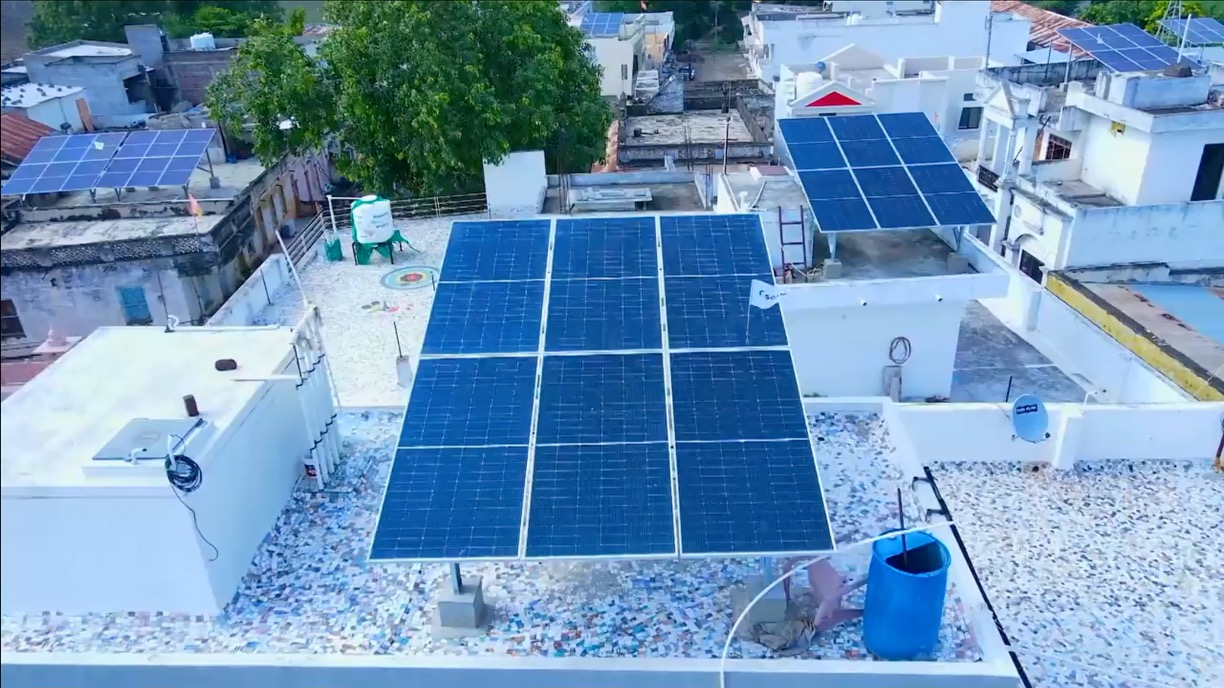
SBI charges 5.75% per annum on PM Surya Ghar rooftop solar loans up to ₹2 lakh and 7.90% from ₹2 lakh to ₹6 lakh (effective December 15, 2025, per SBI), collateral-free up to ₹2 lakh, with tenures up to 120 months. For the most common case in Madhya Pradesh, a 3 kW system costing ₹1.91 lakh, SBI finances 90% of the gross cost, around ₹1,72,000, at an EMI of about ₹1,888 per month over 10 years. Once the ₹78,000 PM Surya Ghar subsidy is credited to your account (usually 30–45 days after commissioning), you can pre-pay it against principal with zero penalty, dropping your EMI to roughly ₹1,032 per month and bringing the net system cost to ₹1,13,000.
SBI solar loan interest rate in 2026
SBI links its PM Surya Ghar solar loan rate to its EBLR (External Benchmark Lending Rate), which follows the RBI repo rate (5.25% as of September 2026). SBI's official loan page lists these terms, effective December 15, 2025 (checked September 14, 2026):
- Rate type: Floating, linked to the RBI repo rate through SBI's EBLR, so your rate moves when the RBI changes the repo rate.
- Loans up to ₹2 lakh: 5.75% per annum (EBLR minus 2.15%), with no minimum CIBIL score
- Loans from ₹2 lakh to ₹6 lakh: 7.90% per annum (EBLR), CIBIL score of 650 or more
- Processing fee: Nil
- Pre-payment penalty: Nil for subsidy-funded pre-payment
Loan amount, eligibility & tenure
| Parameter | SBI PM Surya Ghar Loan (2026) |
|---|---|
| Interest rate | 5.75% p.a. up to ₹2 lakh; 7.90% p.a. from ₹2 lakh to ₹6 lakh (EBLR-linked) |
| Maximum loan amount | ₹6 lakh, with a 10% margin (SBI finances up to 90% of the cost) |
| Collateral-free limit | Up to ₹2 lakh (no collateral needed) |
| Maximum tenure | 120 months, including a 6-month moratorium |
| Processing fee | Nil under PM Surya Ghar scheme |
| Pre-payment penalty | Nil for subsidy-linked pre-payment |
| Minimum CIBIL score | None for loans up to ₹2 lakh; 650 for larger loans |
| Who can apply | Residential homeowners with valid electricity connection in India |
Compare all PM Surya Ghar bank loans and check your EMI
EMI examples for MP homeowners (2026)
These EMI figures use SBI's 5.75% rate for loans up to ₹2 lakh and standard amortisation over 10 years. Try your own numbers in the calculator below.
| System Size | Gross Cost (MP) | PM Surya Ghar Subsidy | SBI loan (90% of gross, up to ₹2 lakh) | EMI, 10 years | Effective tenure after subsidy pre-payment |
|---|---|---|---|---|---|
| 2 kW | ₹1,00,000–₹1,10,000 | ₹60,000 | ~₹90,000–₹99,000 | ~₹990–₹1,090/month (→ ~₹330–₹430 after subsidy) | ~2–3 years after subsidy |
| 3 kW (most common) | ~₹1,91,000 | ₹78,000 | ~₹1,72,000 | ~₹1,888/month (→ ~₹1,032 after subsidy) | ~4–5 years on net cost after subsidy pre-payment |
| 5 kW | ~₹2,76,706 | ₹78,000 (capped) | ~₹2,00,000 (kept at ₹2 lakh for the 5.75% rate) | ~₹2,195/month (→ ~₹1,339 after subsidy) | ~5 years after subsidy pre-payment |
Compare all PM Surya Ghar bank loans and check your EMI
System costs are all-in installed prices in MP including ALMM-approved panels, inverter, mounting, installation, and DISCOM filing. Subsidy is the central government component only. EMIs calculated at 5.75% p.a. on the loan principal shown. See our full solar cost guide for MP for detailed pricing by brand and district.
Solar loan EMI calculator
What your r-solar price actually buys
A cheap quote prices the panels and stops there. The hardware lands on your roof and the rest becomes your problem: finding an electrician, filing the DISCOM net metering application, registering on the PM Surya Ghar portal, and chasing the ₹78,000 subsidy yourself for months.
An r-solar price is for the finished job, not a box of parts. It covers:
- System design sized to your bill, roof and sanctioned load
- ALMM-approved panels, inverter and mounting structure
- Professional installation and electrical safety compliance
- DISCOM net metering application and integration
- The full PM Surya Ghar subsidy filing, followed through until the ₹78,000 reaches your bank account
- One team accountable from your first call to a commissioned, subsidy-credited system
Quotes that look cheaper skip this work and leave you to install, file and chase the subsidy on your own.
Documents required for SBI solar loan
Prepare these before visiting the branch or applying on Jan Samarth. Missing any document is the most common cause of delays.
Identity & address
- Aadhaar card (original + self-attested copy)
- PAN card
- Passport-size photographs (2)
Property proof
- Property registry or khasra-khatoni (for rural MP)
- Municipal property tax receipt (latest)
- Last 3 electricity bills showing your name and address
Income proof
- Salaried: last 3 salary slips + Form 16
- Self-employed/business: ITR for last 2 years
- Last 6 months bank statement
Solar-specific documents
- PM Surya Ghar portal registration number (from pmsuryaghar.gov.in)
- Installer's turnkey quotation (must show ALMM-approved panel make/model)
- DISCOM feasibility letter (if already obtained)
How to apply for SBI PM Surya Ghar solar loan
There are two routes. The Jan Samarth portal route is faster; the branch route is better if you need personal guidance.
Route 1: Jan Samarth Portal (faster)
- Register your system on pmsuryaghar.gov.in. Get your PM Surya Ghar application number.
- Visit jansamarth.in and select "Solar Energy Loan" under the PM Surya Ghar category.
- Select SBI as your preferred lender. The portal auto-populates your PM Surya Ghar data.
- Upload the required documents (scanned copies, 2 MB max each).
- Submit. SBI's system generates a reference number. Approval email/SMS arrives within 7–14 days.
- Visit the nearest SBI branch to complete document verification and collect your sanction letter.
Route 2: SBI branch direct
- Visit the SBI branch nearest to your property (the branch should ideally be in the same district as your DISCOM).
- Ask for the "PM Surya Ghar Loan" form. It is distinct from the general Home Improvement Loan form.
- Submit the document set listed above.
- SBI will conduct a property and income verification (7–21 working days).
- On approval, the disbursement goes directly to your MNRE-registered installer's bank account, not to you.
SBI vs Canara Bank vs Union Bank: quick comparison
| Bank | Rate (2026) | Collateral-Free Limit | Best For |
|---|---|---|---|
| SBI | 5.75% up to ₹2 lakh, 7.90% above (EBLR) | Up to ₹2 lakh | Widest branch network across MP; Jan Samarth portal integration |
| Canara Bank | 5.75% up to ₹2 lakh, 8.75% above (RLLR) | Up to ₹2 lakh | Same 5.75% as SBI up to ₹2 lakh; 6-month repayment holiday |
| Union Bank | 5.75% up to ₹2 lakh, 9.00% to 9.50% above (EBLR) | Up to ₹2 lakh | Transparent floating rate; EMI adjusts automatically with RBI changes |
Compare all PM Surya Ghar bank loans and check your EMI
For borrowers in Madhya Pradesh without a strong bank relationship, SBI is usually the most accessible. For loans up to ₹2 lakh, SBI, Canara Bank, Bank of Baroda, PNB and Indian Bank all list 5.75%, so compare branch access, processing speed, and the rate above ₹2 lakh if you need a larger loan. See the full bank comparison table for all approved lenders with current rates.
Why SBI solar loan applications get rejected
Based on feedback from MP customers who applied before coming to r-solar, these are the most common rejection reasons:
- Installer not MNRE-registered: SBI will not disburse to a non-MNRE installer. Confirm your installer's registration number before applying.
- Non-ALMM panels in the quote: Any panel not on the MNRE ALMM list invalidates the application. Use our ALMM verification guide to check before signing.
- PM Surya Ghar registration missing: You must register on pmsuryaghar.gov.in before the loan application, not after. The registration number is mandatory.
- Electricity bill not in applicant's name: If the bill is in your landlord's or family member's name, you need a NOC from the named holder plus proof of your address.
- Low CIBIL score (below 650): SBI will reject loans above ₹1 lakh for scores below 650. Check your score on CIBIL.com before applying.
Get your SBI solar loan sorted, free
Tell us your details: r-solar handles the SBI loan paperwork and the PM Surya Ghar subsidy. Free callback within 2 hours.
Frequently asked questions
SBI charges 5.75% per annum on PM Surya Ghar rooftop solar loans up to ₹2 lakh (EBLR minus 2.15%) and 7.90% from ₹2 lakh to ₹6 lakh, effective December 15, 2025, according to SBI's official loan page (checked September 14, 2026). The rate is floating and moves with the RBI repo rate. There is no minimum CIBIL score for loans up to ₹2 lakh; larger loans need 650 or more.
Yes, collateral-free up to ₹2 lakh under the PM Surya Ghar scheme. For loans between ₹2 lakh and ₹6 lakh, the solar system is hypothecated (pledged as security). Above ₹6 lakh, standard collateral applies.
Typically 7–21 working days from complete document submission. Jan Samarth portal applications are faster (7–14 days). Branch-level applications can take up to 30 days. Incomplete documents are the most common cause of delays. Prepare the full document set listed above before applying.
Yes, and this is the recommended strategy. The central subsidy (up to ₹78,000) is credited to your bank account 30–45 days after commissioning. SBI allows you to use this as a part-prepayment with zero penalty. For a 3 kW system where your total loan was ~₹1,72,000, the ₹78,000 subsidy pre-payment cuts the outstanding principal to roughly ₹94,000, dropping your EMI to around ₹1,032 per month and materially shortening your effective tenure.
For a 3 kW system in MP (gross ~₹1.91 lakh, subsidy ₹78,000, net ~₹1,13,000): SBI finances 90% of the gross cost = ~₹1,72,000 loan (within the ₹2 lakh collateral-free cap). At 5.75% for 10 years, the EMI is approximately ₹1,888 per month. Once the ₹78,000 subsidy is credited and pre-paid against principal, your EMI drops to roughly ₹1,032 per month and your effective tenure shortens.
SBI disburses only to MNRE-registered, DISCOM-empanelled installers. In Madhya Pradesh, r-solar is MNRE-registered and empanelled with MPEZ, MPMKVVCL, and MPPKVVCL, the three DISCOMs covering all of MP. We coordinate the SBI loan application end-to-end. For guidance on what to look for in an installer, see our solar installer selection guide for MP.

Need help with your SBI solar loan?
r-solar Support Team WhatsApp us
We handle all SBI documentation and coordinate directly with branch managers in Bhopal, Indore, and Barwani, at no extra charge.
See how much you can save before applying for a loan
Open savings calculator