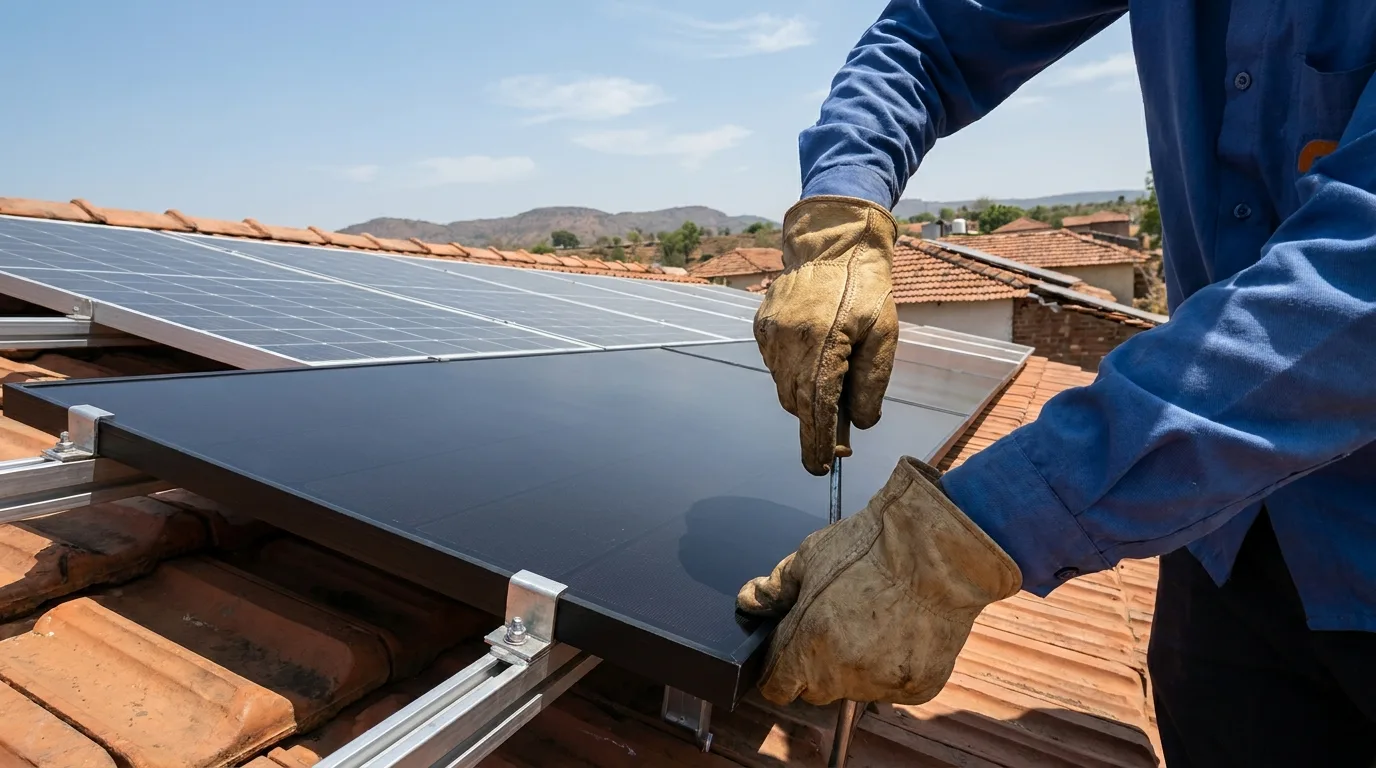
If you're comparing solar quotes in 2026, "TOPCon" shows up more and more often, sometimes as the default panel, sometimes as a paid upgrade over PERC. Neither framing tells you what you actually need to know: is the extra cost worth it, and how does TOPCon really compare to the HJT panels getting even more marketing attention? Here's the straight answer.
What is a TOPCon solar panel?
TOPCon stands for Tunnel Oxide Passivated Contact. Like standard PERC and premium HJT, it is built on a monocrystalline silicon wafer; TOPCon describes what's added to the back of that wafer, not the wafer itself. A tunnel oxide layer just a few nanometres thick, topped with a doped polysilicon layer, is deposited on the rear surface. This passivates the back contact far more effectively than PERC's aluminium back surface field, cutting down electron recombination, the main source of efficiency loss in a solar cell.
The practical result: TOPCon cells reach 23-25% efficiency, meaningfully ahead of PERC's 21-22%, while staying cheaper to manufacture than HJT (which needs more silver and a more specialised, lower-temperature production line). That manufacturing simplicity, real efficiency gain, moderate cost, is exactly why Indian manufacturers have poured investment into TOPCon capacity faster than into HJT.
TOPCon vs PERC: is the upgrade worth it?
| Factor | Mono PERC | TOPCon |
|---|---|---|
| Cell efficiency (2026) | 21-22% | 23-25% |
| Temperature coefficient | -0.34 to -0.40%/°C | -0.28 to -0.30%/°C |
| Annual degradation | 0.5-0.7%/yr | 0.35-0.4%/yr |
| Price premium | Reference | +15-25% |
| Indian manufacturing scale | Very high | High and growing fast |
| ALMM List-I availability | Wide | Wide and growing |
| Best for | Tightest budgets | Most buyers wanting more for a moderate premium |
Every technical number improves from PERC to TOPCon: 1-3 points more efficiency, meaningfully better heat tolerance, and roughly 30-40% slower annual degradation. On an average Indian rooftop with adequate space, the efficiency gain alone rarely changes whether the system fits; what it changes is total lifetime generation. A rough rule of thumb: TOPCon's better heat performance and lower degradation typically add up to 8-12% more electricity generated over a 25-year system life compared to PERC, for a 15-25% higher upfront cost. Whether that trade pays off depends mostly on your local tariff and how long you plan to own the system.
TOPCon vs HJT: do you need to go all the way to HJT?
Usually not. TOPCon captures most of HJT's real-world advantage at a fraction of the premium:
- Efficiency gap is small. TOPCon's 23-25% versus HJT's 24-26% is a real but modest difference, roughly 1 percentage point at the high end of each range.
- Heat performance gap is small too. TOPCon's -0.28 to -0.30%/°C temperature coefficient is close behind HJT's -0.24 to -0.26%/°C. On a 45°C MP summer day, that's the difference between losing about 10% of rated output (TOPCon) versus 9% (HJT), not a dramatic gap.
- The price gap is not small. TOPCon's 15-25% premium over PERC versus HJT's 25-40% is a genuinely large difference in absolute rupees for the same roof.
- ALMM availability favours TOPCon. More Indian manufacturers have ALMM List-I TOPCon models today than HJT models, which matters directly for your PM Surya Ghar subsidy eligibility.
Our full HJT solar panels guide covers exactly when that extra HJT premium does pay off, mainly very space-constrained roofs and extreme long-horizon builds. For everyone else, TOPCon is usually the more sensible upgrade from standard PERC.
TOPCon solar panel price in India (2026)
Realistic 2026 installed numbers for a residential 3 kW system, before the PM Surya Ghar subsidy:
| Technology | Approx. installed cost (3 kW) | Premium over PERC |
|---|---|---|
| Mono PERC | ~₹1.91 lakh | Baseline |
| TOPCon | ~₹2.15-2.35 lakh | +₹25,000-45,000 |
| HJT | ~₹2.4-2.7 lakh | +₹50,000-80,000 |
For the full size-by-size breakdown across 1-10 kW and how the subsidy and EMI math works, see our solar panel installation cost guide. As Indian TOPCon manufacturing capacity keeps expanding, this premium has been narrowing year over year, and 2026 pricing is noticeably closer to PERC than it was even twelve months ago. Run your own numbers with our solar savings calculator.
Is TOPCon ALMM-approved and subsidy-eligible?
Most current TOPCon models from established Indian manufacturers are. The PM Surya Ghar subsidy of up to ₹78,000 requires the exact panel model to be DCR (made with Indian cells) and on MNRE's ALMM List-I. ALMM List-II for cells also becomes mandatory for net-metered projects commissioned after December 31, 2026. TOPCon's ALMM coverage is now wider than HJT's, a direct result of the manufacturing investment described above, but eligibility is still granted per model number, not per technology.
When TOPCon is genuinely worth the premium
TOPCon makes clear sense when:
- You want a real efficiency step up from PERC without paying HJT's much larger premium.
- Your roof runs hot. Central and western India's summer heat is exactly where TOPCon's better temperature coefficient compounds into real extra generation year over year.
- You're planning to own the system long-term. Slower annual degradation means more of the panel's original output is still there in year 20-25.
- You want the widest current ALMM selection among the higher-efficiency technologies.
If your budget is genuinely tight, a quality ALMM-listed mono PERC panel is still a perfectly sound choice; see our 3 kW system guide for the most common residential configuration.
How r-solar thinks about TOPCon
Across the rooftops we've installed and monitored in Madhya Pradesh's heat and dust, TOPCon has become our default recommendation whenever a customer's budget has any flexibility above the baseline PERC quote. The math is straightforward: the premium is modest, the manufacturer selection is now wide enough that we're not locking a customer into a single supplier, and the heat-performance gain is real in MP's climate, not theoretical. We don't push HJT nearly as often; for the vast majority of the homes and small factories we quote, the extra spend over TOPCon buys a smaller improvement than the jump from PERC to TOPCon already delivered.
So our honest recommendation: if you're deciding between PERC and something better, TOPCon is where we'd point most customers first, then let roof space and budget decide whether HJT is worth the extra step. Send us a quote you're evaluating and we'll tell you, free, whether the TOPCon premium you're being asked to pay is fair for that specific model.
Comparing a TOPCon quote? Let us sanity-check it.
Get a free site visitOr estimate your savings first: use our solar savings calculator.
Frequently asked questions
What is a TOPCon solar panel?
TOPCon stands for Tunnel Oxide Passivated Contact. It is a cell technology built on a monocrystalline silicon wafer, where a very thin (a few nanometres) tunnel oxide layer plus a doped polysilicon layer are added to the back of the cell. This passivates the rear surface far better than standard PERC, reducing electron recombination and pushing efficiency to 23-25%, up from PERC's 21-22%. TOPCon panels sold in India in 2026 typically carry a 15-25% price premium over standard mono PERC.
Is TOPCon better than PERC?
On every technical measure, yes: TOPCon is 1-3 percentage points more efficient, has a lower temperature coefficient (around -0.28 to -0.30%/°C versus PERC's -0.34 to -0.40%/°C), and degrades slower (0.35-0.4%/year versus 0.5-0.7%/year for PERC). The trade-off is a 15-25% price premium. For most Indian rooftops with adequate space and moderate heat exposure, PERC remains the better value. TOPCon earns its premium on tighter roofs, hotter climates, and longer ownership horizons.
Is TOPCon better than HJT, or should I just buy HJT?
HJT is technically superior (24-26% efficiency, the lowest temperature coefficient and degradation of any mainstream technology), but TOPCon captures most of that real-world benefit at a much smaller premium: 15-25% over PERC versus HJT's 25-40%. TOPCon is also far more widely manufactured in India, with wider ALMM List-I availability, than HJT. For the typical Madhya Pradesh home, TOPCon is usually the better balance of cost and performance; HJT only pulls ahead on very tight roofs or extreme-heat, long-horizon builds.
How much do TOPCon solar panels cost in India in 2026?
TOPCon panels carry roughly a 15-25% premium over mono PERC. Where a mono PERC 3 kW system might cost approximately ₹1.91 lakh installed, an equivalent TOPCon system typically runs ₹2.15-2.35 lakh before the PM Surya Ghar subsidy. Indian manufacturing capacity for TOPCon has grown quickly through 2025-2026, which is narrowing the premium each year.
Are TOPCon panels ALMM-approved and eligible for the PM Surya Ghar subsidy?
Many are, and TOPCon's ALMM List-I availability is wider and growing faster than HJT's, because major Indian manufacturers have committed heavily to TOPCon production lines. Eligibility is still granted per exact model number, not per technology, so always verify the specific model on MNRE's current ALMM List-I (and that it is DCR, made with Indian cells; ALMM List-II for cells becomes mandatory for net-metered projects commissioned after December 31, 2026) before assuming the up-to-₹78,000 subsidy applies.

About the author
r-solar Editorial Team
r-solar installs and maintains rooftop solar across Madhya Pradesh: residential PM Surya Ghar systems, commercial OPEX/PPA, and RESCO at industrial scale, with software-monitored generation tracking from day one.
Want help choosing the right panel technology for your roof?
Get your free quote