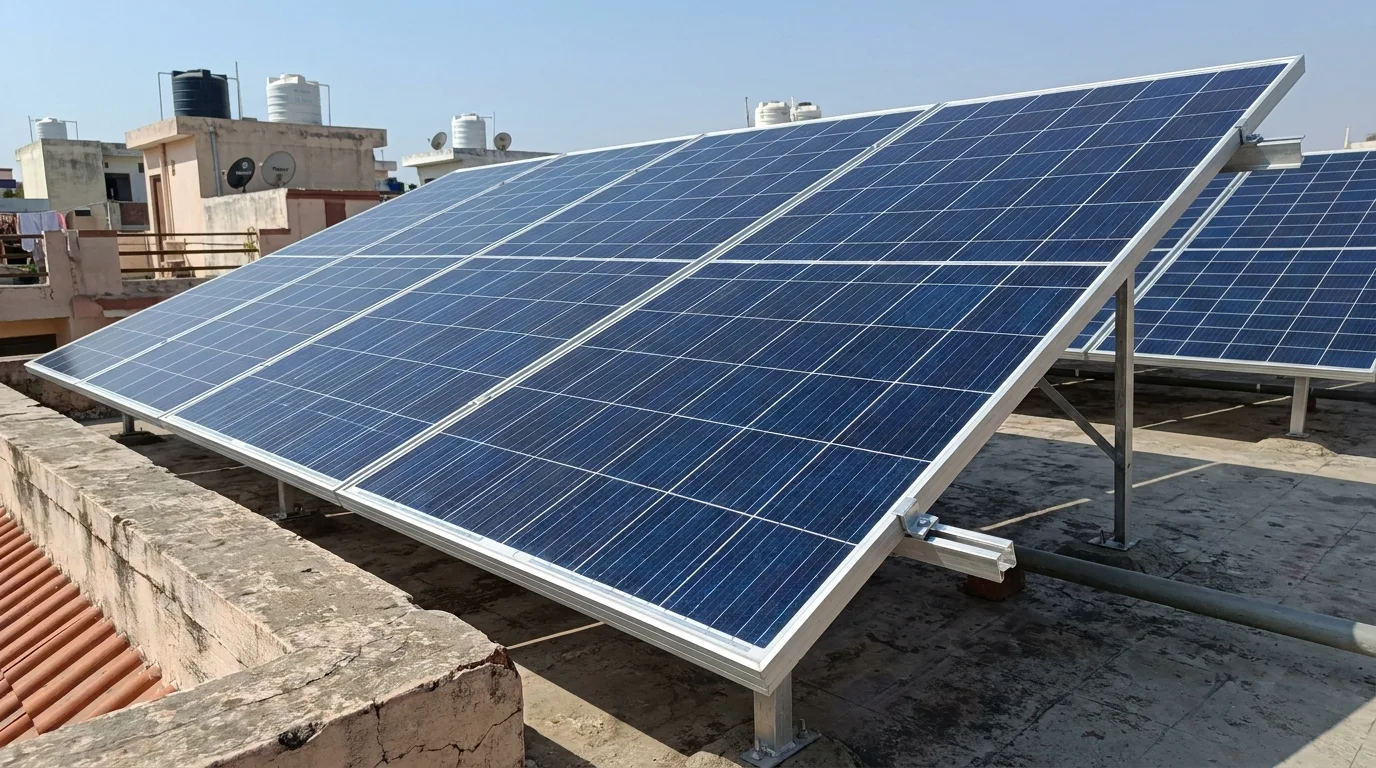
The 500 watt panel has quietly become the default building block of a modern rooftop system in India. A few years ago a "big" residential panel was 330 to 400 watts. Today, 500 to 550 watt monocrystalline modules are standard, which means fewer panels, simpler wiring, and more capacity on the same roof. If you are searching for a 500 watt panel price, you are really asking one of two questions: what does a single panel cost, or what does a system built from these panels cost. This guide answers both, honestly, with the 2026 numbers.
What a 500W panel actually is (and why it became the standard)
A 500 watt panel is simply a solar module rated to produce 500 watts under standard test conditions. Almost all of them today are monocrystalline, built either on Mono PERC cells (the mature, value technology) or the newer TOPCon cells (slightly higher efficiency and better performance in heat). Most are half-cut designs, where each cell is cut in two to reduce internal losses and shading impact.
The reason installers moved to 500W and 550W modules is density. A higher-wattage panel packs more capacity into the same physical footprint, so you need fewer panels, fewer connections, and less roof area per kilowatt. For the full comparison of Mono PERC, TOPCon and the leading brands, see our best solar panels in India buyer's guide.
500 watt solar panel price in India (2026)
As a standalone module, a 500 watt panel costs roughly ₹12,000 to ₹18,000 in 2026, which is about ₹24 to ₹36 per watt. Where a specific panel lands in that range depends on the cell technology, the brand, and whether it is DCR (Domestic Content Requirement) compliant, which is required for subsidised residential projects.
| 500W panel type | Approx. price (2026) | Per watt |
|---|---|---|
| Mono PERC (non-DCR) | ₹12,000 to ₹14,000 | ₹24 to ₹28 |
| Mono PERC DCR (subsidy-eligible) | ₹13,500 to ₹16,500 | ₹27 to ₹33 |
| TOPCon / premium half-cut | ₹15,000 to ₹18,000 | ₹30 to ₹36 |
500W panel specs at a glance
| Rated power | 500W (commonly sold alongside 505 to 550W half-cut variants) |
| Cell technology | Monocrystalline Mono PERC or TOPCon, half-cut |
| Module efficiency | 19% to 22% |
| Size | About 6.4 ft by 4.2 ft (roughly 2094 mm by 1134 mm) |
| Weight | Around 27 to 28 kg |
| Roof space needed | About 28 sq ft per panel including mounting gap |
| Daily generation | About 2 to 3 units (kWh) on a clear day |
| Annual generation | Roughly 650 to 700 units per panel |
| Warranty | Typically 12 year product + 25 to 30 year performance |
How many 500W panels for each system size
Because the panels are 500 watts each, the counting is easy. The roof-area figures assume shadow-free space with standard mounting.
| System size | 500W panels needed | Rough roof area | Typical monthly units |
|---|---|---|---|
| 1 kW | 2 panels | ~80 sq ft | 120 to 140 |
| 2 kW | 4 panels | ~150 sq ft | 240 to 280 |
| 3 kW | 6 panels | 220 to 270 sq ft | 360 to 420 |
| 5 kW | 10 panels | ~400 sq ft | 600 to 700 |
The 3 kW configuration (six 500W panels) is the most common home system in India because it fits the sanctioned load of most households and captures the maximum PM Surya Ghar subsidy. See our full 3 kW solar system guide for costs and payback, or size it against your own bill with the solar savings calculator.
Does a 500W panel qualify for the PM Surya Ghar subsidy?
The wattage does not decide subsidy eligibility. The model does. A 500W panel qualifies for the up-to-₹78,000 PM Surya Ghar residential subsidy only if that exact model is on MNRE's current ALMM List-I. It must also be a DCR panel made with Indian cells. ALMM List-II for cells is not required for net-metered projects commissioned by December 31, 2026, but becomes mandatory after that date, so check both before you buy.
In practice this is easy to satisfy: every major Indian brand sells ALMM-listed 500W and 550W modules. The mistake to avoid is buying a cheaper non-ALMM or imported panel to save a few thousand rupees, and then losing a ₹78,000 subsidy, which makes the "cheaper" panel far more expensive. Our ALMM list decoded guide shows how to verify a model in two minutes, and note that PM Surya Ghar is residential only; commercial and industrial buyers use net metering and depreciation instead (see C&I solar).
Which brands make reliable 500W panels
For a 25-year asset, the brand matters less for its spec sheet and more for whether it will still be around, and serviceable, in year 12. The Indian manufacturers with the scale, ALMM listing, and service footprint to trust with a 500W module include Waaree, Adani Solar, Tata Power Solar, Vikram Solar, and Premier Energies, among other ALMM-listed names. Any of these will sell you a solid 500W or 550W half-cut panel.
What actually separates a good install from a risky one is rarely the panel brand alone. It is whether the panels are genuinely ALMM-listed, whether the inverter is properly sized, who files your net-metering and subsidy paperwork, and whether there is a service team near you for the next two decades.
How r-solar thinks about panel wattage
From the systems we design across Madhya Pradesh: do not shop for a wattage, shop for a correctly sized system. A 500W panel is an excellent, modern building block, but the number of panels, the inverter, the mounting, and the paperwork are what determine your 25-year output and your subsidy, not the figure printed on the module.
If you are pricing a single 500W panel for a small DIY or off-grid job, that is a genuine use case and any ALMM-listed 500W module will do. But if the goal is to cut your home or business electricity bill, you want a designed system, not a loose panel. Send us your latest bill and roof details and we will tell you, free, exactly how many 500W panels you need, which ALMM-listed model fits, and what it costs after subsidy.
Want the right number of 500W panels for your roof?
Get a free site visitOr estimate your savings first: use our solar savings calculator.
How many 500W panels does your roof need?
Tell us your details and we will size the system, recommend the right ALMM-listed 500W panel, and give you the after-subsidy cost, free. Callback within 2 hours (10 AM to 7 PM IST).
Frequently asked questions
A single 500 watt solar panel costs roughly ₹12,000 to ₹18,000 in India in 2026, which works out to about ₹24 to ₹36 per watt. The price depends on the cell technology (Mono PERC is at the lower end, newer TOPCon a little higher), the brand, and whether the panel is DCR compliant. DCR Mono PERC modules used in subsidy-eligible projects usually sit around ₹13,500 to ₹16,500. Remember the panel is only one part of a full system; the inverter, mounting, wiring, net-metering and installation roughly double the per-watt cost of a complete rooftop system.
A single 500 watt panel generates about 2 to 3 units (kWh) on a clear day in most of India, which adds up to roughly 650 to 700 units a year. The exact figure depends on your location's peak sun hours (typically 5 to 6 in Madhya Pradesh), the tilt and orientation, shading, and how clean the panel is kept. Output drops on cloudy days and in the monsoon, which is why annual generation, not a single sunny day, is the number that matters for payback.
You need 6 panels of 500 watts to build a 3 kW system (6 times 500W equals 3,000W), requiring roughly 220 to 270 square feet of shadow-free roof space. As a quick guide with 500W panels: a 1 kW system uses 2 panels, 2 kW uses 4, 3 kW uses 6, and 5 kW uses 10. Installers favour 500W and 550W half-cut modules for homes because fewer, higher-wattage panels mean simpler wiring and less roof area per kilowatt.
Eligibility is decided per model, not per wattage. A 500W panel qualifies for the up-to-₹78,000 PM Surya Ghar residential subsidy only if that exact model is DCR (made with Indian cells) and on MNRE's current ALMM List-I; ALMM List-II for cells also becomes mandatory for net-metered projects commissioned after December 31, 2026. Most major Indian brands sell ALMM-listed 500W and 550W modules, so subsidy-eligible options are easy to find, but always confirm the specific model code on the MNRE portal. A cheaper non-ALMM or imported 500W panel forfeits the subsidy, which usually makes it more expensive overall.
A typical 500 watt solar panel measures about 6.4 feet by 4.2 feet (roughly 2094 mm by 1134 mm) and weighs around 27 to 28 kg. It needs about 28 square feet of clear, shadow-free space including the mounting gap. Most 500W modules are monocrystalline Mono PERC or TOPCon half-cut panels running at 19 to 22 percent efficiency, which is why they fit more capacity into less roof area than older 330 to 400 watt panels.

About the author
r-solar Editorial Team
r-solar installs and maintains rooftop solar across Madhya Pradesh: residential PM Surya Ghar systems, commercial OPEX/PPA, and RESCO at industrial scale, with software-monitored generation tracking from day one.
Want help choosing the right panel for your roof?
Get your free quote