If you have been comparing solar quotes, you have probably seen "monocrystalline" listed as a selling point, sometimes as if it were a premium upgrade over some other kind of panel. Worth asking: upgrade from what, exactly? In 2026, monocrystalline has become the default panel type across Indian rooftop solar, the way LED bulbs became the default over CFL. Understanding what the word actually describes, and where the real technology decisions still live, saves you from paying extra for something you would have gotten anyway.
What is a monocrystalline solar panel?
A monocrystalline solar panel is built from wafers cut from a single, continuous silicon crystal, grown by slowly pulling a rotating seed crystal out of molten silicon (the Czochralski process) to form a cylindrical ingot. That ingot is then sliced into thin wafers. Because the silicon is one uniform crystal lattice rather than many smaller crystals fused together, electrons move through it with less resistance and less energy lost to internal boundaries.
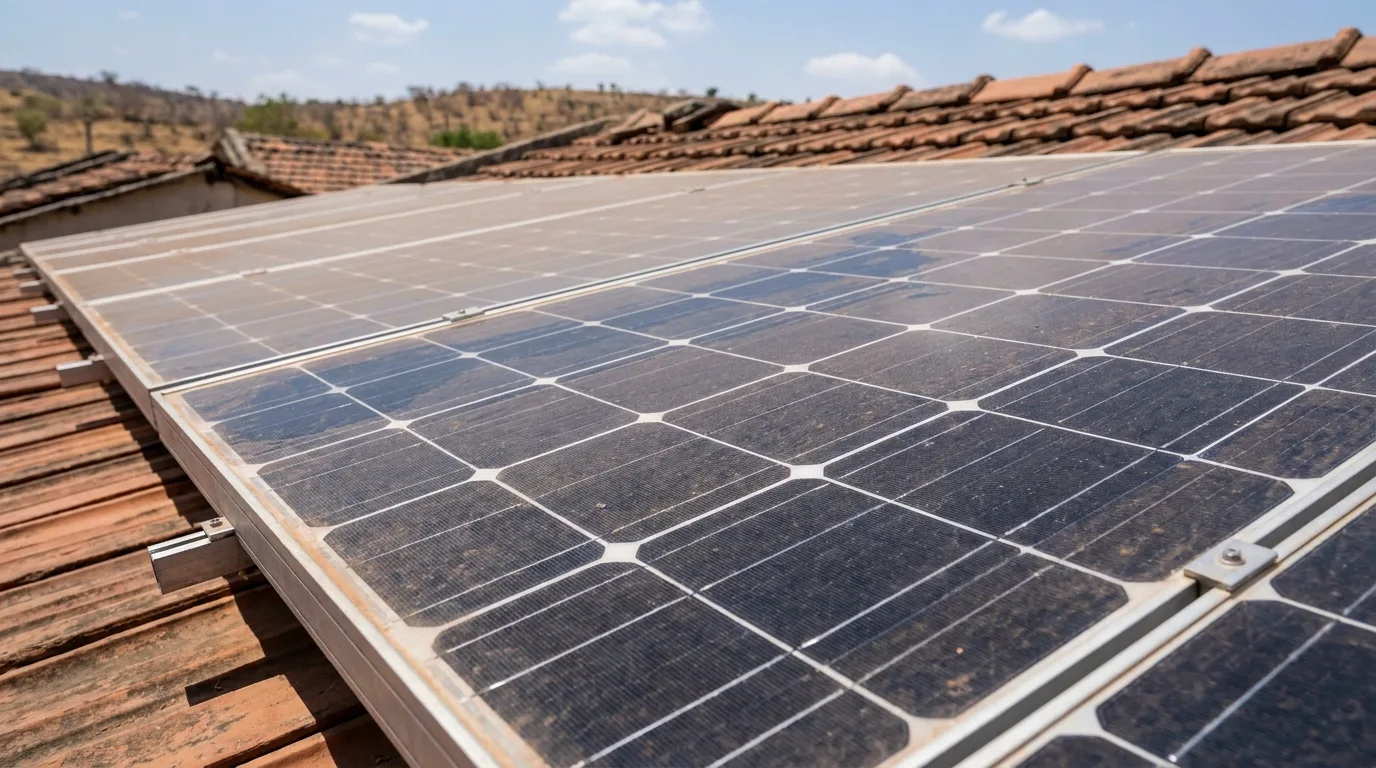
You can usually spot a monocrystalline panel on sight: the cells are a uniform deep black, and each cell has a small rounded or chamfered corner, a visible leftover from cutting square wafers out of a round ingot. Polycrystalline cells, by contrast, are typically a mottled blue with sharp square corners, since they are cast from multiple silicon fragments melted together rather than grown as one crystal.
Monocrystalline vs polycrystalline: why one basically disappeared
For years, polycrystalline was the budget option and monocrystalline the premium one. That gap has mostly closed in India, and it is worth seeing why in numbers:
| Factor | Polycrystalline | Monocrystalline |
|---|---|---|
| Typical efficiency | 13-16% | 16-22% |
| Appearance | Mottled blue, square cells | Uniform black, rounded cell corners |
| Space needed per kW | More | Less (roughly 15-25% less roof area for the same output) |
| Manufacturing cost trend (2020-2026) | Flat to rising | Falling steadily |
| 2026 Indian rooftop market share | Small and shrinking | Dominant |
Two things happened at once. Monocrystalline manufacturing got cheaper (better crystal-growing throughput, diamond-wire wafer cutting that wastes less silicon), while its efficiency advantage kept growing as PERC, TOPCon and HJT passivation technologies were layered onto mono wafers specifically, not poly ones. Polycrystalline never got those upgrades in any serious way. The result: monocrystalline panels now cost roughly the same to manufacture as polycrystalline did a few years ago, while delivering meaningfully more power per square foot of roof. For a roof-space-constrained home, that space saving alone usually settles the question. Our polycrystalline solar panels guide covers the narrow set of cases where the older technology can still make sense.
The mix-up most guides do not clean up
Here is the part that actually helps when you are reading a quote: "monocrystalline" is not a competing option next to PERC, TOPCon, or HJT. Those three names describe the cell's passivation technology, essentially how the surface of the wafer is treated to reduce electron loss. Monocrystalline describes the wafer itself, single-crystal versus multi-crystal silicon. In 2026, virtually every PERC, TOPCon and HJT panel sold in India is built on a monocrystalline wafer. A "mono PERC" panel is not a hybrid of two different things; it is a monocrystalline wafer with PERC passivation, full stop.
So if an installer's quote says "monocrystalline" as though it settles the technology question, ask the follow-up: monocrystalline with which passivation, PERC, TOPCon, or HJT? A quote that leads with "monocrystalline" and stops there is a bit like a car ad that leads with "has four wheels." True, but it was never really in question. That is where the real efficiency, heat-tolerance and price differences actually live today. We cover that decision in detail, including a full PERC vs TOPCon vs HJT comparison table and pricing, in our HJT solar panels guide.
What monocrystalline efficiency actually means for your roof
Efficiency measures how much of the sunlight hitting a panel gets converted to electricity. In practical terms for an Indian rooftop:
- 16-18% efficiency (older or budget monocrystalline): roughly 5.3-6 sq ft of panel per 100 W.
- 20-22% efficiency (current mono PERC from major Indian manufacturers): roughly 4.5-5 sq ft per 100 W.
- 23-26% efficiency (TOPCon and HJT): roughly 4-4.4 sq ft per 100 W, see the HJT guide for the full breakdown.
For a standard 3 kW residential system, that is the difference between needing roughly 165-190 sq ft of clear roof versus 130-145 sq ft. On most Indian rooftops with adequate space, that gap does not change whether the system fits; it mainly changes how much roof is left over. It matters far more on a small or heavily shaded roof, where every square foot is doing double duty.
Monocrystalline solar panel price in India (2026)
Because monocrystalline is now the standard, not the upgrade, its cost is simply the cost of a standard system. Here is what r-solar's own monocrystalline residential installs run, before and after the PM Surya Ghar subsidy:
| System size | Installed cost | Net cost after subsidy |
|---|---|---|
| 3 kW (residential) | ₹1.91 lakh | ~₹1.13 lakh |
| 5 kW (residential) | ₹2.77 lakh | ~₹1.99 lakh |
| 10 kW | ₹3.69 lakh | Subsidy caps below 3 kW-equivalent; see our 10 kW guide |
For the complete size-by-size breakdown from 1 kW to 10 kW, EMI math, and how the subsidy tiers work, see our solar panel installation cost guide. If you want a number specific to your own roof and bill, our solar savings calculator gives a real estimate in under a minute, not a generic range.
Do you need PERC, TOPCon or HJT specifically, or is standard monocrystalline enough?
For most Madhya Pradesh homes with a normal, unshaded rooftop and enough space for the system size they need, a quality ALMM-listed mono PERC panel from an established Indian manufacturer is the sensible default. It is the most widely available, the best value per rupee, and every serious manufacturer's warranty and service network is built around it.
You have a real reason to look at TOPCon or HJT specifically when:
- Your roof is genuinely tight. If a 5 kW target barely fits in mono PERC panels, a higher-efficiency wafer buys you real headroom. A reflective roof surface (white membrane, light-coloured terrace) is also worth a look at bifacial panels, which capture light off the back side too.
- You are in an extreme-heat pocket of central India where panels routinely run 55-65°C in summer; TOPCon and HJT lose less output to heat.
- You want the lowest possible 25-year degradation for a long-horizon or premium build.
Our TOPCon solar panels guide and HJT solar panels guide walk through exactly when each extra spend pays off, and when it does not.
How r-solar thinks about it
We install monocrystalline panels on every residential and commercial roof we quote in Madhya Pradesh; it has not been a genuine either-or decision against polycrystalline for a few years now. What we actually spend the technology conversation on with customers is different: which manufacturer's ALMM List-I model fits their subsidy eligibility, whether PERC is enough or their roof justifies TOPCon, and whether the mounting structure and wiring, the parts that determine whether a system is still performing well in year 15, are done properly. One of our recent Barwani installs had a homeowner insist on "monocrystalline, not the cheap kind" before we even opened the conversation; once we walked through that his quoted panel already was monocrystalline PERC, the real question became roof orientation and shading, which is where his system actually gained the extra units per day.
So our honest recommendation: do not pay a premium for "monocrystalline" on its own; by 2026 you are very unlikely to be offered anything else for a serious residential quote. Spend your attention on the manufacturer, the ALMM listing, the passivation tech if your roof is tight or scorching, and who is accountable for the system over 25 years. Send us a quote you are unsure about and we will tell you, free, whether it is fairly priced for what it actually contains.
Not sure if your quoted panel is a good deal?
Get a free site visitOr estimate your savings first: use our solar savings calculator.
Frequently asked questions
What is a monocrystalline solar panel?
A monocrystalline solar panel is built from wafers cut from a single, continuous silicon crystal, grown using the Czochralski process. Because the silicon is one uniform crystal rather than many fused fragments, electrons move through it with less resistance, which is why monocrystalline cells are more efficient than polycrystalline ones. You can recognise a monocrystalline panel by its uniform deep-black colour and the small rounded or chamfered corner on each cell, a byproduct of how the round silicon ingot is cut into square wafers.
Is monocrystalline the same as PERC, TOPCon or HJT?
No, and this is the most common confusion in panel shopping. Monocrystalline describes the silicon wafer itself, a single-crystal wafer versus a multi-crystal (polycrystalline) one. PERC, TOPCon and HJT are cell passivation technologies applied on top of a wafer, and in 2026 virtually all PERC, TOPCon and HJT panels sold in India are built on monocrystalline wafers. So a "mono PERC" panel and a "monocrystalline" panel are, in practice, the same product described at two different levels of detail. The real historical alternative to monocrystalline was polycrystalline, which has now mostly disappeared from new Indian rooftop installs. For the PERC vs TOPCon vs HJT decision specifically, see our HJT solar panels guide.
What efficiency do monocrystalline solar panels achieve?
Monocrystalline panels sold in India in 2026 typically run 16-22% efficient, depending on which cell passivation technology (PERC, TOPCon or HJT) is layered onto the wafer and how the panel is manufactured. Older or budget monocrystalline panels sit toward the lower end; current mono PERC panels from major Indian manufacturers run 20-22%; TOPCon and HJT push higher still, into the 23-26% range. By comparison, polycrystalline panels typically top out around 13-16%.
How much do monocrystalline solar panels cost in India in 2026?
Monocrystalline is now the mainstream default, not a premium upgrade, so it is priced into standard system costs rather than as an add-on. A residential 3 kW monocrystalline rooftop system installed by r-solar runs approximately ₹1.91 lakh before subsidy (net around ₹1.13 lakh after the PM Surya Ghar subsidy), and a 5 kW system approximately ₹2.77 lakh before subsidy. See our full size-by-size breakdown in the solar panel installation cost guide.
Should I ask for monocrystalline panels specifically when getting a quote?
Usually you do not need to ask, because most reputable Indian installers already quote monocrystalline panels by default in 2026; polycrystalline has largely exited the ALMM-listed residential market on cost and efficiency grounds. What is worth asking about instead is the specific cell technology (PERC, TOPCon or HJT), the exact model's ALMM List-I status (required for the PM Surya Ghar subsidy), and the manufacturer's warranty terms, since those vary far more between models than the mono-vs-poly distinction does.

About the author
r-solar Editorial Team
r-solar installs and maintains rooftop solar across Madhya Pradesh: residential PM Surya Ghar systems, commercial OPEX/PPA, and RESCO at industrial scale, with software-monitored generation tracking from day one.
Want help choosing the right panel for your roof?
Get your free quote