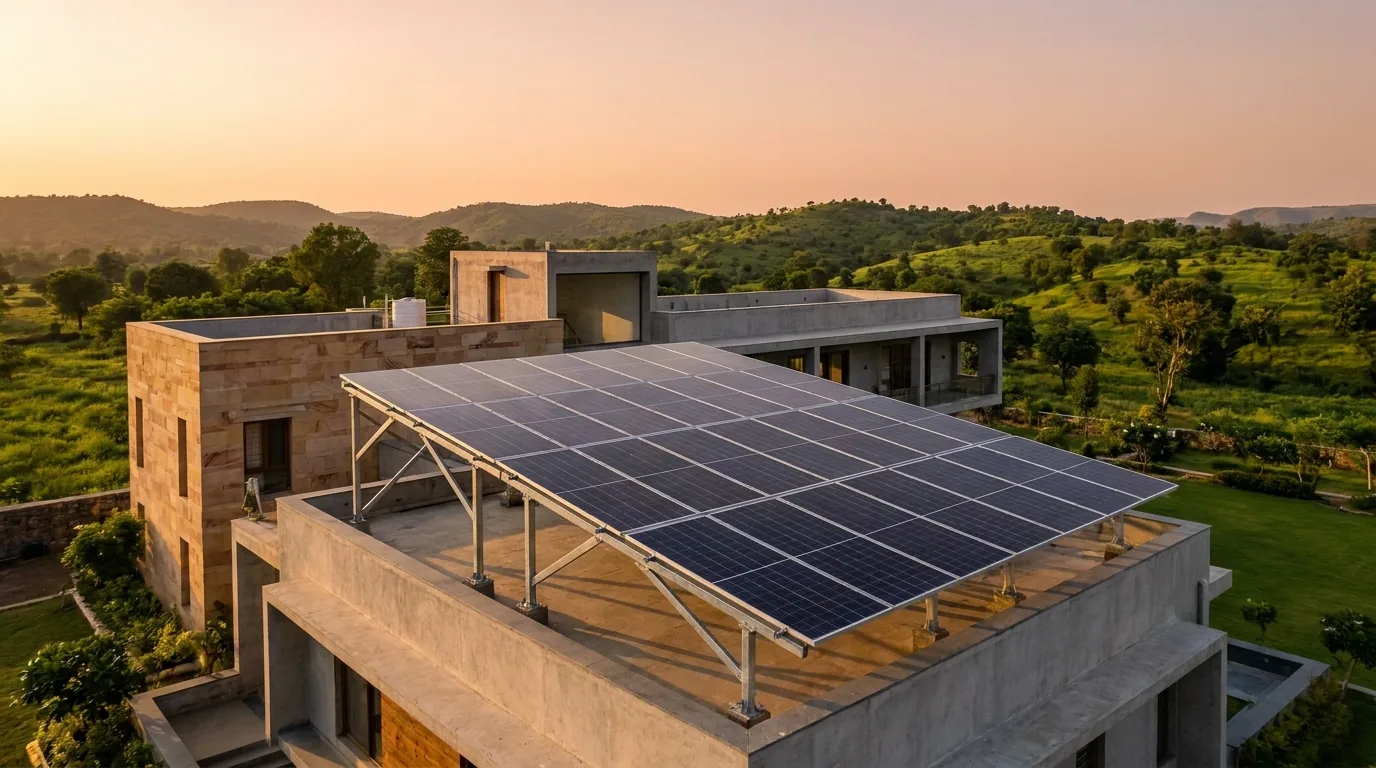
The 10 kW system is where solar stops being a household appliance and starts being an energy asset. It is the right choice when a 5 kW system leaves you still importing power from the grid: a large villa running four or more ACs, a farmhouse with pumps and cold storage, or a small shop or workshop with commercial equipment. So how much does a 10 kW solar system really cost, and does the same ₹78,000 subsidy still make it worthwhile when the system is this large? The short answer is yes for genuinely high-consumption properties, but the maths works differently than it does at 3 kW, and net metering starts to matter a lot. Here is the honest breakdown.
Who actually needs a 10 kW system?
A 10 kW system is the right size if any two of these are true for your property:
- Monthly electricity bill consistently above ₹8,000
- You run four or more 1.5-ton ACs for more than 6 hours per day
- You have a large villa, bungalow, or farmhouse (5+ bedrooms, or multiple floors)
- You run water pumps, a borewell motor, or cold storage on the same connection
- You operate a small shop, clinic, workshop, or home-based commercial premises
If your monthly bill is ₹3,000-₹6,000, a 5 kW system is the better fit, and for smaller homes the 3 kW system captures the maximum PM Surya Ghar subsidy as a percentage of cost. At 10 kW, the same ₹78,000 subsidy covers only about 21 percent of the cost, versus about 41 percent at 3 kW. But when your consumption genuinely justifies 10 kW, the absolute electricity savings are large enough that the system still earns its place, provided you can either consume most of the generation onsite or export the surplus under a good net-metering arrangement.
10 kW solar system price breakdown (India 2026)
A turnkey 10 kW (9.81 kW, 18-panel) residential solar installation from r-solar costs around ₹3.69 lakh in 2026, roughly ₹37,600 per kW. The per-kW cost is meaningfully lower than a 3 kW or 5 kW system, because fixed costs (site visit, inverter wiring, net metering filing, subsidy paperwork) are spread over more kW. Here is what makes up that approximate cost:
| Component | Approx. cost | % of total |
|---|---|---|
| 18× ALMM-approved monocrystalline solar panels (545W each) | ₹2,00,000-₹2,25,000 | ~57% |
| 10 kW string inverter/s (Sungrow / Growatt / Sofar / Delta) | ₹42,000-₹55,000 | ~13% |
| Galvanised steel mounting structure (HDG, elevated) | ₹40,000-₹50,000 | ~12% |
| AC + DC cabling, conduits, junction boxes | ₹22,000-₹30,000 | ~7% |
| Earthing kit, MCBs, SPDs, DCDB/ACDB | ₹13,000-₹18,000 | ~4% |
| Civil work (mounting base, cable trays, weatherproofing) | ₹11,000-₹16,000 | ~3% |
| Net metering application + DISCOM coordination | ₹4,000-₹7,000 | ~2% |
| Installation labour, commissioning, monitoring setup | ₹32,000-₹42,000 | ~9% |
| Total turnkey installed cost (approx.) | ~₹3,69,000 | 100% |
How the 10 kW solar price compares across India (2026)
The 10 kW solar panel price in India varies widely by system type and by how much of the job is actually included. National brands quoting a "10 kW price" often mean a grid-tied system before installation and paperwork, and premium installers price well above the regional average. Here is the honest 2026 market picture for a fully installed 10 kW system, and where r-solar sits:
| 10 kW system type | Typical India price range (2026, installed) | Best for |
|---|---|---|
| On-grid (grid-tied, no battery) | ₹4.5 lakh to ₹6.5 lakh at national brands; from about ₹3.7 lakh at value regional installers | Most homes and shops with reliable grid + net metering |
| Hybrid (with battery backup) | ₹4.9 lakh to ₹9 lakh | Areas with frequent, long power cuts |
| Off-grid (full battery, no grid) | ₹6 lakh to ₹8.5 lakh | Farmhouses or sites with no reliable grid connection |
| r-solar on-grid (9.81 kW turnkey) | around ₹3.69 lakh, all-in | Value-for-money, full-service, MP |
Two things to read from that table. First, most buyers want on-grid: it skips the expensive, short-lived battery and banks surplus units with the grid through net metering, so it is the cheapest and most common choice. Second, r-solar's ~₹3.69 lakh sits at the value end of the on-grid market, below the ₹4.5 lakh to ₹6.5 lakh that national brands charge, for the same ALMM-approved panels and the same 25-year panel warranty. r-solar keeps the price lower by running lean as a Madhya Pradesh regional installer rather than a pan-India brand with heavier overhead. A higher sticker price does not buy you better panels; the cells and inverters are largely the same hardware. r-solar recommends comparing quotes on what is actually included (installation, net metering filing, and the PM Surya Ghar subsidy follow-through), not on the headline number alone.
What your r-solar price actually buys
A cheap quote prices the panels and stops there. The hardware lands on your roof and the rest becomes your problem: finding an electrician, filing the DISCOM net metering application, confirming your sanctioned load can carry a 10 kW export, registering on the PM Surya Ghar portal, and chasing the ₹78,000 subsidy yourself for months.
An r-solar price is for the finished job, not a box of parts. It covers:
- System design sized to your bill, roof and sanctioned load
- ALMM-approved panels, inverter/s and mounting structure
- Professional installation and electrical safety compliance
- DISCOM net metering application and load review
- The full PM Surya Ghar subsidy filing, followed through until the ₹78,000 reaches your bank account
- One team accountable from your first call to a commissioned, subsidy-credited system
Quotes that look cheaper skip this work and leave you to install, file and chase the subsidy on your own, which is a heavier burden at 10 kW where the paperwork and load approvals are more involved.
For a cross-size comparison, see our 5 kW solar system guide and the smaller 3 kW solar system India 2026 page. If your load is genuinely commercial, compare against a commercial and industrial solar build, and estimate returns with the C&I solar calculator.
How much electricity does a 10 kW system generate?
A 10 kW solar system in India generates approximately 1,200-1,400 units (kWh) per month, or roughly 40-46 units per day, at about 40 units per kW per month. Annual generation is roughly 13,000-14,500 kWh depending on your state and rooftop orientation.
| State | Daily avg (units) | Monthly (units) | Annual (kWh) |
|---|---|---|---|
| Rajasthan, Gujarat | 44-48 | 1,320-1,450 | 15,500-17,000 |
| Madhya Pradesh, Maharashtra, Karnataka, Andhra Pradesh | 40-44 | 1,200-1,320 | 14,000-15,200 |
| Tamil Nadu, Punjab, Haryana, Uttar Pradesh | 36-40 | 1,080-1,200 | 12,500-14,000 |
| Bihar, Odisha, West Bengal | 32-36 | 960-1,080 | 11,000-12,500 |
| Northeast states, Coastal Kerala | 28-32 | 840-960 | 9,700-11,000 |
In Madhya Pradesh (where r-solar operates), 10 kW systems consistently deliver 1,250-1,350 units/month in clear weather, dropping to 950-1,100 in monsoon season (June to September). Annual generation of approximately 14,000-15,200 kWh is typical. Here is the important part: that is often more electricity than a single home consumes. Any generation you do not use in the moment is exported to the grid, so net metering becomes central to the economics of a 10 kW system in a way it never is at 3 kW.
Subsidy math: 10 kW still gets only ₹78,000
The PM Surya Ghar Muft Bijli Yojana uses a tiered subsidy structure that caps at 3 kW for residential systems, and the cap does not move no matter how large you go:
- 1st kW: ₹30,000 subsidy
- 2nd kW: ₹30,000 subsidy (₹60,000 cumulative)
- 3rd kW: ₹18,000 subsidy (₹78,000 cumulative, cap reached)
- 4th kW and every kW above it, all the way to 10 kW: ₹0 additional subsidy
So a 10 kW residential system receives the same ₹78,000 as a 3 kW or 5 kW residential system. Not more. This is the single most important buyer insight on this page: the subsidy does not scale with system size. For a 10 kW system at around ₹3.69 lakh, the ₹78,000 covers only about 21 percent of the cost.
| 10 kW system installed cost (approx.) | ~₹3,69,000 |
| PM Surya Ghar subsidy (capped at 3 kW) | – ₹78,000 |
| Net cost after subsidy (approx.) | ~₹2,91,000 |
| Subsidy as % of cost | ~21% |
For the full subsidy process, including eligibility criteria, required documents, and application steps, see the PM Surya Ghar subsidy guide 2026. The ₹78,000 cap is exactly why the "should I split my system" question, covered further down, is worth taking seriously at this size.
10 kW solar system EMI with PM Surya Ghar bank loan
PM Surya Ghar loans are charged SBI's concessional 5.75% up to ₹2 lakh; banks lend up to ₹6 lakh, but above ₹2 lakh SBI charges 7.90%. For a 10 kW system at around ₹3.69 lakh, this example borrows ₹2 lakh at the lower rate and self-funds the remaining ₹1.69 lakh as a down payment:
| Turnkey installed cost (10 kW, approx.) | ~₹3,69,000 |
| Down payment (customer pays upfront) | ~₹1,69,000 |
| Loan amount (kept at ₹2 lakh for the 5.75% rate) | ₹2,00,000 |
| SBI rate (loans up to ₹2 lakh) | 5.75% p.a. |
| Tenure | 10 years |
| EMI before subsidy credit | ~₹2,195 / month |
| Subsidy credited (month 2), part-paid to principal | – ₹78,000 |
| Remaining principal after subsidy | ₹1,22,000 |
| EMI after subsidy part-payment | ~₹1,339 / month |
The EMI itself is modest, because this example keeps the loan at ₹2 lakh whatever the system size. The real difference at 10 kW is the larger down payment (around ₹1.69 lakh) left to fund upfront, or a larger loan at SBI's 7.90% rate. Compare the ~₹1,339/month EMI to the electricity bill a 10 kW system replaces (typically ₹8,000-₹15,000 per month for a large property with multiple ACs and pumps). The monthly savings comfortably clear the EMI. For other bank rates, see our PM Surya Ghar solar loan interest rates comparison: Canara Bank, Bank of Baroda, PNB and Indian Bank also list 5.75% for loans up to ₹2 lakh.
Payback period and 25-year savings for 10 kW
For a 10 kW system from r-solar, the realistic payback period is 5 to 7 years on net cost. That is a little longer than a 3 kW system (4-5 years), for one simple reason: the ₹78,000 subsidy is a much smaller share of a 10 kW system than of a 3 kW one. Here is the calculation:
- Net cost after subsidy: approximately ₹2.91 lakh
- Annual generation: ~14,000 kWh (MP average for 10 kW)
- Electricity tariff: ₹6-9 per unit for self-consumed power; exported surplus is credited at your DISCOM's net-metering rate, which is usually lower
- Effective annual savings: ₹55,000-₹80,000, depending on how much you consume onsite versus export
- Simple payback: 5 to 7 years on net cost, closer to 7 years on gross cost
Notice the honesty in that savings range. A 10 kW system on a home that genuinely uses most of its output (say a farmhouse with daytime pumps and cold storage) can hit the top of the range and pay back near 5 years. A 10 kW system on a home that only consumes half of it and exports the rest at a lower net-metering credit sits closer to 7 years. This is not a rounding detail. It is the core of the 10 kW decision, and it is why net metering terms deserve a close look before you buy.
After payback, a 10 kW system saves roughly ₹15-25 lakh over the remaining life of the 25-year panel warranty. Solar savings are inflation-proof: as electricity tariffs rise (historically 5-8% per year in India), your savings compound. A system saving ₹70,000 today saves well over ₹1.2 lakh annually by year 10.
10 kW: where residential meets commercial
Ten kilowatts is a threshold size. Below it, you are almost always a straightforward residential customer. At 10 kW, several things start to change, and a good installer will flag them before you sign:
- Sanctioned load. Many homes have a sanctioned load of 5-7 kW. A 10 kW solar system can push you to request a load enhancement, and in some cases the DISCOM will re-examine whether your connection should be domestic or commercial. r-solar checks this first, because getting it wrong causes approval delays.
- Net metering caps. Some state DISCOMs limit rooftop net metering to a percentage of your sanctioned load, or shift larger systems to net billing (where exported units are bought at a lower rate than you pay for imports). This directly changes your payback, as the section above showed.
- Connection category. A shop, clinic, or workshop on a commercial connection is not a PM Surya Ghar residential case. It may instead qualify under commercial or industrial pathways, with different (often accelerated-depreciation) economics.
If your 10 kW is going on a genuinely commercial premises, the residential subsidy math on this page does not apply to you. Read the commercial and industrial solar guide and model your returns with the C&I solar calculator instead. For a domestic property, the Madhya Pradesh net metering guide explains exactly how your surplus is credited.
r-solar's advice: when to go 10 kW vs split the system
Here is the insight a generic price-comparison site will never give you, because it reduces the size of the sale. Given that the PM Surya Ghar subsidy is capped at ₹78,000 for any single residential connection, a 10 kW system on one meter claims that ₹78,000 exactly once, on the first 3 kW. The other 7 kW are entirely unsubsidised.
r-solar recommends that most large-property owners still go with a single 10 kW system, because a single connection is simpler to approve, simpler to net-meter, and simpler to maintain, and one system means one accountable team. The convenience and clean approval are usually worth more than the subsidy you could theoretically chase by splitting.
But r-solar recommends considering a split (a 3 kW subsidised residential system on the home connection, plus a separate commercial connection for the rest) in one specific situation: when the property legitimately has two distinct uses. A farmhouse where the residence is domestic and the pumps, cold storage, or a farm-shop are commercial is the textbook case. Here a 3 kW residential system captures the full ₹78,000 subsidy on the home, while the commercial load goes on its own connection where it may qualify for accelerated depreciation and commercial net-metering terms. That can beat a single unsubsidised 10 kW residential build, because both pathways earn their own incentive instead of one ₹78,000 cap being stretched across everything.
The trap to avoid is splitting a single genuine home into two fake connections just to claim two subsidies. DISCOMs check for this, it delays approvals, and it is not something r-solar will do. The split only makes sense when the two uses are real. A typical large farmhouse near Barwani or Khargone finds that its residence and its irrigation load are genuinely separate, and for those properties the split is worth modelling. For an ordinary large villa in Indore or Bhopal with one domestic connection, the single 10 kW system almost always wins. Ask r-solar to model both before you decide.
Key components of a 10 kW rooftop solar system
A grid-tied 10 kW on-grid rooftop system has these key components:
- Solar panels (18×): 545W ALMM-approved mono PERC or TOPCon panels, totalling 9.81 kW. Only ALMM-listed panels qualify for the PM Surya Ghar subsidy, so verify your installer's panel brand against the ALMM list before signing the contract.
- 10 kW inverter (or two smaller units): Converts DC from panels to AC for use and export. Top brands in India 2026: Sungrow SG10RT, Growatt MOD 10KTL3-X, Sofar Solar, Delta. On larger systems, a three-phase inverter is common. Warranty: 5 years (extendable to 10-12 years).
- Mounting structure: Hot-dip galvanised (HDG) steel rails rated for 150 kmph wind load. For MP specifically, structures must meet IS 875 Part 3 wind zone requirements, which matter more on a larger array with greater wind uplift.
- DC cables + combiner: 4-6 sq.mm DC cables with MC4 connectors, in more strings than a smaller system. A DCDB with fuses and SPD (surge protection device) is mandatory under CEA 2019 standards.
- AC cables + ACDB: Heavier AC cabling from inverter to distribution board, usually on a three-phase connection at this size. Includes dedicated MCB, isolator, and a bidirectional energy meter for net metering.
- Monitoring system: Most inverters include WiFi/GPRS monitoring (Sungrow iSolarCloud, Growatt ShinePhone), which matters more on a 10 kW system where a single underperforming string is a bigger rupee loss.
The 18 panels require approximately 600-700 sq ft of shadow-free roof area, oriented south (or as close to south as your roof allows). A slight east or west tilt reduces annual generation by 5-12%; shading by a water tank, parapet, tree, or neighbouring building can reduce it by 15-40%. On a system this large, r-solar always provides a shading analysis before finalising the layout, because a shaded string costs far more here than on a 3 kW roof.
Get an exact quote for your 10 kW system
Tell us your details. r-solar designs, installs and handles your subsidy, and confirms your sanctioned load and net metering first. Free callback within 2 hours (10 AM to 7 PM IST).
Frequently asked questions

r-solar editorial team
r-solar is a MNRE-empanelled solar EPC company serving residential and industrial customers across Madhya Pradesh, and the solar business of Farmkart Group, which has served rural India since 2017. Our team of engineers and energy consultants has designed and commissioned over 1,500 rooftop and ground-mount systems across MP.
Get a free 10 kW quote for your propertyRelated reading
- → 5 kW Solar System India 2026: Cost and Payback (for large homes)
- → 3 kW Solar System India 2026: Cost and Payback (for smaller homes)
- → PM Surya Ghar Subsidy Guide: How to Apply and Get ₹78,000
- → Net Metering in Madhya Pradesh: How Your Surplus Is Credited
- → Commercial and Industrial Solar: When 10 kW Is a Business Decision
- → C&I Solar Calculator: Model Commercial Solar Returns
- → Savings Calculator: Estimate Your System Size and Savings