If you've seen "polycrystalline" on a quote and wondered whether the lower price is worth the trade-off, you're asking the right question, it just doesn't have the same answer it did five years ago. This guide covers what polycrystalline actually is, why the Indian market has largely moved past it, and the narrow set of situations where it might still make sense.
What is a polycrystalline solar panel?
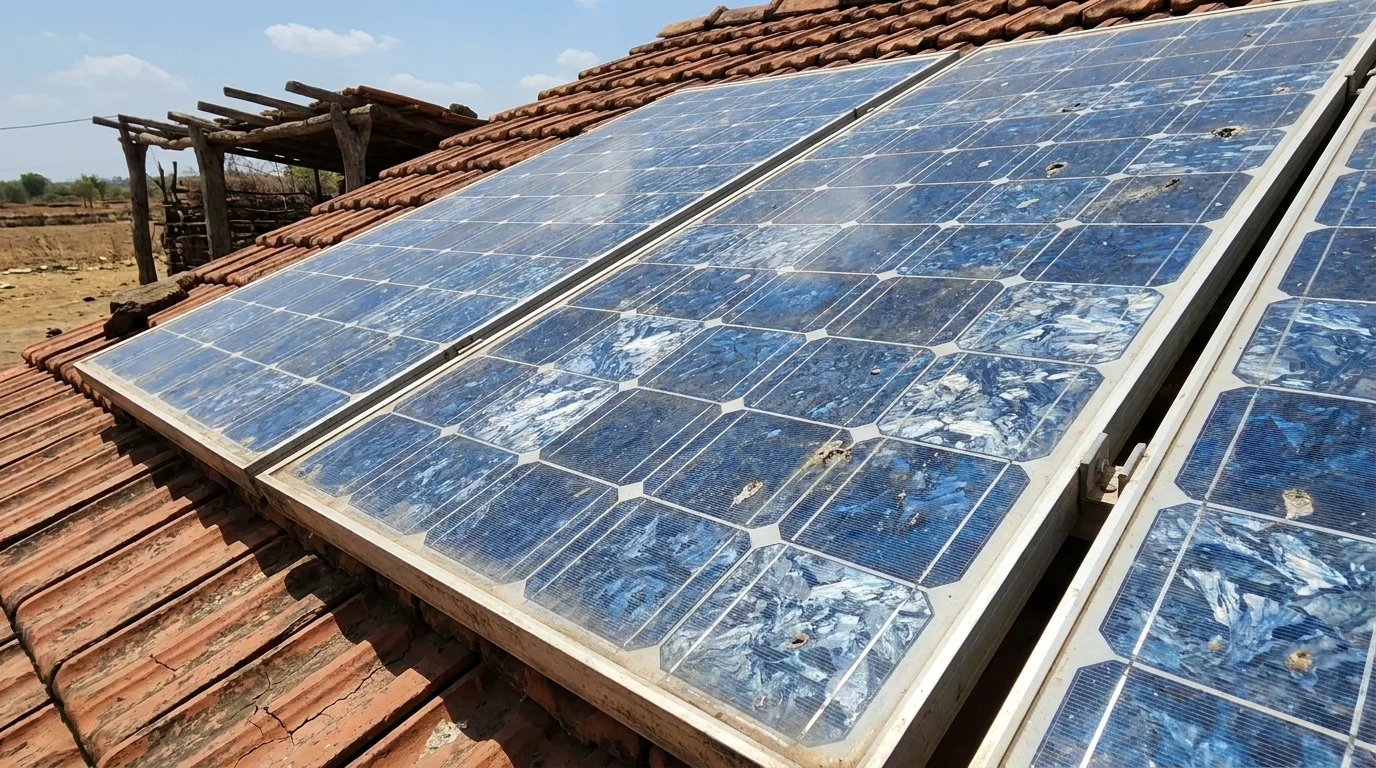
A polycrystalline (sometimes "multi-crystalline") solar cell is cast by melting multiple fragments of silicon together in a mould, rather than growing one continuous crystal the way monocrystalline wafers are made. When that mould cools, the silicon solidifies as many small, differently-oriented crystals fused together, visible as the panel's signature mottled blue, marbled texture with sharp square cell corners (versus monocrystalline's uniform black cells with rounded corners).
Those internal crystal boundaries matter electrically: they scatter and trap some electrons that would otherwise become usable current, which is why polycrystalline cells run less efficient, 13-16%, than monocrystalline's 16-22%. The upside was always cost: casting silicon fragments is a simpler, cheaper process than growing a single crystal ingot, so polycrystalline used to be the clear budget choice.
Polycrystalline vs monocrystalline: the math that changed
| Factor | Polycrystalline | Monocrystalline (mono PERC) |
|---|---|---|
| Typical efficiency | 13-16% | 20-22% |
| Roof area for a 3 kW system | ~230-260 sq ft | ~190-210 sq ft |
| Manufacturing cost trend (2020-2026) | Flat to rising | Falling steadily |
| Price gap vs mono PERC (2026) | 5-10% cheaper | Reference |
| 2026 Indian rooftop market share | Small and shrinking | Dominant |
Here's the number that actually decides this for most buyers: a polycrystalline system needs roughly 15-25% more roof area for the same output as monocrystalline, while costing only 5-10% less. Five years ago, the price gap was 20-30%, wide enough that the extra roof space was a fair trade. In 2026, it usually is not, unless your roof has genuinely unlimited space and every rupee of upfront cost matters more than long-term generation or eventual resale/upgrade flexibility.
Why polycrystalline is fading out of the Indian market
Two trends moved in opposite directions at once. Monocrystalline manufacturing got cheaper, through better crystal-growing throughput and diamond-wire wafer cutting that wastes less silicon, while TOPCon and HJT passivation technologies were developed specifically for monocrystalline wafers, not polycrystalline ones. Polycrystalline never received a comparable efficiency upgrade. The result is a technology that costs almost the same to manufacture as it did years ago while its main competitor kept getting both cheaper and better. Major Indian manufacturers have shifted the bulk of their new production lines to monocrystalline accordingly, which is also why polycrystalline's ALMM List-I selection has narrowed, fewer new models are being certified each year.
When polycrystalline can still make sense
It is not obsolete everywhere. A polycrystalline panel is a reasonable choice when:
- Roof space is genuinely not a constraint, a large flat rural rooftop or open ground-mount area where the extra 15-25% footprint costs nothing real.
- The budget is the single hardest constraint and every available rupee matters more than long-term generation, common for smallholder or first-time buyers stretching to afford any system at all.
- It's for a non-subsidy, standalone use case like a small off-grid pump or DIY setup where ALMM eligibility and 25-year optimisation matter less than upfront cost.
Outside those cases, a quality ALMM-listed monocrystalline mono PERC panel is now the more sensible default, not just the premium option. See our 3 kW system guide for what a standard residential monocrystalline install actually costs.
Is polycrystalline ALMM-approved and subsidy-eligible?
Some models still are, but the list has narrowed each year as manufacturers redirect new certifications toward monocrystalline lines. The PM Surya Ghar subsidy of up to ₹78,000 requires the exact model to be on MNRE's current ALMM List-I, regardless of cell technology. Before assuming a polycrystalline quote qualifies, verify the specific model number yourself using our ALMM list decoded guide, since an installer offering a lower price on an unlisted panel can quietly cost you the entire subsidy.
How r-solar thinks about polycrystalline
We do not install polycrystalline panels on residential or commercial systems, and we're upfront about why: across the rooftops we quote in Madhya Pradesh, the roof space is rarely so abundant that the trade makes sense, and the price gap has shrunk to the point where a customer choosing polycrystalline over mono PERC is usually leaving generation on the table for a saving that no longer justifies it. We had one homeowner in Khargone specifically ask for polycrystalline because a relative's older system used it years ago; once we walked through the current roof-area and 25-year generation numbers side by side, the decision was straightforward.
So our honest recommendation: if a quote you're comparing includes polycrystalline as the budget option, ask what the equivalent mono PERC quote would cost. In 2026, that gap is usually small enough that monocrystalline wins outright, not just on paper. Send us a quote you're unsure about and we will run the comparison for you, free.
Comparing panel types on a quote? Let us check the real numbers.
Get a free site visitOr estimate your savings first: use our solar savings calculator.
Frequently asked questions
What is a polycrystalline solar panel?
A polycrystalline (or multi-crystalline) solar panel is made from cells cast by melting multiple fragments of silicon together in a mould, rather than growing one continuous crystal the way monocrystalline wafers are made. The result is a cell with many small crystal boundaries, visible as the panel's distinctive mottled blue, marbled appearance with sharp square corners. Those internal boundaries scatter some electrons, which is why polycrystalline cells are less efficient (13-16%) than monocrystalline ones (16-22%).
Is polycrystalline cheaper than monocrystalline?
It used to be meaningfully cheaper, but that gap has mostly closed in India. Monocrystalline manufacturing costs have fallen sharply since 2020 (better crystal-growing throughput, diamond-wire wafer cutting), while polycrystalline manufacturing costs stayed roughly flat. In 2026, a polycrystalline panel typically costs only 5-10% less than an equivalent-wattage mono PERC panel, not enough to offset needing 15-25% more roof area for the same output.
Are polycrystalline panels still sold in India in 2026?
Yes, but the selection has narrowed considerably, and most major Indian manufacturers have shifted their production lines to monocrystalline (PERC, TOPCon and increasingly HJT). Polycrystalline panels still appear mainly at the budget end of the market and in some standalone off-grid or DIY kits. Very few current ALMM List-I models are polycrystalline, so verify a specific model's subsidy eligibility before assuming it qualifies.
Should I choose polycrystalline over monocrystalline to save money?
For a typical rooftop system in 2026, usually not. The price gap has narrowed to roughly 5-10%, while polycrystalline needs 15-25% more roof area for the same system size and produces less electricity over its lifetime. Unless your roof space is unlimited and the small price gap genuinely matters more than long-term generation, monocrystalline (mono PERC at minimum) is now the better value in most cases, not just the higher-spec choice.
Does r-solar install polycrystalline panels?
No. r-solar installs monocrystalline panels on every residential and commercial system we quote (DCR mono bifacial 550 W modules for subsidised homes, N-type TOPCon on other projects), because the real-world value case for polycrystalline in 2026 is weak enough that we cannot recommend it in good conscience. This guide exists to explain why, for anyone comparing quotes that still include polycrystalline options.

About the author
r-solar Editorial Team
r-solar installs and maintains rooftop solar across Madhya Pradesh: residential PM Surya Ghar systems, commercial OPEX/PPA, and RESCO at industrial scale, with software-monitored generation tracking from day one.
Want an honest read on your panel options?
Get your free quote