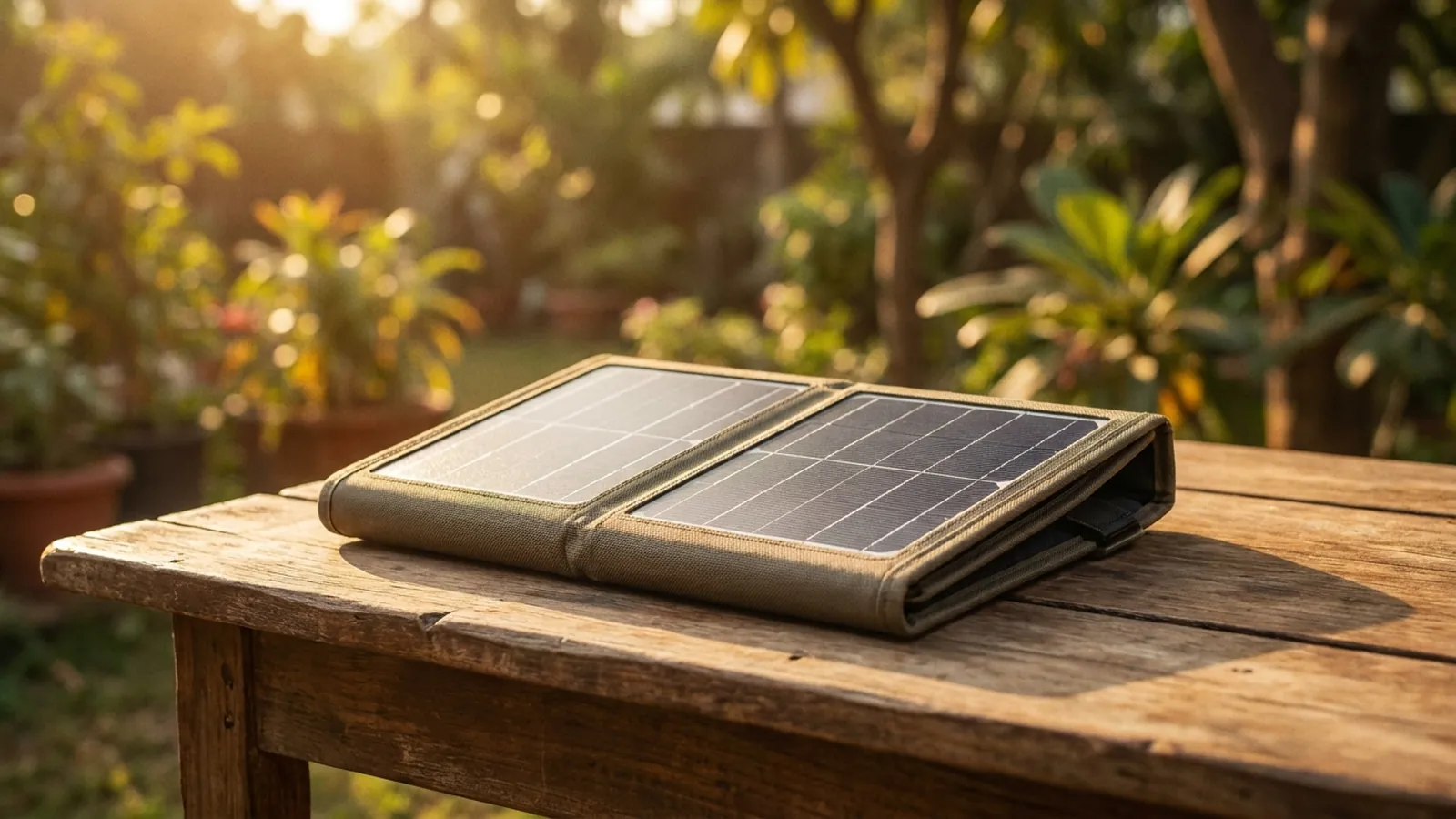
"Mini solar panel" searches typically mix three different shoppers: hobbyists building a DIY project, campers and RV owners wanting portable 12V power, and homeowners hoping a small panel can offset their electricity bill. The first two groups are well-served by mini panels. The third group is almost always disappointed. This guide separates the use cases honestly so you don't spend ₹2,000 on a 50W panel expecting it to run your fridge.
What is a mini solar panel?
Short answer: a mini solar panel is a small photovoltaic module rated between roughly 5W and 50W, costing between ₹200 and ₹3,500 in India in 2026. It will charge a phone, run garden lights, a USB device or a 12V RV or boat setup. It will not run a home appliance, and it is not a small version of a rooftop system.
A mini solar panel is a small photovoltaic module rated between 5W and 50W, typically measuring 10–40 cm on a side. They use the same silicon-cell technology as residential rooftop panels. Most are monocrystalline (higher efficiency, ~18-22%) or polycrystalline (lower efficiency, ~14-17%) at this size class. The difference vs a residential panel (typically 540-550W in 2026) is purely scale: a mini panel is roughly 1/10th to 1/100th the area of a rooftop panel.
Mini panels are sold for three primary use cases:
- USB/phone charging panels (5W-15W): typically pocket-sized or backpack-mounted, with a built-in USB-A output and basic voltage regulation
- 12V DC system panels (10W-50W): designed to charge a lead-acid or lithium battery via a charge controller; standard for RVs, boats, garden setups, and off-grid lighting
- DIY/hobby panels (1W-20W): bare panels sold for electronics projects, Arduino sensors, weather stations, agricultural sensors, etc.
What unifies these is the portability and off-grid nature. A mini panel doesn't connect to your home wiring, doesn't feed the grid, and doesn't qualify for any government subsidy. It's a self-contained accessory, not a power infrastructure investment.
Mini solar panel sizes and what each actually powers
The most useful way to think about a mini panel's output is in watt-hours per day, not nameplate wattage. A 10W panel does not produce 10 watt-hours; it produces roughly 5-6 watt-hours per peak sun hour, and India gets about 5 peak sun hours per day on average. So a 10W panel realistically delivers 50-60 Wh/day in clear weather.
| Panel size | Realistic Wh/day (Indian sun) | Realistically powers | Typical price (2026) |
|---|---|---|---|
| 5W | 25-30 Wh | 1 phone charge; LED night light (4-6 hours) | ₹200-₹400 |
| 10W | 50-60 Wh | 2 phone charges; small LED string lights; portable speaker | ₹400-₹800 |
| 20W | 100-120 Wh | 4 phone charges; trickle-charge 12V battery for garden setup; CCTV camera | ₹800-₹1,500 |
| 30W | 150-180 Wh | RV/caravan 12V system top-up; small fan (3-4 hours); router during outage | ₹1,200-₹2,200 |
| 50W | 250-300 Wh | Maintain 12V battery on parked boat/RV; small LED lighting for shed or garden cabin | ₹2,000-₹3,500 |
For context, an Indian household consumes roughly 8,000-15,000 Wh per day (8-15 kWh). Even thirty 50W mini panels stacked together would only generate about 7,500-9,000 Wh/day, and the economics (panels + batteries + controllers + wiring) make no sense compared to a real residential solar system at one-third the per-watt cost.
What mini solar panels are genuinely good for
Mini panels shine in five specific use cases where portability and off-grid operation matter more than per-watt cost:
- Phone and USB device charging on the go. A 10W foldable panel with built-in USB output is genuinely useful for campers, trekkers, fieldwork, and anywhere mains power isn't reliable. Look for panels with charge management to avoid frying your phone with voltage spikes.
- Garden and outdoor LED lighting. Solar-powered garden lights, decorative string lights, and pathway lights typically use 2-10W panels with built-in batteries. These work fine because the load (LED lighting, ~1-3W) matches the daily generation.
- RV, caravan, and boat 12V systems. 30-100W panels can maintain a lead-acid or lithium battery on a parked vehicle/boat for indefinite periods. The slow, steady trickle charge prevents battery degradation during long storage. This is one of the most legitimate use cases.
- CCTV cameras and security devices. Outdoor wireless CCTV cameras often need power where no mains is available. A 20W panel + 12V battery setup runs a basic camera 24/7 indefinitely. Solar-powered ANPR cameras at small businesses use the same architecture.
- DIY, hobby, and educational projects. Arduino sensors, weather stations, IoT devices, agricultural soil sensors, school science projects. These all consume tiny power. A 5W panel is overkill, but it's also cheap and the right shape factor.
What mini solar panels are NOT good for (most people's real question)
Search analytics show that a large share of "mini solar panel" buyers are actually trying to reduce their home electricity bill. We get this question all the time. The honest answer is: they will not.
Here is the math. A typical Indian home with a ₹2,000/month electricity bill consumes about 250-350 units (kWh) per month, or roughly 8-12 kWh per day. To meaningfully offset this with mini panels, you would need:
- About 40-60 mini panels at 50W each (~₹1.2-2 lakh in panels alone)
- A bank of lithium or lead-acid batteries to store the daytime generation for evening use (~₹40,000-₹80,000)
- Multiple charge controllers and inverters to manage the disjointed array (~₹15,000-₹25,000)
- Significant DIY wiring and integration work, not plug-and-play
Total: roughly ₹2-3 lakh for a janky off-grid setup that still won't run your AC and gets you zero government subsidy.
Compare that to a 3 kW PM Surya Ghar rooftop system: ₹1.91 lakh installed, professionally wired, grid-connected with net metering, qualifying for ₹78,000 in central government subsidy, financed at SBI's 5.75% solar loan rate, and producing 360-400 units/month, enough to zero out a typical residential bill.
The r-solar price is all-in. It is the cost of a done-for-you project (design, installation, net metering and the entire PM Surya Ghar subsidy handled for you), not a hardware-only quote you are left to finish yourself.
Mini solar panel price in India (2026)
Indian retail prices for mini panels vary widely by brand, cell type, and where you buy. Here are realistic 2026 ranges from common channels (Amazon, Flipkart, brand stores):
| Panel | Polycrystalline (cheaper) | Monocrystalline (better efficiency) | Branded (Loom, Microtek, Luminous) |
|---|---|---|---|
| 5W | ₹200-₹300 | ₹350-₹500 | ₹450-₹700 |
| 10W | ₹400-₹600 | ₹550-₹850 | ₹750-₹1,200 |
| 20W | ₹800-₹1,100 | ₹1,100-₹1,500 | ₹1,400-₹2,000 |
| 30W | ₹1,200-₹1,600 | ₹1,600-₹2,200 | ₹2,000-₹2,800 |
| 50W | ₹2,000-₹2,500 | ₹2,400-₹3,500 | ₹3,000-₹4,500 |
Add roughly ₹400-₹1,500 for accessories you'll likely need: a charge controller (₹200-₹600 for PWM, ₹1,000-₹2,000 for MPPT), basic wiring and connectors (₹100-₹300), and a small battery if you want to store overnight (₹500-₹2,000 for a 12V 7Ah lead-acid).
The branded options (Loom Solar, Microtek, Luminous, Tata Solar's mini line) typically cost 30-50% more but come with better quality control, accurate wattage labelling, and warranty support. Unbranded panels from Amazon/Flipkart can be 30-50% under-spec. A "20W" panel might deliver only 12-14W in practice. For phone charging this is a minor annoyance; for charge-controller setups it can damage your battery.
How to choose a mini solar panel
Five things to check before buying:
- Monocrystalline vs polycrystalline. At small sizes, mono panels are worth the 30-40% price premium because the efficiency gap shows up clearly. A 10W mono panel often outperforms a 12W poly panel in mixed lighting. Mono is the better default.
- Actual peak power vs nameplate. Look for panels that publish their measured output in standard test conditions (STC: 1000 W/m², 25°C, AM 1.5). Vague claims like "high-power" or "premium" without numbers usually mean under-rated panels.
- Weather rating. Look for IP65 or higher on the junction box if the panel will be outdoors year-round. India's monsoon humidity destroys low-IP panels within 1-2 years.
- Built-in voltage regulation (for USB charging panels). A bare panel produces fluctuating voltage that can damage modern phones and devices. Panels with built-in USB output should have voltage regulation circuits; cheap ones often don't.
- Warranty. Branded panels offer 10-25 year power warranties even at this size class. Unbranded panels typically offer 1-2 years at best. For a ₹500-₹3,000 purchase the warranty difference matters less than for a rooftop system, but it's still a quality signal.
When you actually need a residential rooftop system instead
If any of these apply, you do not want mini panels. You want a real residential rooftop system:
- Your goal is to reduce or eliminate your home electricity bill
- You want to run AC, fridge, washing machine, water heater, or other home appliances on solar
- You have a rooftop with at least 100 sq ft of shadow-free space
- You want to qualify for the PM Surya Ghar ₹78,000 government subsidy
- You want net metering credits that turn your meter backwards during the day
- You want a financed solution with monthly EMI lower than your current electricity bill
For all of these, the right product is a 2-3 kW residential rooftop system, professionally installed by an MNRE-registered installer. The economics are not even close: a 3 kW system at ₹1.91 lakh installed (~₹58,000/kW or ₹58/W) is dramatically cheaper per useful watt than mini panels (~₹50-70/W bare, plus all the off-grid balance-of-system costs).
For a complete cost breakdown by system size, see solar panel installation cost in India 2026. For an MP-specific guide, see solar panel cost in Madhya Pradesh.
Thinking about a real residential rooftop system?
Get a free quoteOr run the numbers yourself first. Use our solar savings calculator.
Frequently asked questions
What is a mini solar panel and what can it power?
A mini solar panel is a small photovoltaic module rated between roughly 5W and 50W, designed for low-power applications like phone charging, garden lights, small fans, USB devices, security cameras, RV/boat 12V systems, and DIY electronics projects. A typical 10W mini panel generates about 50-60 watt-hours per day in clear Indian sunlight, enough to charge two smartphones or run a small LED light for 6-8 hours. Mini solar panels are NOT suitable for running home appliances like fridges, ACs, washing machines, or full lighting; for that you need a residential rooftop solar system of 1 kW or larger.
How much does a mini solar panel cost in India 2026?
Mini solar panel prices in India 2026: a 5W panel costs ₹200-₹400, 10W panel ₹400-₹800, 20W panel ₹800-₹1,500, 50W panel ₹2,000-₹3,500. Add roughly ₹500-₹1,500 for a charge controller, battery (if needed), and basic wiring. Popular brands include Loom Solar, Microtek, Luminous, Tata Solar (which has a mini panel line), and various OEMs sold on Amazon/Flipkart. The same per-watt cost (~₹50-70/W for mini) is significantly higher than a residential rooftop system (~₹55-65/W installed turnkey), but minis are about portability and small-scale use, not cost efficiency.
Can a mini solar panel run a home in India?
No. A 50W mini solar panel produces about 250-300 watt-hours per day in good Indian sunlight. The average Indian home consumes 8,000-15,000 watt-hours per day (8-15 kWh). Even 30 mini panels would not cover a typical residential load, and the economics make no sense once you factor in batteries and charge controllers. For home electricity, you need a 1-3 kW residential rooftop solar system, which costs ₹65,000 to ₹1.91 lakh installed and qualifies for the PM Surya Ghar subsidy of up to ₹78,000. The per-watt cost of a real residential system is one-third the cost of an equivalent mini-panel array.
What is the best mini solar panel for mobile charging?
For mobile phone charging only, a 5W-10W mini solar panel with a built-in USB output is sufficient. A 10W panel in clear Indian sunlight produces 50-60 watt-hours per day, enough to fully charge two modern smartphones (typically 15-20 Wh each) with margin. Look for monocrystalline panels (higher efficiency than polycrystalline at small sizes), built-in voltage regulation, and IP65 or higher weather rating. Avoid panels that claim "high wattage" without specifying actual peak power output in lab conditions. Many low-cost units deliver 30-50% less than their nameplate.
Are mini solar panels eligible for PM Surya Ghar subsidy?
No. The PM Surya Ghar Muft Bijli Yojana subsidy applies only to grid-connected residential rooftop solar systems between 1 kW and 10 kW that use ALMM-approved panels and are installed by MNRE-registered installers. Mini solar panels (5W-50W) are off-grid retail products and do not qualify. If your goal is to reduce your home's electricity bill, the financially correct choice is a 2-3 kW residential rooftop system. You will receive ₹60,000-₹78,000 in central government subsidy and the system pays back in 4-6 years. Mini panels are for portable, low-power, hobbyist, or DIY applications only.

About the author
r-solar Editorial Team
r-solar installs and maintains rooftop solar across Madhya Pradesh: residential PM Surya Ghar systems, commercial OPEX/PPA, and RESCO at industrial scale, with software-monitored generation tracking from day one.
Need real home solar, not mini panels?
Get your free quote